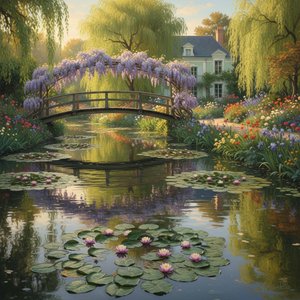
A Life Shaped by Light and Water The story of Oscar-Claude Monet begins in the streets of Paris, though his heart was often found wandering the salt-misted air of Le Havre. As a young boy, he moved to Normandy, where his father initially hoped he wou...
Before the gardens of Giverny defined his vision, the salt-misted air of Le Havre shaped the young Claude Monet. Born in Paris in 1840, his early years were spent amidst the rugged landscapes of Normandy, where the unpredictable Atlantic weather provided a rigorous first instructor. This period was marked by a restless eye for detail, a trait developed while selling charcoal caricatures to local acquaintances. It was here that a chance encounter with Eugène Boudin introduced him to the practice of painting en plein air, teaching him to set his easel directly within the elements.
The influence of the sea and sky cannot be overstated. In these early works, one finds the seeds of a lifelong obsession with the transient. The atmosphere of the coast, characterized by shifting mists and the play of light on moving water, instilled in Monet a fundamental understanding that solid forms are often dissolved by the air itself. This training prepared him for the later complexities of his career, where the subject was never merely a landscape, but the very light that animated it.
Breaking the Academic Mold: The Birth of Impressionism
The First Impressionist Exhibition was an art exhibition held by the Société anonyme des artistes peintres, sculpteurs, graveurs, etc., a group of nineteenth-century artists who had been rejected by the official Paris Salon and pursued their own venu...
The mid-19th century art world was governed by the rigid, dark constraints of the official Paris Salon. This institution valued historical subjects and precise, polished realism, where the artist's hand remained hidden beneath smooth glazes. Monet, alongside contemporaries such as Renoir and Pissarro, sought a different truth. In 1874, this group organized an independent exhibition at the studio of photographer Nadar, an act of rebellion that would change art history.
It was from a satirical review of his painting, Impression, Sunrise, that the term "Impressionism" emerged. While critics initially used the label to mock the unfinished appearance of the work, Monet embraced it. He moved away from the heavy, dark grounds of tradition, opting instead for light-colored primers that allowed for a new brightness. This movement was not merely a change in subject matter but a fundamental shift in purpose: to record the world as it is perceived by the eye in a single, fleeting moment.
The Science of Perception: Technique and Broken Color
Introduction Imagine standing before a canvas where the air itself feels heavy with moisture, where the sun doesn't just shine but vibrates against the water, and where every brushstroke is a heartbeat captured in time. To step into the world of Clau...
To understand Monet is to understand his technical devotion to optical truth. He rejected the traditional method of blending colors on a palette to achieve a smooth transition. Instead, he employed "broken color," applying unmixed pigments side-by-side. This technique allows the viewer's eye to perform the blending, creating a sense of vibration and luminosity that a flatly painted surface cannot replicate.
His brushwork was purposeful and energetic. Through rapid, visible strokes and the use of impasto, he captured the movement of wind through grass or the shimmer of sunlight on a wave. By layering textures, he added a physical dimension to his canvases, making the surface as lively as the scenes they depicted. This approach prioritized the sensory experience over photographic accuracy, inviting the viewer to participate in the act of seeing.
In 1883, Monet settled in Giverny, a move that shifted his practice from observation to creation. He did not merely paint nature; he sculpted it. His landscaping project, which included the construction of a water garden and a Japanese-style footbridge, provided him with a controlled yet ever-changing subject. This garden functioned as a laboratory for his studies of light and season.
At Giverny, the boundaries between the artist and his environment blurred. He spent decades documenting the same scenes under varying weather conditions, from the intense heat of summer to the heavy mists of autumn. This dedication to series painting allowed him to explore how sunlight alters the appearance of a single subject over time. The garden was an extension of his brush, a place where he could manipulate flora and water to achieve specific atmospheric effects.
The Water Lily Series: A Study in Reflection and Flux
Captivating Subject and Enchanting Atmosphere This exquisite impressionist masterpiece transports viewers to a tranquil water lily pond, where nature’s delicate beauty is captured in a harmonious balance of light and color. The scene centers around a...
The Water Lilies (Nymphéas) represent the pinnacle of Monet's late career. These works, painted during the final thirty years of his life, move toward a near-abstract exploration of color and reflection. In pieces such as The Water Lily Pond, Pink Harmony, the traditional horizon line disappears. The viewer is no longer looking at a landscape from a distance but is instead submerged within it.
These canvases focus on the interplay between the floating blossoms and the liquid surface below. The lilies themselves—symbols of purity and renewal—drift amidst reflections of sky, clouds, and foliage. Through soft contours and a palette of greens, purples, and whites, Monet captures the constant flux of nature. Even as his vision was affected by cataracts in his later years, his ability to translate the ephemeral beauty of the pond into a rhythmic arrangement of color remained profound.
An Immersive Sanctuary: The Legacy at Musée de l'Orangerie
A Sanctuary of Light: The Musée de l'Orangerie Nestled within the tranquil embrace of the Tuileries Garden in Paris, the Musée de l’Orangerie is more than a repository of masterpieces; it is an immersive experience, a sanctuary dedicated to the ether...
The legacy of this monumental work finds its most profound expression in the Musée de l'Orangerie in Paris. Within the museum's specially designed oval rooms, eight large-scale water lily murals are displayed in a way that honors Monet's original intent. The architecture, featuring skylights that bathe the works in soft, natural light, mimics the very conditions of Giverny, creating an environment of deep tranquility.
To stand before these panels is to experience an immersive dreamscape. The scale of the canvases surrounds the viewer, dissolving the edges of the room and replacing them with a sea of shimmering reflections. This sanctuary serves as a lasting tribute to an artist who taught us that beauty resides in the transient. His work remains a vital part of our global heritage, preserved in institutions like the Musée Marmottan Monet and the Orangerine, inviting every generation to find solace in the enduring power of light.
Journey through Impressionism's golden age! Explore 10 masterpieces by Monet, Renoir & Degas that redefined art. Discover the stories behind these iconic paintings and find museum-quality reproductions to elevate your home decor on ArtsDot.com.
Embark on a visual journey through the Musée d'Orsay. From Monet’s light to Van Gogh’s soul, explore 25 iconic Impressionist masterpieces and find museum-quality art inspiration for your decor. Discover all masterpieces on ArtsDot.com.
Explore the luminous world of Claude Monet. Discover the history, techniques, and revolutionary impact of Impressionism through an expert art-history lens. From Giverny to his iconic series, learn how the Master of Light redefined modern art.
Embark on a visual journey through Claude Monet's Giverny. Discover the enchanting light, vibrant colors, and breathtaking landscapes of his legendary gardens through an expert exploration of Impressionist mastery and timeless beauty.



 Claude Monet
 First Impressionist Exhibition
 Mastering Light: The 25 Most Iconic Claude Monet Paintings
 Giverny in Springtime
 The Water Lily Pond, Pink Harmony
 Musee de l'Orangerie