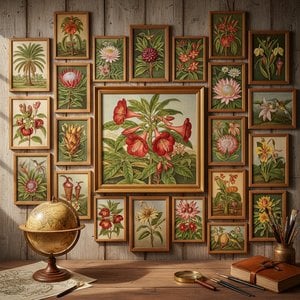
The Art of Observation: Defining Botanical Realism Botanical illustration Botanical illustration is the art of depicting the form, color, and details of plant species. They are generally meant to be scientifically descriptive about subjects depicted ...
Botanical realism is not a mere stylistic choice but a disciplined pursuit where the artist’s eye functions as a primary instrument of discovery. Unlike general landscape painting, which may prioritize atmosphere or mood, a botanical study focuses its lens on the intimate architecture of life itself. It requires an understanding of plant morphology, where every brushstroke must contribute to a truthful representation of the specimen. The illustrator seeks to capture the subtle curve of a petal, the intricate vein of a leaf, and the structural truth of a stem with such fidelity that the work serves as both an aesthetic achievement and a scientific record.
This commitment to accuracy finds its roots in the rigorous standards of biological illustration. In this field, the goal is to communicate structure and detail through technical precision. Whether utilizing carbon dust, watercolor, or stennic ink, the objective remains the same: to provide a visual reference that satisfies the taxonomist's need for clarity. This level of scrutiny ensures that even minute details, such as those found in the works of the Department of Plant Sciences at Cambridge, are preserved with an accuracy that transcends simple decoration.
From Medicinal Herbals to Scientific Records: A Lineage of Utility
The Roots of Observation: Early Botanical Depictions & Medicinal Herbals Wikipedia: Botanical illustration Botanical illustration is the art of depicting the form, color, and details of plant species. They are generally meant to be scientifically des...
The history of botanical art began not in a gallery, but in the practical necessity of survival and medicine. In the medieval period, monasteries served as vital centers for preserving knowledge, where monks cultivated medicinal gardens and created herbals—illustrated compendiums detailing the uses of plants for healing. These early works were functional tools, designed to assist in the identification of species for medicinal preparations. While some early manuscripts, such as the 6th-century Vienna Dioscurides, struggled with accuracy due to the limitations of the era, they established a fundamental human impulse to categorize and interpret the natural world.
This lineage of utility evolved significantly during the Renaissance and into the Enlightenment. As botany moved from monastic gardens to formal scientific study, the demand for precision grew. The 12th-century Circa Instans manuscript demonstrated an increasing reliance on documented visual motifs to spread botanical knowledge. This progression eventually led to the monumental works of the 18th century, such as those by Johann Wilhelm Weinmann. His Phytanthoza iconographia represented a shift toward a more comprehensive visual guide, where the artist’s skill was directly tied to the advancement of botanical science.
The Mastery of Detail: Techniques in Form and Texture
Exquisite botanical illustration by Pierre-Joseph Redouté (1759-1840). Detailed watercolor of *Gaultheria* species, showcasing his 'Raphael of Flowers' style. A timeless piece for plant lovers & art collectors.
Achieving true botanical realism requires a sophisticated command of various media to replicate the diverse textures found in nature. Watercolor remains a cornerstone of the genre, particularly through the technique of layering light washes on high-quality paper to create translucency. This method allows an artist to build color gradually, capturing the delicate, almost ethereal quality of certain petals. In contrast, other methods such as stipple pen and ink or lithography are employed to define sharper edges and more rigid structures, such as bark or woody stems.
We see this technical versatility in the work of artists like Pierre-Joseph Redouté, often referred to as the "Raphael of Flowers." His ability to use watercolor to showcase the delicate textures of species like Gaultheria procumbens set a standard for the golden age of botanical art. Similarly, the use of innovative techniques like mezzotint engraving, utilized by Georg Dionysius Ehret in collaboration with Weinmann, allowed for unprecedented levels of tonal gradation and realism. These methods ensure that the physical characteristics of the plant—the velvety texture of a leaf or the waxy sheen of a bud—are communicated to the viewer with absolute clarity.
The Explorer’s Eye: Documenting Global Biodiversity
A Window Into Borneo’s Soul: Marianne North's "A New Pitcher Plant from the Limestone Mountains of Sarawak, Borneo" Marianne North’s “A New Pitcher Plant from the Limestone Mountains of Sarawak, Borneo,” painted in 1876, isn’t merely a botanical illu...
As the era of global exploration expanded, botanical illustration became a vital tool for documenting species unknown to the Western world. Illustrators often accompanied scientific expeditions, acting as the visual chroniclers of newly discovered ecosystems. This period saw a shift from studying local European flora to capturing the exotic and often overwhelming diversity of distant continents. The artist’s task was to translate the unfamiliar into a format that could be studied by scientists back in Europe, often under difficult field conditions.
Marianne North stands as a singular figure in this tradition. Eschewing the domestic expectations of her time, she traveled through Borneo, Japan, and Brazil, painting directly from nature. Her work, such as her depiction of a pitcher plant from the limestone mountains of Sarawak, captures plants within their natural habitats rather than as isolated specimens. This approach provides a sense of place and ecological context that is often missing from more clinical studies. Her use of oil paints allowed for a richer color palette and deeper shadows, bringing the humidity of the rainforest to life on canvas.
Materiality and Method: The Evolution of Illustrative Media
Walter Hood Fitch: A Pioneer of Botanical Illustration Walter Hood Fitch (1817-1892) stands as a towering figure in the history of botanical illustration, a Scottish artist whose dedication and meticulous skill transformed the way plants were depicte...
The evolution of printing technology has profoundly influenced how botanical art is disseminated and preserved. In the early days of the printing press, woodcuts were the primary method for reproducing illustrations in herbals, though these often lacked fine detail. By the 16th and 17th centuries, engraving and etching became more prevalent, allowing for much finer lines and greater complexity. The introduction of lithography in the 19th century further revolutionized the field, enabling artists like Walter Hood Fitch to produce highly detailed and color-accurate plates for publications such as Curtis’s Botanical Magazine.
This technological progression has continued into the modern era with the advent of digital illustration. Today, tools such as 2D and 3D software, alongside drawing tablets, allow for even more precise technical illustrations, including exploded views and cutaways that can demonstrate complex plant anatomy. However, the fundamental principles of observation remain unchanged. Whether an artist uses a traditional quill or a digital stylus, the requirement for morphological accuracy remains the guiding force behind every line drawn.
Botanical Aesthetics in Modern Architectural Design
Admire Marianne North’s stunning botanical masterpiece depicting palm trees in Buitenzorg Botanic Garden (Java). Explore this vibrant 1876 painting and discover the beauty of tropical flora.
In contemporary interior design, botanical aesthetics offer a way to introduce organic sophistication and a sense of historical depth into professional spaces. The structured beauty of botanical art—characterized by its focus on pattern, symmetry, and natural color—complements both classical and modern architectural styles. Large-format murals or multi-panel arrangements can transform a corporate lobby or a hotel corridor, providing a focal point that is both intellectually engaging and visually calming.
For procurement managers and designers, the versatility of botanical art allows for significant customization to match specific brand identities or color palettes. The ability to utilize group set paintings, where a single image is split across multiple panels, provides a modern, architectural look suitable for large walls or staircases. By integrating these works, spaces can evoke the serenity of a botanical garden, bridging the gap between the built environment and the natural world through a shared language of precision and grace.
At ArtsDot.com, we specialize in providing high-quality, hand-painted oil reproductions of these historical botanical works for professional use. Whether you require large-scale murals for hospitality projects or custom commissions to match a specific interior palette, our artists deliver museum-standard excellence with reliable global logistics and streamlined order management.
Journey through the vibrant world of Marianne North’s botanical paintings! Explore 25 iconic artworks from this Victorian artist, celebrating exotic flora & travel. Find museum-quality reproductions and curated decor ideas at ArtsDot.com.
Journey through the vibrant world of Marianne North. Explore 25 iconic botanical masterpieces that blend Victorian adventure with scientific beauty. Find museum-quality art reproductions and decor inspiration for your home. Discover all masterpieces on ArtsDot.com.
Explore the high-impact world of scientific illustration. From botanical realism to precision-driven masterpieces, discover how legendary illustrators blend scientific accuracy with breathtaking aesthetic beauty for the modern art collector.



 Nature in Detail: A Guide to the Timeless Elegance of Botanical Realism Art
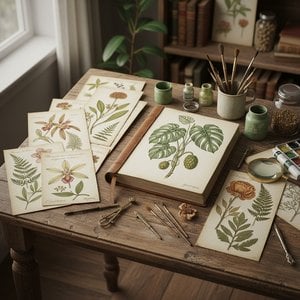 The Flourishing Canvas: A Historical & Artistic Exploration of Botanical Illustration
 Gautheria procumbens
 A New Pitcher Plant from the Limestone Mountains of Sarawak, Borneo
 Walter Hood Fitch
 Palms in the Botanic Garden, Buitenzorg, Java