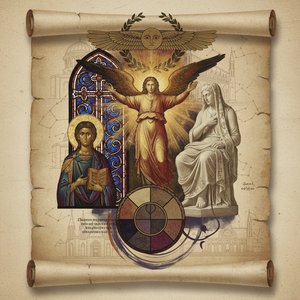
Subject and Composition This exquisite religious scene captures a moment of divine revelation, likely depicting the descent of the Holy Spirit during Pentecost or a similar sacred event. The composition is meticulously structured into two distinct le...
Light has never been merely a technical requirement for visibility; it is a language of its own. In the hands of a master, light functions as a bridge between the tangible world and the unseen. When we observe the way a sunbeam pierces through morning mist or how the water of a river transforms into a mosaic of gold, we are witnessing more than an optical event. We are seeing the medium through which the spiritual becomes perceptible. In religious contexts, light is frequently associated with divinity, acting as a physical manifestation of grace or the presence of the Holy Spirit.
This reverence for illumination finds a profound historical echo in the early Renaissance works of Fra Angelico. In his depiction of La venida del Espíritu Santo, the artist uses a structured, hierarchical arrangement to guide the eye toward a moment of revelation. The warm palette, blending pinks, oranges, and golds, evokes a sense of divine illumination that transcends simple naturalism. This use of light does not just illuminate the figures; it sanctifies them.
Today, we see this same pursuit of luminosity in the evolution of painting techniques. From the soft sfumato of the Renaissance to the intense focus on light in later movements, artists have sought to capture how light shapes composition and emotion. Whether through the subtle shading of a classical portrait or the broken, shimmering colors of an Impressionist landscape, the goal remains the same: to use the interplay of shadow and brightness to reveal a deeper truth.
Sacred Signposts: Interpreting Biblical Creatures in Landscape
Olive Trees near Nice – A Post-Impressionist Masterpiece Theo van Rysselberghe’s “Olive Trees near Nice,” painted in 1905, is more than just a depiction of a Provençal landscape; it's a carefully constructed meditation on light, form, and the emotion...
Beyond the brilliance of light, art often employs a vocabulary of symbols—creatures and objects that carry weight far beyond their physical forms. To the trained eye, a landscape is rarely just a collection of trees and hills; it is a field of meaning. In biblical tradition, animals and natural elements serve as signposts for complex theological truths. A dove may represent the gentleness of redemption, while the serpent serves as a reminder of deception. Even the more rugged elements, such as locusts or eagles, carry connotations of judgment or divine strength.
This symbolic depth is mirrored in the Post-Impressionist approach to nature. Consider Theo van Ryssebhegde’s Olive Trees near Nice. While the painting captures a Mediterranean scene of sun-drenched fields and distant mountains, it also includes a small group of sheep. These figures add a layer of pastoral tranquility that resonates with the ancient imagery of the shepherd and the flock. The trees themselves, sturdy and enduring, echo the themes of life and persistence found in sacred texts.
When we look at such works, we are invited to move beyond mere observation. We learn to see the world not as a series of disconnected objects, but as a cohesive narrative where every element has the potential for deeper significance. The landscape becomes a space for contemplation, where the physical environment reflects an internal, spiritual reality.
Materiality and Devotion: From Carved Wood to Oil on Canvas
A Sanctuary of Sacred Splendor In the heart of Valladolid, where the echoes of Spain’s imperial past still linger in the air, lies the National Museum of Religious Carvings—a profound sanctuary dedicated to the spiritual and artistic soul of a nation...
The medium through which an artist works is inseparable from the message they convey. There is a profound difference in the emotional weight of a heavy, polychrome wooden sculpture compared to the fluid, translucent layers of an oil painting. The tactile nature of art—the grain of the wood, the texture of the canvas, the thickness of the paint—contributes to the sense of presence and devotion.
In the heart of Valladolid, the National Museum of Religious Carvings preserves this connection to materiality. Here, the works of masters like Gregorio Fernández demonstrate how artists breathed life into wood and stone. These carvings, often part of intricate altarpieces, utilize intense emotionality and realistic textures to bridge the gap between the earthly and the divine. The physical weight of the sculpture demands a certain type of reverence, much like the heavy, protective walls of a monastery.
This tradition of craftsmanship finds a different but equally sincere expression in the oil paintings of the Impressionist and Post-Impressionist eras. In works like Paul Cézanne’s Peaches, Pears and Grapes, the focus shifts to the structural use of color and form. The artist uses bold brushstrokes to create depth and texture, making the fruit feel tangible and present. While the subject is secular, the dedication to capturing the essence of the object through the physical manipulation of paint reflects a similar devotion to truth and observation.
The Palette of Promise: Color as a Spiritual Narrative
The Painting "Cezanne's Peaches, Pears and Grapes " is a captivating still life that exemplifies the artist's unique approach to color and composition. Painted in 1879, this oil on canvas work measures 57 x 44 cm and is a quintessential representatio...
Color possesses an inherent emotional frequency. In sacred art, specific hues are often employed to evoke particular theological states. Gold signifies sanctity and the eternal; white represents purity; red can signal both sacrifice and the fire of the Holy Spirit. These colors are not chosen by whim but are parted from a long tradition of using visual language to instruct and inspire.
We see this intentionality in the way color is used to create atmosphere and meaning. In many religious panels, a sunset palette of purple and gold is used to evoke hope and divine illumination. The color does not just decorate the scene; it defines the spiritual temperature of the moment.
This use of color as an expressive tool reached new heights during the transition from Impressionism to Post-Impressionism. Artists began to move away from purely naturalistic colors toward a more subjective palette. In the works of the Pont-Aven School or the Neo-Impressionists, color was used to convey psychological depth and emotional resonance. By applying small strokes of pure pigment side-by-side, they allowed the eye to blend them, creating a luminosity that felt as though it radiated from within the canvas itself.
Shadows of the Soul: Tenebrism and the Presence of Mystery
Symbolist painting was one of the main artistic manifestations of symbolism, a cultural movement that emerged at the end of the 19th century in France and developed in several European countries. The beginning of this current was in poetry, especiall...
If light provides the revelation, then shadow provides the mystery. The use of deep shadows—techniques such as chiaroscuro and tenebrism—allows an artist to direct the viewer's attention and create a sense of drama and introspection. Shadow is the space where the unknown resides, and in religious art, it often represents the profound mysteries of faith that cannot be fully grasped by human intellect.
This interplay between light and dark is a hallmark of the Baroque period, where intense contrasts were used to heighten the emotional impact of sacred scenes. The darkness does not merely obscure; it defines the light, making every highlight feel more precious and significant. It creates a stage for the miraculous to occur within the shadows.
In a different way, the Symbolist movement explored the darker, more irrational aspects of the human experience. Moving away from the objective descriptions of Realism, Symbolist painters used dreamlike imagery and murky tones to depict themes of death, sin, and the unconscious. They understood that the parts of our existence that remain in shadow are just as essential to our understanding of the whole as the parts bathed in light.
Eternal Echoes: The Enduring Resonance of Sacred Imagery
Explore Fernand Leger’s ‘The Sacred Heart of Audincourt,’ a vibrant 1950 digital stained-glass abstraction. Geometric forms, bold colors & dynamic energy – a unique art piece.
The history of art is a continuous dialogue between the past and the present. The symbols, techniques, and light-work developed centuries ago continue to inform how we perceive beauty and meaning today. We do not look at these works with mere nostalgia; rather, we recognize them as part of a long, unbroken tradition of human inquiry into the nature of existence.
Whether it is the structured devotion of an Early Renaissance panel or the luminous rebellion of an Impressionist landscape, these works invite us to slow down. In an age characterized by rapid change and digital fleetingness, there is a profound need for art that holds a question open—art that encourages us to linger on a brushstroke or contemplate a shadow.
As we explore the collections at ArtsDot.com, we find ourselves part of this enduring conversation. We invite you to rediscover these moments of light and shadow, and to find within them a sense of the eternal.
Discover Théo van Rysselberghe's vibrant Neo-Impressionist paintings! Explore his landscapes, portraits & Moroccan scenes – a key figure of Les XX blending light and color.
Embark on a soulful journey through Impressionist masterpieces, uncovering the sacred light within. Discover how masters like Monet and Gauguin captured the divine, and bring that luminous transcendence home with museum-quality, hand-painted oil reproductions from ArtsDot.com.
Explore the profound impact of spiritual themes in fine art. From Renaissance iconography to Baroque drama, discover how sacred symbolism and divine visions have shaped art history through a scholarly and reflective lens.



 La venida del Espíritu Santo
 Olive Trees near Nice (also known as Oliviers aux environs de Nice)
 National Museum of Religious Carvings
 Peaches, Pears and Grapes
 Symbolist painting
 The Sacred Heart of audincourt