The Emergence of Drama: Moving Beyond Mannerist Complexity
The transition from the late 16th century into the 17th was marked by a profound shift in how artists approached the canvas. Where the Mannerist period often favored the intellectualized, the asymmetrical, and the intentionally distorted, the Baroque sought a more direct engagement with the viewer. It was a departure from the cerebral toward the visceral. This era was defined by a desire to evoke specific emotional states, often through a sense of tension and vitality that felt immediate and unforced. In the works of early Baroque masters, we see a rejection of the artificial in favor of a heightened realism. This was not merely about accuracy, but about the weight of the moment. The art of this period was designed to be felt as much as it was seen, using exaggerated forms and bold color to pull the observer into the scene. It was a period of stylistic complexity that, despite its contradictions, shared a singular goal: to move the soul through the senses.Chiaroscuro: The Architecture of Light and Shadow
 Rembrandt van Rijn
Rembrandt van Rijn. A master of chiaroscuro known for The Night Watch. Discover our collection of hand-painted reproductions today.
Faith and Feeling: The Visual Language of the Counter-Reformation
 Christ on the Cross
Christ on the Cross, Francisco de Zurbarán
The Captured Moment: Movement and Tension in Composition
 The Drunken Hercules
The Drunken Hercules, Peter Paul Rubens
Tactile Grandeur: The Importance of Texture and Materiality
A fascination with the physical world was central to the Baroque sensibility. There was a profound interest in the way light interacted with different surfaces—the softness of skin, the coldness of stone, the luster of silk, or the weight of heavy wool. This focus on materiality was not merely decorative; it was a way to ground the drama of the subject in a recognizable, sensory reality. This dedication to texture is evident in the meticulous brushwork of the period. Artists used layered applications of oil paint to build up surfaces, creating a tactile quality that invites the eye to linger on the details. This attention to the "feel" of a painting contributes to its overall sense of richness and presence. It is a celebration of the physical world, rendered with a technical virtuosity that honors the complexity of nature.Regional Divergence: From Spanish Piety to Italian Exuberance
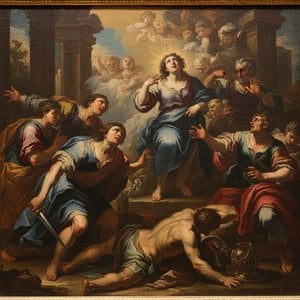
 Giovanni Battista Carlone
Explore the Baroque paintings of Giovanni Battista Carlone, a prolific Genoan artist known for his diverse works & provincial talent between Mannerism & Baroque.
The Baroque Aesthetic: Reclaiming Grandeur in the Modern Interior
The impulse to surround oneself with art that possesses weight and emotional depth remains a constant, even in a modern world often dominated by the ephemeral. To bring the Baroque into a contemporary space is to introduce a sense of permanence and drama. It is about choosing pieces that command attention and provide a focal point for contemplation.
One might look to the scale of historical ceiling frescoes or the dramatic tension of a multi-panel arrangement to anchor a room. The use of heavy textures and deep tones can mirror the sensuous richness of the seventeenth century. For those seeking to integrate these elements, the choice often lies between the tactile depth of a hand-painted oil on cotton canvas or the grand scale of a mural. Customizing a piece to match a specific color palette or using a digital mockup to test a composition allows for a deliberate integration of these intense styles into a modern setting.
The objective is to find pieces that resonate with a sense of historical weight and visual intensity.