The Seeds of Revolution: Cézanne's Influence & Proto-Cubism
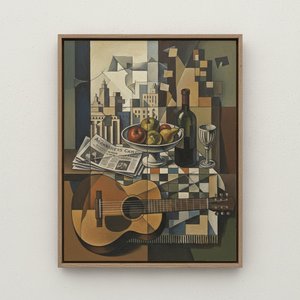
Cubism is an early-20th-century avant-garde art movement which began in Paris. It revolutionized painting and the visual arts, and sparked artistic innovations in music, ballet, literature, and architecture. Cubist subjects are analyzed, broken up, a...
The story of Cubism isn’t one of sudden invention, but rather a gradual unfolding—a deliberate dismantling of artistic convention rooted in the late works of Paul Cézanne. Before Picasso and Braque fractured form and redefined perspective, Cézanne embarked on his own radical journey, questioning the very nature of representation. He wasn't interested in mimicking reality’s surface; instead, he sought to capture its underlying structure, reducing natural forms to their essential geometric components—cylinders, spheres, cones. This pursuit of fundamental shapes, visible brushstrokes that acknowledged the painting’s two-dimensionality, and a rejection of traditional modeling laid the groundwork for the Cubist revolution. The 1904 retrospective of Cézanne's paintings at the Salon d'Automne served as a pivotal moment, igniting a spark in a generation of artists eager to break free from academic constraints. It was a call to explore not what things looked like, but how they were constructed—a shift that would irrevocably alter the course of art history.
Early experiments by Picasso and Braque, fueled by their fascination with African sculpture – particularly masks – further propelled this deconstructive process. These sculptures weren’t valued for their realistic depiction of anatomy but for their powerful geometric forms and symbolic resonance. The artists began to incorporate these influences into their work, flattening perspective, simplifying shapes, and challenging the illusion of depth that had dominated Western painting for centuries. This nascent stage, often referred to as Proto-Cubism, was characterized by a deliberate distortion of form, hinting at the fragmentation to come.
Analytical Cubism: Fragmentation, Multiple Perspectives & The Monochromatic Palette
 Deconstructing Reality: Analytical Cubism's Formative Years & Lasting Influence
Explore the revolutionary world of Analytical Cubism with ArtsDot. Discover Picasso & Braque's groundbreaking techniques, its philosophical roots, and lasting impact on modern art. Expert insights for collectors.
Around 1908, Picasso and Braque entered a period of intense collaboration that birthed Analytical Cubism. This phase wasn’t about creating visually pleasing compositions; it was an intellectual exercise—a systematic dissection of objects and scenes into their constituent parts. Subjects – often still lifes or portraits – were broken down into fragmented planes, analyzed from multiple viewpoints simultaneously, and reassembled on the canvas in a monochromatic palette dominated by browns, grays, and ochres. The goal wasn’t to replicate reality but to represent it as a complex interplay of forms seen from various angles at once. Imagine holding an object in your hand, rotating it slowly, observing its changing contours—Analytical Cubism sought to capture this dynamic experience on a static surface.
This approach resulted in paintings that were often visually dense and challenging to decipher. Forms overlapped and intersected, creating a sense of ambiguity and fragmentation. The emphasis was on intellectual understanding rather than immediate visual appeal. Consider Picasso’s The Mandolinist, where the instrument and figure are fractured into geometric shapes, almost dissolving before our eyes. Or Braque's Clarinet, which similarly deconstructs its subject, presenting a complex puzzle of planes and angles. The limited color palette further reinforced the analytical nature of the work, stripping away distractions and focusing attention on the interplay of shapes and lines. It’s important to note that this wasn't simply about randomness; there was a rigorous logic underlying these compositions—a deliberate attempt to represent the subject in its totality.
Synthetic Cubism: Collage, Simplicity & the Reintroduction of Color
 Pablo Picasso: A Revolutionary Vision – Cubism, Symbolism & Enduring Legacy
Explore the revolutionary art of Pablo Picasso with ArtsDot.com. Discover Cubism's origins, symbolism in his masterpieces & investment insights for collectors. Expert appraisal & custom reproductions available.
By 1912, Analytical Cubism had reached a point of near-abstraction. Picasso and Braque began to question whether further fragmentation was necessary or even desirable. This led them to explore new avenues—a shift that marked the emergence of Synthetic Cubism. Instead of breaking down objects, they started building them up from simplified geometric shapes, often incorporating elements of collage into their compositions. Newspaper clippings, patterned papers, and other found materials were pasted onto the canvas, introducing a new level of materiality and challenging traditional notions of artistic authorship.
Synthetic Cubism represented a move towards greater clarity and accessibility. The color palette expanded, though remained subdued compared to earlier styles. Shapes became larger and more defined, often resembling letters or numbers—a playful nod to the everyday world. This phase also saw the introduction of papier collé, where actual pieces of paper were glued onto the canvas, blurring the boundaries between painting and sculpture. The focus shifted from analyzing form to constructing it, creating a new visual language that was both innovative and engaging.
Key Figures and Masterpieces: Picasso, Braque & Beyond
While Pablo Picasso and Georges Braque are rightfully considered the pioneers of Cubism, their collaborative spirit fostered a movement that attracted numerous other talented artists. Juan Gris joined the ranks in 1911, bringing his own unique sensibility to the style, characterized by bolder colors and more structured compositions. Other significant figures included Jean Metzinger, Albert Gleizes, Robert Delaunay, Henri Le Fauconnier, and Fernand Léger, each contributing their individual interpretations of Cubist principles.
Beyond the core group, Cubism’s influence extended to sculpture as well. Picasso's experiments with constructed forms paved the way for a new approach to three-dimensional art, challenging traditional notions of carving and modeling. The movement also inspired artists in other disciplines, including music, literature, and architecture, demonstrating its far-reaching impact on 20th-century culture.
The Philosophical Roots of Cubism: Challenging Representation & Perception
Cubism wasn’t merely a stylistic innovation; it was deeply rooted in philosophical inquiry. The artists were questioning the very nature of representation—how we perceive reality and how that perception is translated onto canvas. Traditional painting aimed to create an illusion of depth and realism, but Cubists rejected this notion, arguing that reality is multifaceted and cannot be captured from a single viewpoint.
This challenge to traditional perspective was influenced by advancements in science and mathematics, particularly Einstein’s theory of relativity, which demonstrated the subjective nature of time and space. By presenting multiple perspectives simultaneously, Cubist artists sought to represent the totality of an object or scene, acknowledging its complexity and dynamism. They were not interested in depicting what they *saw*, but rather what they *knew* about the subject—a radical shift that fundamentally altered the course of art history.
Cubism's Lasting Impact: From Modern Art to Popular Culture
The impact of Cubism was far-reaching and wide-ranging. It shattered traditional artistic conventions, paving the way for a multitude of subsequent movements—Futurism, Suprematism, Dada, Constructivism, De Stijl, and Art Deco all owe a debt to its groundbreaking innovations. Cubism introduced collage as a modern art form, forever changing the possibilities of visual expression.
Even today, Cubist principles continue to resonate in contemporary art, design, and architecture. Its influence can be seen in everything from abstract paintings to graphic design to architectural forms. The movement’s legacy lies not only in its aesthetic innovations but also in its intellectual rigor—its relentless questioning of representation and perception continues to inspire artists and thinkers alike. At ArtsDot.com, we are proud to offer a curated selection of Cubist masterpieces, allowing you to experience the revolutionary power of this transformative art movement firsthand.