


 Preview
 Send
Send Share
Share
 Details
 Guide
Guide

 Download
 Similars
 X-Ray
X-Ray Diaporama
 Stats
StatsIn Old Virginia, Belmont


 Read More
Hand Made Oil Reproduction
Hand-painted oil on canvas in your size and frame, made to order by our artists. ( Switch to Print Switch to Digital Image)




































Pick from our preset sizes that match the artwork's original proportions.

You may enter your own dimensions to fit a specific frame or space. If your selected size does not match the original image's proportions, we will either crop the artwork or extend the painting with additional hand-painted elements. A digital mockup will be sent for your approval before production begins.
Please note that the on-screen preview does not reflect the actual cropping or extension. Only the mockup will accurately show the final composition.
While custom sizes are available, we recommend selecting a dimension from the predefined list to preserve the original proportions.
After order, ArtsDot.com team will email client for instructions and provide a mockup preview
Worldwide Delivery () in 3/4 weeks instead of standard 5 weeks. (23 September). No compromise on quality.

Free Worldwide Express Shipping

High-Quality Linen Canvas

Full Shipping Insurance

Customs Tax Refund Guarantee

True Color Matching Guarantee

100-Day Return Policy (Defects Only)

100% Money-Back Guarantee

Bulk Discount Offer
 Glass option is only available in size under 110 CM

In Old Virginia, Belmont
Reproduction Medium
Reproduction Size
-


Total Price
$ 263
Artistic Style and Technique
Julius Garibaldi Melchers was an American artist known for his impressionist style, which is evident in In Old Virginia, Belmont. The use of soft brushstrokes and muted colors creates a sense of calmness, drawing the viewer into the peaceful world of the painting. The artist's technique is reminiscent of other notable artists, such as Gustave Klimt, who was a key figure in the Vienna Secession movement. For example, Klimt's Lady with Cape showcases a similar use of symbolism and eroticism.Similar Paintings and Artists
Other notable paintings that showcase a similar style and technique include Oskar Kokoschka's Les Amis, Friends and Gustave Klimt's Portrait of Johanna Staude. These paintings demonstrate the artists' ability to capture the essence of their subjects, whether it be a person or a landscape.- Handmade oil painting reproductions of these pieces can be found on ArtsDot.com, allowing art enthusiasts to own a piece of history.
- The Gari Melchers Home and Studio in the United States is also home to many of Melchers' works, including In Old Virginia, Belmont.
The Museum Gwynedd County Council Collection in Caernarfon, United Kingdom, is another notable institution that features artworks from renowned artists. For more information on Julius Garibaldi Melchers and his works, visit ArtsDot.com.
Related Artworks


Artist Biography
The Visionary Eye of Julius Garibaldi Melchers
Born in the industrial heart of Detroit in 1860, Julius Garibaldi Melchers—often affectionately known as Gari—emerged as a luminous figure in the late nineteenth-century art world. His life was a profound tapestry woven from threads of scientific precision and poetic impressionism. Raised by a father who was an ophthalmologist, Melchers developed an early, almost clinical fascination with the mechanics of sight, botany, and zoology. This foundational interest in the natural sciences did not merely supplement his art; it became the very soul of his technique. To look at a Melchers canvas is to witness a man attempting to decode the world through light and texture, translating the delicate anatomy of a flower or the fleeting shimmer of a Dutch canal into a permanent, tactile reality.
His artistic evolution was shaped by the prestigious halls of the École Supérieure des Beaux-Arts in Paris. Under the rigorous guidance of Gustave Boulanger, Melchers mastered the classical foundations of composition and form, yet he remained perpetually enchanted by the burgeoning movements of his time. He possessed a rare ability to bridge the gap between the disciplined academic tradition and the atmospheric freedom of Impressionism. This duality allowed him to capture the structural dignity of his subjects while bathing them in the ephemeral, shifting light that defines the natural world. His training provided him with the technical vocabulary to render skin, fabric, and landscape with an almost miraculous realism, yet his spirit always sought the emotional resonance found in the subtle nuances of atmosphere.
A Journey Through Dutch Light and American Spirit
Perhaps the most enchanting chapter of Melchers’ career was his deep, enduring connection to the Netherlands. Settling for significant periods in Haarlem, he became a master chronicler of the Dutch landscape and its traditional way of life. His works from this period are far more than mere topographical records; they are nostalgic evocations of a vanishing era. Through his brush, the quietude of the Dutch countryside comes alive, characterized by:
- The mastery of atmosphere: Capturing the heavy, moisture-laden air of the Low Countries and the way it softens distant horizons.
- Genre scenes: Meticulous depictions of daily life, where peasants and townspeople are rendered with a profound sense of dignity and quiet purpose.
- Luminous landscapes: The use of light to create depth, particularly during the "blue hour" or twilight, which imbues his scenes with a sense of peace and introspection.
As his career progressed, Melchers’ reach expanded far beyond the borders of Europe. His later years were marked by a deep connection to the landscapes of Virginia, where he found a new muse in the rolling hills and serene vistas of the American South. This transition demonstrated the versatility of his naturalist approach; whether painting the damp, lowlands of Haarlem or the lush, verdant expanses of Virginia, his fundamental mission remained unchanged: to honor the quiet beauty of the earth through an observant and empathetic lens.
Legacy of a Naturalist Master
The historical significance of Julius Garibaldi Melchers lies in his ability to harmonize the objective with the subjective. In an era where art was often divided between strict Realism and experimental Impressionism, Melchers carved out a unique space for Naturalism. He did not merely paint what he saw; he painted how it felt to witness the world’s quietest moments. His portraits are celebrated not just for their likeness, but for their ability to reveal the inner character and quiet dignity of his sitters, making them feel present and breathing even a century later.
Today, Melchers is remembered as an artist who bridged continents and styles. His legacy is found in the way he taught viewers to slow down and appreciate the intricate details of the natural world—the way light hits a petal or how shadows lengthen across a field. Through his meticulous brushwork and emotional depth, he remains a cornerstone of American and international art history, a painter who captured the very essence of tranquility for generations to come.

julius garibaldi melchers
1860 - 1932 , United States of America
Quick Facts
- Artistic Movement Or Style: Naturalism painting
- Artists Or Movements Influenced By This Artist: ['Realism']
- Artists Who Influenced This Artist: ['Impressionists']
- Date Of Birth: August 11, 1860
- Date Of Death: November 30, 1932
- Full Name: Julius Garibaldi Melchers
- Nationality: American
- Notable Artworks:
- Vespers
- General Alger
- Place Of Birth: Detroit, United States
Related Articles

Evocations of Place: A Historical Journey Through Landscape Art
Explore the rich history of landscape art with ArtsDot. Discover renowned artists, movements like Impressionism & Romanticism, and expert guidance for collecting timeless pieces. Find your perfect serene escape today!

Romantic Landscapes: 10 Masterpieces for Your Home | ArtsDot
Journey through 10 Romantic landscape masterpieces by Friedrich, Turner & Cole. Explore emotional art, sublime nature scenes & iconic 19th-century paintings. Find museum-quality reproductions for your home at ArtsDot.com – discover the full collection online!
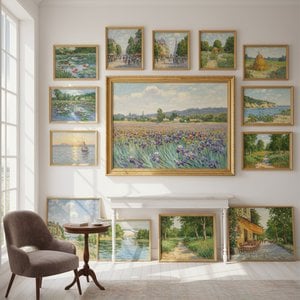
Impressionist Landscapes: 10 Masterpieces for Your Home | ArtsDot
Journey through 10 iconic Impressionist landscapes by Monet, Renoir & Degas. Explore the history, techniques & emotions behind these masterpieces. Find museum-quality reproductions for your home at ArtsDot.com – where art comes to life! Discover all masterpieces on ArtsDot.com

Impressionistic Landscapes: 10 Masterpieces That Changed Art & Decor
Journey into the heart of Impressionism! Explore 10 masterpieces by Monet, Renoir & Degas that revolutionized landscape art. Discover their stories, techniques & find museum-quality reproductions to elevate your home decor on ArtsDot.com.

Evocations of Place: A Historical Journey Through Landscape Art
Explore the rich history of landscape art with ArtsDot. Discover renowned artists, movements like Impressionism & tonalism, and expert guidance for collecting timeless pieces. Find your perfect serene escape today!


