

 Preview
 Send
Send Share
Share
 Details

 Download
 Similars
 X-Ray
X-Ray Diaporama
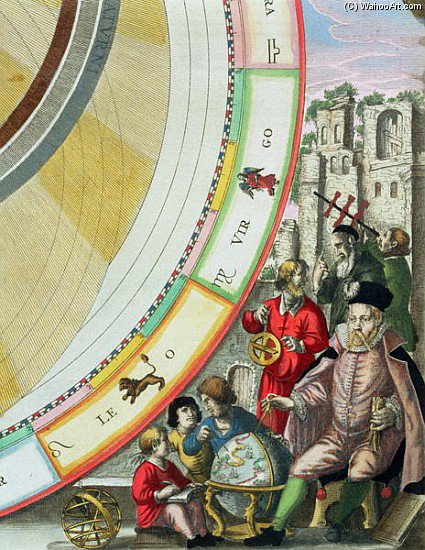
Tycho Brahe , Detail From A Map Showing His System Of Planetary Orbits

 Read More
Hand Made Oil Reproduction
Hand-painted oil on canvas in your size and frame, made to order by our artists. ( Switch to Print Switch to Image)




































Pick from our preset sizes that match the artwork's original proportions.

You may enter your own dimensions to fit a specific frame or space. If your selected size does not match the original image's proportions, we will either crop the artwork or extend the painting with additional hand-painted elements. A digital mockup will be sent for your approval before production begins.
Please note that the on-screen preview does not reflect the actual cropping or extension. Only the mockup will accurately show the final composition.
While custom sizes are available, we recommend selecting a dimension from the predefined list to preserve the original proportions.
After order, ArtsDot.com team will email client for instructions and provide a mockup preview
Worldwide Delivery () in 3/4 weeks instead of standard 5 weeks. (8 August). No compromise on quality.

Free Worldwide Express Shipping

High-Quality Linen Canvas

Full Shipping Insurance

Customs Tax Refund Guarantee

True Color Matching Guarantee

60-Day Return Policy (Defects Only)

100% Money-Back Guarantee

Bulk Discount Offer
 Glass option is only available in size under 110 CM

Tycho Brahe , Detail From A Map Showing His System Of Planetary Orbits
Reproduction Medium
Reproduction Size
-


Total Price
$ 263
Related Artworks


Artist Biography
Andreas Cellarius: Pioneer of Celestial Cartography
Andreas Cellarius (1596 – 1665) stands as a singular figure in the history of Renaissance art and scientific illustration, primarily recognized for his groundbreaking ‘Celestial Atlas,’ published in 1603. This monumental work wasn’t merely a decorative endeavor; it represented an ambitious attempt to synthesize classical knowledge with emerging astronomical observations—a testament to the intellectual fervor of the era. Born in Neuhausen an der Zauche, Germany, Cellarius possessed a prodigious talent for mathematics and drawing from a young age, fostering a lifelong fascination with the cosmos. His formative years were steeped in humanist scholarship, influencing his worldview and shaping his artistic sensibilities. He studied at Jena University under Johannes Kepler, arguably the most influential astronomer of his time, absorbing Kepler’s revolutionary theories regarding planetary orbits—a pivotal moment that irrevocably altered scientific understanding. Cellarius's dedication to precision and meticulous detail extended beyond mathematics; it permeated every aspect of his artistic practice. He approached astronomical charts with an unwavering commitment to accuracy, painstakingly recreating constellations based on observations made by Tycho Brahe and Galileo Galilei – figures who challenged established dogma and championed empirical evidence. Cellarius’s ‘Celestial Atlas’ wasn't simply a compilation of existing maps; it was a transformative achievement. Unlike previous celestial representations that relied heavily on mythological symbolism, Cellarius adopted a rational framework, incorporating Ptolemaic cosmology alongside Keplerian mechanics. He meticulously crafted detailed engravings depicting constellations and planets, accompanied by explanatory text—a daring innovation for its time. The atlas’s impact resonated throughout Europe, disseminating knowledge of astronomy and inspiring generations of artists and scientists alike. It solidified Cellarius's reputation as a visionary thinker and artist who bridged the gap between art and science. Furthermore, Cellarius’s artistic output encompassed a broader range of subjects beyond celestial maps. He produced stunning watercolor illustrations for botanical treatises, demonstrating his versatility and mastery of technique. His depictions of plants—particularly fungi—were remarkably realistic, showcasing an unparalleled understanding of anatomy and coloration. These watercolors stand as exceptional examples of Renaissance naturalism, reflecting Cellarius’s profound respect for the natural world. His legacy extends beyond individual artworks; Cellarius established a workshop in Prague where he trained numerous assistants, ensuring that his artistic principles and scientific methodologies were disseminated throughout Bohemia. This collaborative effort fostered innovation and contributed to the flourishing intellectual environment of Prague during the Baroque period. Andreas Cellarius’s contribution to both art history and astronomical science remains undeniable—a beacon of enlightenment illuminating the path toward a more accurate comprehension of our universe.
andreas cellarius
1596 - 1665 , Germany
Quick Facts
- Artistic Movement Or Style: Renaissance Prints
- Artists Or Movements Influenced By This Artist: ['Selenographia']
- Artists Who Influenced This Artist: ['Johannes Bayer']
- Date Of Birth: 1596
- Full Name: Andreas Cellarius
- Nationality: German
- Notable Artworks:
- Map Of Christian Constellations,
- Map Of The Southern Hemisphere
- Place Of Birth: Neuhausen an der Zauche, Germany



