


 Preview
 Send
Send Share
Share
 Details
 Guide
Guide

 Download
 Similars
 X-Ray
X-Ray Diaporama
 Stats
StatsSingle-Masted Damlooper and Rowboat on a Breezy Day
 Oil On Canvas
- WallArt
- Baroque
 Early Modern
 23.0 x 21.0 cm
 Staatliche Museen
 Read More
Hand Made Oil Reproduction
Hand-painted oil on canvas in your size and frame, made to order by our artists. ( Switch to Print Switch to Digital Image)




P118B $10

P118H $10

P118W $10

P438Z $10

P508JH $12

P508YH $12

P805H $10

P805Z $10

P919BZ $10

P919G $10

P919XJ $10

P959ZH $10

P968JZ $12

W106C $8

W218G $10

W218JH $8

W218Y $10

W307PJ $10

W316G $10

W316PJ $8

W316Y $10

W398PJ $8

W4111J $10

W500HY $15

W500JH $15

W692G $12

W849H $8

W940BG $15

W953PJ $8




Pick from our preset sizes that match the artwork's original proportions.

You may enter your own dimensions to fit a specific frame or space. If your selected size does not match the original image's proportions, we will either crop the artwork or extend the painting with additional hand-painted elements. A digital mockup will be sent for your approval before production begins.
Please note that the on-screen preview does not reflect the actual cropping or extension. Only the mockup will accurately show the final composition.
While custom sizes are available, we recommend selecting a dimension from the predefined list to preserve the original proportions.
After order, ArtsDot.com team will email client for instructions and provide a mockup preview
Worldwide Delivery () in 3/4 weeks instead of standard 5 weeks. (25 September). No compromise on quality.

Free Worldwide Express Shipping

High-Quality Linen Canvas

Full Shipping Insurance

Customs Tax Refund Guarantee

True Color Matching Guarantee

100-Day Return Policy (Defects Only)

100% Money-Back Guarantee

Bulk Discount Offer
 Glass option is only available in size under 110 CM

Single-Masted Damlooper and Rowboat on a Breezy Day
Reproduction Medium
Reproduction Size
-


Total Price
$ 263
The Drama of the Open Water
To gaze upon this depiction of a single-masted damlooper on a breezy day is to feel the exhilarating pull of the tide itself. It is more than just a painting of boats; it is an immersion into the very spirit of maritime adventure. The composition immediately draws the eye across the restless surface of the water, where the vessel seems caught in a moment of perfect, dynamic motion. One can almost hear the creak of the wood and feel the salty spray against the skin as the boat cuts through the waves under a dramatic, cloud-laden sky. The sheer number of figures aboard—at least twelve souls visible—suggests not merely travel, but a communal journey, bound together by the rhythm of the wind and the shared thrill of the open sea.
A Masterclass in Atmospheric Light
The genius of this work lies in its handling of atmosphere. The sky is not a placid blue expanse; it is a tapestry woven from dramatic clouds, suggesting the unpredictable grandeur of nature. This masterful use of light and shadow imbues the scene with depth and palpable energy. Jan Porcellis, the hand behind this vision, was revolutionary precisely because he shifted the focus from static historical narratives to the raw, emotional power of the seascape itself. His technique captures that transitional moment—the breath between gusts of wind—rendering the water not as a flat mirror, but as a living entity responding to unseen forces.
Historical Echoes and Artistic Revolution
Considering Jan Porcellis’s place in art history is to understand a pivotal turning point. Emerging from the turbulent waters of 17th-century Dutch art, his work signaled a decisive move away from overly ornate backdrops toward an intense focus on the elemental drama of the sea. This piece embodies that shift towards what scholars call the tonal phase—a style prioritizing mood and atmosphere over mere documentation. For the collector or decorator, owning a reproduction of this work is acquiring a tangible link to this artistic revolution, bringing the pioneering spirit of Dutch marine painting into a modern setting.
Symbolism of the Voyage
Beyond its technical brilliance, the scene resonates with deep symbolism. The voyage itself has always been a metaphor for life’s journey—a passage through uncertainty guided by skill and companionship. The damlooper, sturdy yet graceful, represents human resilience against the vastness of nature. The gathering of people suggests that even in moments of potential peril or overwhelming beauty, humanity finds its greatest strength in shared experience. It is an artwork that speaks quietly to the soul about endurance, community, and the breathtaking freedom found only when one commits fully to the journey.
Related Artworks


Artist Biography
Jan Porcellis: A Revolutionary of the Dutch Seascapes
Jan Porcellis, born in Ghent around 1583 or 1584 and tragically passing away in Zoeterwoude in 1632, stands as a pivotal figure in the evolution of maritime art. More than just a painter of ships at sea, he instigated a profound shift – a deliberate move away from the opulent historical settings that dominated earlier marine paintings towards a more atmospheric, emotionally resonant depiction of the ocean itself. His work represents a decisive transition from early realism to what became known as the tonal phase, fundamentally altering the subject matter and style of maritime art for generations to come.
Porcellis’s early life was marked by upheaval. Born into a family fleeing religious persecution in Ghent, he experienced a nomadic existence, eventually settling in Rotterdam. Despite speculation about his training – with some suggesting an apprenticeship under Hendrick Vroom – the precise details of his artistic education remain shrouded in mystery. His career began to gain momentum around 1612, and quickly established him as a distinctive voice within the burgeoning Dutch art scene. Early works, though relatively scarce due to their often serialized production and subsequent loss, already hinted at the dramatic skies and turbulent waters that would become his signature.
The Dawn of Atmospheric Seascapes
What truly distinguishes Porcellis’s work is his masterful manipulation of light and shadow. Unlike his predecessors who frequently depicted ships engaged in grand historical battles or voyages, Porcellis focused on the raw power and beauty of the sea itself. His paintings are characterized by overcast skies, brooding mists, and relentlessly churning waters – a radical departure from the idealized portrayals that preceded him. Consider *Storm at Sea* (a work readily available for reproduction through ArtsDot), where the interplay of light and dark creates an almost palpable sense of drama and foreboding. The use of impasto technique adds texture and depth, further enhancing the feeling of immersion within the scene.
His 1622 painting, *Mussel Fishing*, exemplifies this shift perfectly. It’s not a heroic naval engagement; instead, it presents a quiet, almost melancholic scene of fishermen working in a coastal landscape dominated by muted colors and subtle textures. This deliberate simplification – the reduction of the subject to its essential elements – was revolutionary. Similarly, *Sea Battle at Night*, painted in 1620, showcases his ability to render the drama of conflict under dim light, with barely discernible enemy ships emerging from the gloom. The gradual unveiling of the scene creates a powerful sense of suspense and uncertainty.
Financial Struggles and Lost Works
Despite his growing reputation, Porcellis’s career was not without its challenges. By 1615, he faced significant financial difficulties, compounded by the birth of three children and ultimately leading to bankruptcy in Rotterdam. He moved to Antwerp, where much of his work during this period was produced for sale in open markets – a practice that resulted in many of these early paintings being lost or unattributed due to their lack of signature. Only approximately ten works from this turbulent period have been definitively identified as his creations.
Legacy and Influence
Despite the loss of much of his oeuvre, Jan Porcellis’s impact on maritime art is undeniable. His emphasis on atmospheric effects – the shifting light, the dramatic skies, and the relentless power of the sea – paved the way for subsequent generations of marine painters, including Hendrick Vroom and later artists like Jacob van Ruisdael. His work demonstrated that the sea itself could be a subject worthy of profound artistic exploration, moving beyond mere depictions of ships to capture its essence and mood. The legacy of Jan Porcellis continues to resonate today, reminding us of his pivotal role in shaping the history of Western art.
Further Exploration
To delve deeper into the life and work of Jan Porcellis, we invite you to explore our hand-painted reproductions available at ArtsDot.com. Specifically, consider *Shipping in Stormy Seas* and *Vessels in a Strong Wind*, both powerful examples of his distinctive style. For additional information, you may also consult the Wikipedia article on Jan Porcellis (https://en.wikipedia.org/wiki/Jan_Porcellis) and the British Museum’s entry (https://www.britishmuseum.org/collection/term/BIOG41589).

Jan Porcellis
1583 - 1632 , Belgium
Quick Facts
- Artistic Movement Or Style: Marine painting; tonal phase
- Artists Or Movements Influenced By This Artist: ['Haarlem school']
- Artists Who Influenced This Artist: ['Hendrick Vroom']
- Date Of Birth: 1583/84 Ghent
- Date Of Death: 1632 Zoeterwoude
- Full Name: Jan Porcellis
- Nationality: Dutch
- Notable Artworks:
- Shipping in Stormy Seas
- Vessels in a Strong Wind
- Mussel Fishing
- Place Of Birth: Ghent, Belgium
Related Articles

Abraham Hulk Senior: Pioneering Maritime Topography of the Dutch Golden Age
Explore the captivating seascapes of Abraham Hulk Senior, a leading Anglo-Dutch marine painter of the 19th century. Discover his signature style, family legacy & collectable artworks at ArtsDot.

Jan van Goyen: Master of Dutch Landscape & Atmospheric Perspective
Discover Jan van Goyen, the master of Dutch landscape painting. Explore his subtle technique, atmospheric realism & lasting influence on art history. Learn about this 17th-century pioneer at ArtsDot.
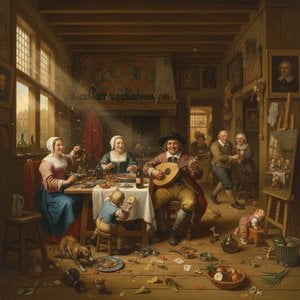
Jan Steen: A Master of Dutch Genre Painting & the Golden Age
Explore the life & art of Jan Steen, a leading Dutch Golden Age painter renowned for his humorous genre scenes & insightful social commentary. Discover his techniques, legacy, and collecting tips.

Navigating the Depths of Representation: A Historical Exploration of Marine Painting
Explore the rich history of marine painting with ArtsDot. Discover Dutch Masters, Romantic seascapes & renowned artists like Wyllie and Harris. Expert guidance for collectors & custom reproductions.

The Allure of the Horizon: A Comprehensive Exploration of Seascape Art Through History & Emotion
Explore the captivating world of seascape art! Discover its history, key artists & movements – from Dutch Masters to Impressionism. Expert insights for collectors and enthusiasts at ArtsDot.


