- Home

- Oil Painting Reproduction
- Auguste Rodin
- Fugitive Love
 Buy print
 Send
Send Share
Share
 Details

 Download
 Similars
 X-Ray
X-Ray Diaporama
Fugitive Love


Hand Made Oil Reproduction
Hand-painted oil on canvas in your size and frame, made to order by our artists.




P118B $10

P118H $10

P118W $10

P438Z $10

P508JH $12

P508YH $12

P805H $10

P805Z $10

P919BZ $10

P919G $10

P919XJ $10

P959ZH $10

P968JZ $12

W106C $8

W218G $10

W218JH $8

W218Y $10

W307PJ $10

W316G $10

W316PJ $8

W316Y $10

W398PJ $8

W4111J $10

W500HY $15

W500JH $15

W692G $12

W849H $8

W940BG $15

W953PJ $8




 Read more
Pick from our preset sizes that match the artwork's original proportions.

You may enter your own dimensions to fit a specific frame or space. If your selected size does not match the original image's proportions, we will either crop the artwork or extend the painting with additional hand-painted elements. A digital mockup will be sent for your approval before production begins.
Please note that the on-screen preview does not reflect the actual cropping or extension. Only the mockup will accurately show the final composition.
While custom sizes are available, we recommend selecting a dimension from the predefined list to preserve the original proportions.
After order, ArtsDot.com team will email client for instructions and provide a mockup preview
Worldwide Delivery () in 3/4 weeks instead of standard 5 weeks. (1 July). No compromise on quality.

Free Worldwide Express Shipping

High-Quality Linen Canvas

Full Shipping Insurance

Customs Tax Refund Guarantee

True Color Matching Guarantee

60-Day Return Policy (Defects Only)

100% Money-Back Guarantee

Bulk Discount Offer
 Glass option is only available in size under 110 CM

Fugitive Love
Reproduction Medium
Reproduction Size
-


Total Price
-
Artwork Description
Auguste Rodin’s “Fugitive Love”: A Symphony of Emotion in Marble
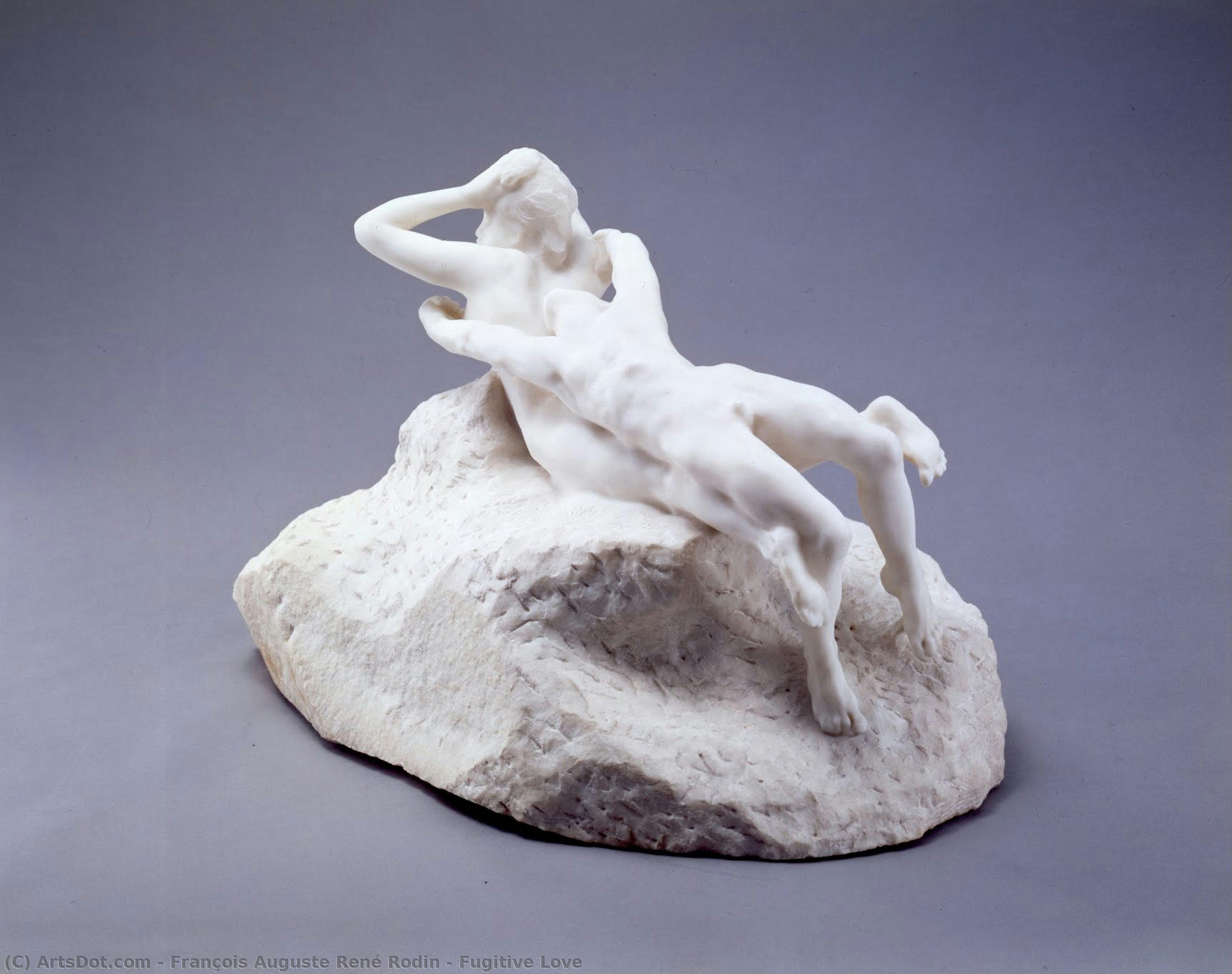
“Fugitive Love,” sculpted by Auguste Rodin between 1886 and 1887, stands as a cornerstone of Romantic sculpture—a testament to the artist's profound understanding of human emotion and his masterful manipulation of marble. More than just an aesthetically pleasing form, this piece embodies a complex narrative about desire, vulnerability, and the fleeting beauty of connection. Examining its artistic elements reveals layers of meaning that continue to resonate with audiences today.A Dynamic Composition Reflecting Romantic Ideals
The sculpture’s visual impact is immediately striking due to its asymmetrical arrangement. Two nude figures intertwine in an embrace atop a rocky outcrop—a deliberate choice mirroring the turbulent currents of Romantic thought. Unlike Neoclassical sculptures prioritizing idealized beauty and rationality, Rodin prioritizes expressive form over formal perfection. The diagonal thrust of the rock face creates tension and dynamism, propelling the viewer’s gaze across the scene and emphasizing the figures' precarious position. This unconventional composition speaks to the Romantic fascination with nature as a source of inspiration and emotional upheaval—a departure from academic conventions that championed serene landscapes and balanced compositions.Technique and Material: Mastering Marble’s Potential
Rodin’s technique exemplifies his dedication to capturing human anatomy with unparalleled realism. He painstakingly carved into white marble, utilizing tools honed through years of apprenticeship as a stonemason. The surface texture is subtly varied—smooth where polished, retaining delicate depressions that mimic the contours of flesh and stone alike. This meticulous attention to detail underscores Rodin’s belief that sculpture should strive for an illusion of life, conveying not just physical form but also psychological depth. The artist skillfully exploited marble's inherent qualities – its ability to hold light and shadow—to heighten the sculptural drama and illuminate the figures' emotional expressions.Symbolism: Embracing Impermanence and Passion
“Fugitive Love” derives its symbolic power from several interwoven elements. The rocky outcrop represents instability and vulnerability, mirroring the precariousness of romantic relationships. The intertwined figures embody the yearning for intimacy and connection—a desire that is simultaneously joyful and fraught with anxiety. Rodin’s depiction captures a moment suspended between passion and retreat, acknowledging the ephemeral nature of love itself. This resonates deeply with Romantic sensibilities, which celebrated intense emotion alongside contemplation of mortality and beauty.Emotional Resonance: Capturing the Essence of Human Experience
Ultimately, “Fugitive Love” succeeds in conveying an overwhelming sense of tenderness and vulnerability. The sculptor’s ability to imbue marble with palpable emotion is remarkable—a feat achieved through careful observation of human anatomy and masterful manipulation of form. Viewing this sculpture evokes feelings of compassion, longing, and a poignant awareness of the fleeting beauty of human experience. It remains a powerful reminder that art can transcend mere representation, capturing the very soul of its subject matter and transporting viewers to the heart of Romantic emotion.Related Artworks




Artist Biography
The Sculptor of Souls: A Life Forged in Clay
François Auguste René Rodin, a name synonymous with modern sculpture, emerged from 19th-century France as a revolutionary force. Born in Paris on November 12, 1840, to modest beginnings, young Rodin’s path wasn't immediately destined for artistic greatness. He initially struggled to gain acceptance into the prestigious École des Beaux-Arts, facing rejection three times before ultimately finding his footing through practical training as a decorative stonemason. This early experience, however, proved invaluable, honing his technical skills and fostering an intimate understanding of form and material. It was a period of quiet apprenticeship, a necessary prelude to the seismic shifts he would later introduce into the world of sculpture. The seeds of his future innovation were sown not in academic halls but in the tangible reality of stone and clay. A profound personal loss – the death of his sister Marie – deeply affected him, leading to a brief contemplation of religious life before fully committing himself to art. This emotional depth would become a defining characteristic of his work, imbuing it with a raw, human quality rarely seen before.
Breaking with Tradition: A New Language in Stone
Rodin’s artistic journey was marked by a deliberate departure from the prevailing academic standards of his time. While trained in classical techniques, he rejected the idealized forms and narrative rigidity that dominated sculpture. He sought instead to capture the fleeting nuances of human emotion, the weight of thought, and the complexities of the inner life. His early works, such as *The Age of Bronze* (1877), initially sparked controversy for their realism and lack of mythological or allegorical subject matter. Critics found his figures too naturalistic, too devoid of the polished perfection expected of sculpture. However, Rodin persevered, driven by an unwavering belief in his artistic vision. He began to explore fragmented forms, rough surfaces, and dynamic compositions that conveyed a sense of movement and psychological intensity. This innovative approach challenged conventional notions of beauty and paved the way for a new era in sculptural expression. His ability to model complex, turbulent surfaces in clay was unparalleled, allowing him to capture the play of light and shadow with remarkable sensitivity.
Iconic Forms: The Thinker, The Kiss, and Beyond
Rodin’s legacy is cemented by a series of iconic sculptures that continue to resonate with audiences worldwide. *The Thinker* (1880-1882), originally conceived as part of *The Gates of Hell*, became an emblem of philosophical contemplation, its powerful form embodying the weight of human thought and existential questioning. *The Kiss* (1886-1898), a celebration of passionate love, is renowned for its sensual beauty and emotional intimacy. And *The Burghers of Calais* (1884-1895), a monumental tribute to courage and sacrifice, stands as a testament to Rodin’s ability to convey profound human drama through sculptural form. These works weren't merely representations of physical bodies; they were explorations of the human condition, imbued with psychological depth and emotional resonance. He didn’t shy away from portraying imperfection or suffering, recognizing that these qualities are integral to the human experience. His sculptures often featured unfinished surfaces, deliberately leaving traces of the artist’s hand as a testament to the creative process itself.
A Lasting Influence: Rodin's Place in Art History
By the turn of the 20th century, Rodin had achieved international acclaim, becoming arguably the most celebrated sculptor of his time. His work profoundly influenced generations of artists, inspiring them to break free from traditional constraints and explore new avenues of artistic expression. He is widely considered a pivotal figure in the transition from 19th-century realism to modern sculpture. His emphasis on emotional intensity, psychological depth, and innovative use of form laid the groundwork for movements such as Expressionism and Cubism. Today, Rodin’s sculptures can be found in museums and collections around the globe, most notably at the Musée Rodin in Paris, a dedicated space showcasing his life's work. His influence extends beyond sculpture, impacting painting, literature, and even film.
Exploring Further: Museums & Key Works
- Musée Rodin, Paris: A must-visit destination for anyone interested in experiencing the full breadth of Rodin’s artistic vision.
- National Gallery of Art, Washington D.C.: Houses a significant collection of Rodin's works, offering insights into his creative process.
- Cantor Arts Center at Stanford University: Features notable pieces like the bust of Albert-Ernest Carrier-Belleuse.
- Key Sculptures to Explore:
- *The Thinker* – A universal symbol of contemplation and intellect.
- *The Kiss* – An iconic representation of love and passion.
- *The Burghers of Calais* – A powerful depiction of sacrifice and courage.
- *Saint John the Baptist* - Demonstrates Rodin's ability to convey intense emotion through form.
- Small head of Jean de Fiennes with hand- An intimate study in portraiture, showcasing his mastery of detail.
Rodin’s legacy is not merely one of artistic innovation; it's a testament to the power of art to connect us to our shared humanity. He dared to explore the depths of human emotion and experience, leaving behind a body of work that continues to inspire, challenge, and move audiences today. His sculptures are not simply objects to be admired; they are windows into the soul, inviting us to contemplate the complexities of life, love, loss, and everything in between.

Auguste Rodin
1840 - 1917 , France
Quick Facts
- Artistic Movement Or Style: Modern Sculpture
- Artists Or Movements Influenced By This Artist: Modern sculpture
- Date Of Birth: November 12, 1840
- Date Of Death: November 17, 1917
- Full Name: François Auguste René Rodin
- Nationality: French
- Notable Artworks:
- The Thinker
- The Kiss
- Burghers of Calais
- Place Of Birth: Paris, France
Related Articles

Anniversary Art Gifts: 10 Masterpieces for a Lasting Love Story |
Find the perfect anniversary gift! Explore 10 meaningful art masterpieces – from Monet to Van Gogh – & discover their romantic stories. Shop museum-quality reproductions at for a lasting tribute to your love.

The Enduring Allure of Marble in Art History: From Classical Sculpture to Modern Abstraction
Explore the captivating history of marble sculpture from ancient Greece to modern art. Discover renowned artists like Canova & Michelangelo, carving techniques, and investment insights at ArtsDot.

The Eloquent Body: A Historical & Artistic Exploration of Figures in Painting & Sculpture
Explore the rich history of figure painting & sculpture! Discover classical masterpieces, modern interpretations, and expert insights for art lovers & collectors. ArtsDot offers museum-quality reproductions.

The Eloquent Form: A Historical & Aesthetic Exploration of the Nude in Art
Explore the captivating history of the nude in art! From ancient Greece to modern masters, discover its evolving symbolism, techniques & enduring beauty. Expert insights for collectors and enthusiasts.

François-Auguste Rodin: Revolutionizing Sculpture Through Emotion & Modernity
Explore the revolutionary world of Auguste Rodin, the founder of modern sculpture. Discover his iconic works like 'The Kiss' & 'The Thinker,' innovative techniques, and lasting impact on art history. A deep dive into emotion and realism.