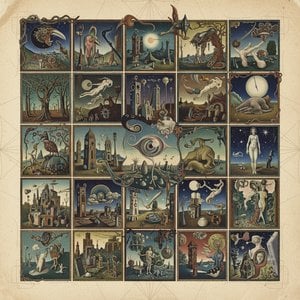
Yiannis Tsaroychis: A Dreamscape Painter From Ancient Greece
Yiannis Tsaroychis (1910 – 1989) emerged from the vibrant artistic milieu of post-war Athens, Greece, establishing himself as a singular voice within the burgeoning surrealist movement. Though largely unrecognized during his lifetime, Tsaroychis’s evocative paintings—characterized by fantastical landscapes and enigmatic figures—continue to captivate collectors and scholars alike, offering glimpses into a deeply personal vision of mythic grandeur and psychological introspection.
Early Life & Artistic Formation
Born in Piraeus, Tsaroychis’s formative years were steeped in the traditions of Greek art history. He studied at the Athens School of Fine Arts, absorbing influences from Impressionism and Symbolism before gravitating towards Surrealism in the mid-1930s. This pivotal shift was catalyzed by encounters with European avant-garde artists—particularly Giorgio Morandi and Fernand Léger—who championed a contemplative approach to artistic expression.
The Surrealist Vision
Tsaroychis’s distinctive style is instantly recognizable: dreamlike landscapes populated by stylized human forms, often imbued with symbolic resonance. He meticulously crafted his canvases using techniques honed over decades of practice—primarily oil paint and watercolor—employing impasto textures to convey a palpable sense of materiality alongside ethereal imagery. Recurring motifs included knights, angels, and solitary figures contemplating vast vistas, reflecting themes of heroism, spirituality, and the contemplation of existence.
- Notable Techniques: Tsaroychis favored layering oil paint with watercolor, creating textured surfaces that enhanced the emotional impact of his compositions.
- Influences: His artistic sensibilities were profoundly shaped by Impressionist masters like Claude Monet and Symbolists such as Gustave Moreau, alongside Surrealist pioneers Morandi and Léger.
- Recurring Themes: Landscapes dominated Tsaroychis’s oeuvre, frequently depicting idealized vistas reminiscent of ancient Greece—a deliberate homage to the nation's heritage.
Major Achievements & Recognized Works
Among Tsaroychis’s most celebrated paintings are ‘Entrance of Country House,’ a breathtaking watercolor capturing a chivalrous scene within an aged landscape, and ‘Study for ''May''’, a poignant depiction of an angel-like figure reflecting Renaissance artistic ideals. His self-portrait—a masterful blend of realism and Impressionism—further solidified his reputation as a gifted artist capable of conveying profound psychological depth.
- ‘Entrance of Country House’ (1928): This watercolor exemplifies Tsaroychis's ability to fuse fantasy with meticulous observation.
- ‘Study for ''May''’ (1973): The painting showcases Morandi’s influence and a masterful use of impasto, conveying both beauty and melancholy.
- ‘Self Portrait’ (c. 1960): Tsaroychis's self-portrait is considered a cornerstone of his artistic legacy—a testament to his skill in portraying human emotion through subtle tonal variations.
Legacy & Historical Significance
Despite remaining largely outside the mainstream art world during his lifetime, Yiannis Tsaroychis’s work continues to inspire admiration for its imaginative vision and technical prowess. His paintings serve as a poignant reminder of Greece's artistic past while simultaneously exploring universal themes of spirituality and contemplation—a legacy that ensures his place among the most distinctive figures of 20th-century Surrealism.
Questions & Answers
In which historical period did Yiannis Tsaroychis work?
Yiannis Tsaroychis worked in the Modern period. The period situates the artist's activity in history.
How can I follow Yiannis Tsaroychis's work year by year?
The artist's Artwork Timeline page presents Yiannis Tsaroychis's works ordered by date, year by year.
What are the birthplace and birth year of Yiannis Tsaroychis?
Yiannis Tsaroychis was born in Piraeus in 1910.