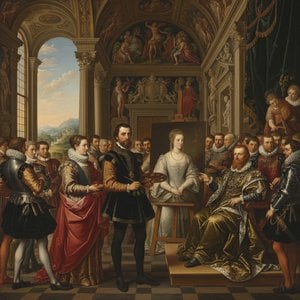
The Augsburg Origins and Basel Flourishing
Hans Holbein the Younger, born in the free imperial city of Augsburg around 1497–98, emerged from a family deeply rooted in artistic tradition. His father, Hans Holbein the Elder, was an accomplished painter and draughtsman of the Late Gothic school, and it was within his bustling workshop that young Hans received his initial training alongside his brother, Ambrosius. This early education instilled not only technical skill but also a keen understanding of meticulous detail and precise representation—qualities that would become hallmarks of Holbein’s style. Augsburg itself, a thriving center for commerce and humanist thought, provided a stimulating environment for the budding artist. However, it was Basel, to which both brothers travelled around 1515, that truly ignited Holbein's career. The city’s flourishing printing industry offered new avenues for artistic expression, particularly in book illustration, while its vibrant humanist circles—populated by figures like Bonifacius Amerbach and the renowned Erasmus of Rotterdam—exposed him to a world of intellectual curiosity and patronage. Early commissions included murals and religious works, but it was his portraits, even at this stage, that began to attract attention, notably those depicting prominent humanists. This period saw Holbein deftly balancing traditional Gothic aesthetics with emerging Renaissance influences, laying the foundation for his unique artistic voice.
A Portraitist in Demand: England and Beyond
The winds of religious upheaval sweeping through Basel during the Reformation presented both challenges and opportunities for Holbein. He skillfully navigated these turbulent times, accepting commissions from both reformist and traditional patrons, demonstrating a remarkable adaptability and diplomatic sensibility. Yet, it was his ambition to reach a wider audience that propelled him towards England in 1526, armed with a letter of introduction from Erasmus himself. This move proved pivotal. Welcomed into the humanist circle surrounding Thomas More, Holbein quickly established a reputation as an exceptional portraitist, capturing not merely likenesses but also the inner character and social standing of his sitters. His ability to convey personality through subtle gestures, expressive eyes, and carefully chosen details set him apart from his contemporaries. A four-year return to Basel followed, during which he continued to produce significant works, including the striking ‘Madonna of Mayor Jakob Mayer’ (the Darmstadt Madonna). However, England beckoned once more in 1532, this time under the patronage of Anne Boleyn and Thomas Cromwell. This marked a turning point, leading to his appointment as King's Painter to Henry VIII in 1535.
The Court of Henry VIII: A Chronicle in Paint
As King’s Painter, Holbein became an integral part of the Tudor court, tasked with immortalizing the royal family and its inner circle. His portraits from this period are not simply representations of power and status; they are a meticulously documented chronicle of a momentous era—a time when Henry VIII was asserting his supremacy over the Church of England and reshaping the nation’s identity. He painted Anne Boleyn, Jane Seymour, Christina of Denmark, and Anne of Cleves, each portrait imbued with layers of symbolism and political nuance. Beyond portraits, Holbein designed jewelry, plate, festive decorations, and other precious objects, showcasing a versatility that extended far beyond his mastery of paint. The iconic double portrait of ‘The Ambassadors’ (1533), brimming with hidden meanings and intellectual allusions, stands as a testament to his artistic brilliance and the complex political climate of the time. His work wasn't merely decorative; it was an active participant in the court's power dynamics.
Style and Legacy: A Unique Renaissance Master
Holbein’s art defied easy categorization. While rooted in the Northern Renaissance tradition, he absorbed influences from Italy, France, and the Netherlands, forging a style uniquely his own. He possessed an unparalleled ability to render textures with astonishing realism—the sheen of silk, the glint of metal, the softness of skin—creating portraits that seemed almost lifelike. However, his genius lay not just in technical skill but also in his psychological insight. His sitters were not merely posed figures; they were individuals with complex personalities and hidden depths, revealed through subtle gestures, expressive eyes, and carefully chosen accessories. He embedded layers of symbolism within his works, inviting viewers to decipher the hidden meanings and allusions that spoke volumes about the sitter’s character and social context. Holbein was lauded in his time as “the Apelles of our time” by poet Nicholas Bourbon, a testament to his exceptional talent. Though he founded no formal school, his influence on subsequent generations of portraitists is undeniable. His art continues to captivate and intrigue, offering a glimpse into the lives and times of one of history’s most fascinating courts.
A Lasting Impression: Rediscovery and Modern Appreciation
Despite initial acclaim, some of Holbein's work was lost or dispersed after his untimely death in London between October and November 1543, likely due to the plague. However, much of his oeuvre survived, collected by discerning patrons and preserved through the centuries. While recognized as a significant artist during his lifetime, it wasn’t until the 19th century that Holbein truly achieved widespread recognition as one of the greatest portrait masters. Recent exhibitions have further illuminated his versatility, showcasing not only his iconic portraits but also his designs for jewelry, book illustrations, and other lesser-known works. His art remains unsurpassed for its sureness of statement, penetration into character, and combined richness and purity of style—a testament to a unique artistic vision that continues to resonate with audiences today. He is remembered as more than just a portraitist; he was a chronicler of his age, a master craftsman, and an artist whose work embodies the spirit of the Renaissance.