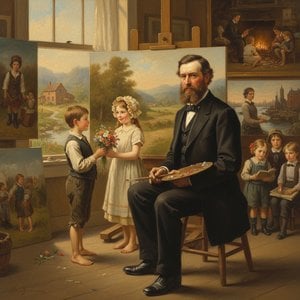
Jean-Baptiste Lallemand: A Painter of Delicate Landscapes and Elegant Engravings
Jean-Baptiste Lallemand (1716–1803) stands as a testament to the flourishing Rococo artistic movement in Dijon and Paris during the eighteenth century. Born in Dijon, France, he embarked on a prolific career primarily focused on landscape painting and genre scenes—a duality that reflects the broader cultural sensibilities of his time. Often signing himself Lallemant or Allemanus, Lallemand’s artistic journey spanned across Europe, culminating in a Parisian residency where he became affiliated with the Académie de Saint-Luc, cementing his position within the influential artistic circles of the era.
- Early Life and Training: Precise biographical details surrounding Lallemand's formative years remain somewhat elusive, though records indicate he received training initially in Dijon, absorbing influences from Flemish masters prevalent at the time.
- Italian Influence: A pivotal moment in his artistic development occurred during a prolonged stay in Italy—a tradition for aspiring artists seeking inspiration and honing their skills amidst the grandeur of Roman art and Venetian painting. This exposure undoubtedly broadened his stylistic horizons.
- Parisian Career: Upon returning to Paris, Lallemand established himself as a respected artist, actively participating in academic exhibitions and cultivating connections with fellow painters and patrons. His membership in Saint-Luc allowed him to engage in ongoing artistic discourse and contribute to the advancement of French art.
Lallemand’s oeuvre is characterized by an exquisite sensitivity to light and color—traits emblematic of Rococo aesthetics. He excelled at capturing atmospheric effects, particularly in his landscapes, employing subtle gradations of tone and delicate brushwork to convey a profound sense of tranquility and beauty. Recurring motifs included serene riversides, picturesque villas nestled amongst verdant hills, and meticulously rendered architectural details—all imbued with an understated elegance that distinguishes his work from more overtly dramatic styles. His genre paintings often depicted scenes of domestic life—portraits of families engaged in leisurely pursuits—executed with a similar level of refinement and psychological insight.
- Notable Paintings: Among Lallemand’s most celebrated canvases is “Soap Bubbles,” an oil painting that encapsulates the ephemeral charm of childhood innocence. Its luminous palette and masterful technique exemplify his artistic prowess, capturing a fleeting moment of joy with remarkable precision. Similarly, "An Evening Landscape With An Estuary And A Ruined Temple" showcases his ability to evoke mood and atmosphere through muted tones and soft lighting—a hallmark of Baroque/Rococo painting.
- Engraving Technique: Beyond painting, Lallemand achieved considerable renown as an engraver, demonstrating exceptional skill in transferring images from paintings onto copper plates. His engravings, notably “Vue Du Château De Pierre Scize À Lyon,” are distinguished by their meticulous detail and vibrant hand-coloring—a technique that elevates the visual impact of his subjects. The inclusion of flying birds over prominent buildings—such as the Tour des Ursulines and the Cathedral—served as a deliberate symbolic gesture, reflecting the prevailing fascination with mythological narratives and conveying a sense of grandeur and aspiration.
Lallemand’s artistic legacy extends beyond individual artworks; his contributions to the École française d'impressionnisme are particularly noteworthy. His meticulous observation of nature and his masterful rendering of light—traits honed during his formative years—provided inspiration for subsequent generations of artists striving to capture the immediacy of visual experience. Museums across France, including Dijon’s Musée des Beaux-Arts and Paris’ Musée Carnavalet and Bibliothèque nationale, proudly display numerous specimens of his paintings and engravings—testaments to his enduring artistic influence and securing his place as a pivotal figure in French art history. His work continues to resonate with viewers today, reminding us of the beauty and subtlety achievable through careful artistic practice.