


 Aperçu en situation
 Partager
 Partager
 Détails
 Guide imprimable

 Télécharger
 Articles similaires
 Radiographie
 Voir le diaporama
 Statistiques
The Descent into Hell


 Afficher la suite
L’œuvre d'art présentée sur cette page est protégée par le droit d'auteur, ce qui signifie que nous ne pouvons légalement créer ou vendre de reproduction identique. Cette protection est appliquée en vertu d'accords internationaux tels que la Convention de Berne et par les lois nationales, notamment celles énoncées par le Loi américaine sur le droit d'auteur - Titre 17.
Cette méthode est pleinement conforme aux réglementations sur le droit d'auteur car elle ne repose pas sur la copie ou la duplication de l'œuvre protégée. Il s'agit plutôt d'une réinterprétation créative — une nouvelle peinture qui s'inspire de l'original sans pour autant lui être identique.
Giclées et impressions d'art
Impressions giclées ou sur toile de qualité musée, avec une production rapide et des finitions au choix. ( Acheter la peinture faite à la main Passer au format image numérique)




P118B €10

P118H €10

P118W €10

P438Z €10

P508JH €12

P508YH €12

P805H €10

P805Z €10

P919BZ €10

P919G €10

P919XJ €10

P959ZH €10

P968JZ €12

W106C €8

W218G €10

W218JH €8

W218Y €10

W307PJ €10

W316G €10

W316PJ €8

W316Y €10

W398PJ €8

W4111J €10

W500HY €15

W500JH €15

W692G €12

W849H €8

W940BG €15

W953PJ €8




Choisissez parmi nos formats prédéfinis qui respectent les proportions originales de l’œuvre.

Saisissez la largeur et la hauteur souhaitées pour qu'elles s'adaptent à votre cadre ou à votre mur. Une impression ne peut être que découpée, elle ne peut jamais être agrandie au-delà de l'image originale ; ainsi, un format de forme différente entraînera la perte d'une partie de l'image. Nous vous envoyons une maquette numérique pour approbation avant toute impression. L'image présentée sur cette page ne montre pas le recadrage réel — seule la maquette le permet.
Livraison dans le monde entier () en 2 semaines au lieu des 4/5 semaines habituelles. (18 octobre)

Livraison express gratuite dans le monde entier

Toile de lin de haute qualité

Assurance transport complète

Garantie de remboursement des droits de douane

Garantie de fidélité des couleurs

Garantie de retour de 100 jours (uniquement en cas de défaut)

Garantie de remboursement à 100%

Tarifs dégressifs sur quantité
 L'option verre n'est disponible que pour les dimensions inférieures à 110 cm.

The Descent into Hell
Giclées et impressions d'art
Format de la reproduction
-


Prix total final
€ 54
Georges Braque's *The Descent into Hell*: A Study in Fragmented Reality
Georges Braque’s *The Descent into Hell*, painted circa 1932, is a powerfully unsettling work that exemplifies the artist’s pivotal role in the development of Cubism and his exploration of psychological states. This seemingly simple depiction – a central bird amidst a scattering of fish and supporting birds – belies a complex layering of meaning rooted in the anxieties of the interwar period and Braque's own intensely personal struggles with mental health. The painting’s raw emotional impact stems from its deliberate ambiguity, forcing the viewer to confront unsettling questions about mortality, chaos, and the fractured nature of perception.
- Subject Matter: The central figure, a bird in mid-flight, immediately evokes notions of transcendence and spiritual aspiration. However, this is quickly undermined by the surrounding elements – the fish, traditionally symbols of death and the underworld, and the other birds, potentially representing fragmented memories or lost souls.
- Style & Technique: Braque’s masterful use of muted earth tones—ochres, browns, and grays—creates a somber atmosphere, characteristic of his mature Cubist style. The painting is rendered with meticulous detail, employing a technique of broken planes and multiple perspectives to dismantle traditional representation. This fragmentation isn't merely stylistic; it mirrors the psychological disintegration suggested by the subject matter.
Historical Context & the Rise of Psychological Art
Painted during a period of immense social and political upheaval – the Great Depression and the looming threat of World War II – *The Descent into Hell* reflects the broader artistic trends of the time. The rise of Cubism, pioneered by Braque and Pablo Picasso, was directly influenced by a desire to move beyond representational illusionism and explore the underlying structure of reality. Furthermore, this period witnessed an increased interest in psychology and psychoanalysis, with artists like Freud gaining prominence. This fascination with the subconscious fueled a shift towards art that explored subjective experience and emotional turmoil – a trend powerfully evident in Braque’s work.
- Cubism's Influence: Braque’s approach to Cubism—particularly his emphasis on geometric forms and multiple viewpoints—challenged conventional notions of space and perspective.
- Expression of Anxiety: The painting can be interpreted as a visual manifestation of the anxieties prevalent in Europe during this era, reflecting a sense of disorientation and uncertainty about the future.
Symbolism & Interpretation
The symbolism within *The Descent into Hell* is deliberately open to interpretation, adding to its enduring power. The bird’s flight can be seen as an attempt to escape a dark fate, while the fish represent the inescapable pull of death and decay. The arrangement of these elements – seemingly random yet carefully constructed – suggests a descent not just into physical hell but also into the depths of the human psyche. The repetition of birds reinforces this idea of fractured identity and lost direction.
- The Bird as Symbol: Birds have long been associated with spirituality, freedom, and transcendence; however, in Braque’s work, this symbolism is complicated by the surrounding imagery.
- Color Palette & Mood: The subdued color palette contributes significantly to the painting's melancholic mood, enhancing its emotional impact.
A Timeless Masterpiece – Recreated for Your Collection
ArtsDot.com is proud to offer a meticulously crafted hand-painted reproduction of Georges Braque’s *The Descent into Hell*. This artwork captures the essence of Braque's genius, allowing you to experience its profound emotional depth and intellectual complexity in your own space. Whether for a private collection or as a striking interior design element, this reproduction provides an authentic connection to one of the most significant works of modern art. Own a piece of history – own a fragment of Braque’s soul.
Questions et réponses
Quelle atmosphère «The Descent into Hell» de Georges Braque apporte-t-il à un intérieur ?
L'atmosphère Ethereal de «The Descent into Hell» de Georges Braque s'accorde parfaitement avec l'espace recommandé : un(e) Reception.
L'image de «The Descent into Hell» de Georges Braque peut-elle être librement reproduite ?
Le statut des droits d'auteur pour «The Descent into Hell» de Georges Braque : l'œuvre est dans le toujours protégé par le droit d'auteur. Cela détermine si les reproductions de l'image peuvent être réalisées librement.
Quelles couleurs dominent «The Descent into Hell» de Georges Braque ?
«The Descent into Hell» de Georges Braque utilise une palette Pastels, avec le Clay (#bb6036) comme couleur dominante.
Œuvres similaires


Biographie de l'artiste
**Jeunesse et formation**
Georges Braque, peintre français renommé, collagiste, dessinateur, graveur et sculpteur, est né le 13 mai 1882 à Argenteuil, dans les Val-d'Oise. Il a grandi à Le Havre et a initialement été formé pour devenir peigneur et décorateur comme son père et son grand-père. Cependant, les inclinations artistiques de Braque l’ont conduit à étudier la peinture à l’École des Beaux-Arts de Le Havre de 1897 à 1899.**Évolution artistique et fauvisme**
En 1902, après avoir terminé son apprentissage auprès d'un décorateur à Paris, Braque a fréquenté l’Académie Humbert jusqu’en 1904. Cette période a marqué son introduction au fauvisme, un style caractérisé par des couleurs vives et des réponses émotionnelles. Influencé par les œuvres de Henri Matisse et André Derain, Braque a adopté une approche fauviste, comme en témoigne son tableau La Patience (fauvisme, huile sur toile).**Contribution au cubisme**
La collaboration de Braque avec Pablo Picasso de 1908 à 1912 a conduit au développement du cubisme. Leurs œuvres cubistes analytiques, telles que Georges Braque: La Patience et Pablo Picasso: Le Clarinette(cubisme analytique, huile sur toile), sont aujourd’hui considérées comme des jalons de l'histoire de l'art.**Héritage et œuvres notables**
* Maisons à l’Estaque : Témoignage de l'utilisation innovante de la géométrie et de la perspective simultanée par Braque. * La Patience(fauvisme, huile sur toile) : démontre le style fauve de Braque. * Le Clarinette(cubisme analytique, huile sur toile) : œuvre cubiste collaborative avec Picasso.**Musées et collections**
* Musée d'Orsay : présente une vaste collection d'art impressionniste et post-impressionniste, incluant des œuvres de Braque. * Musée de l'Orangerie : expose une large gamme d'œuvres d'art, incluant celles de Braque et d'autres artistes notables.- Découvrez-en davantage sur la vie et l’œuvre de Georges Braque sur ArtsDot.com
- Explorez la collection du Musée d'Orsay, présentant des œuvres de Braque et d'autres artistes, sur Musée d'Orsay - Wikipédia
- Apprenez-en davantage sur le fauvisme et son influence sur le développement du cubisme avec le mouvement artistique fauviste sur ArtsDot.com

Georges Braque
1882 - 1963 , France
En bref
- Artistes Influents:
- Henri Matisse
- André Derain
- Paul Cézanne
- Date De Décès: 1963
- Date De Naissance: 13 mai 1882
- Influence Sur Les Artistes: ['Pablo Picasso']
- Lieu De Naissance: Argenteuil, France
- Mouvement Artistique: Cubisme, Fauvisme
- Nationalité: Française
- Nom Complet: Georges Braque
- Oeuvres Notables:
- Maisons à L'Estaque
- La Patience
- Le Clarinette
- Nature morte avec cruets
Articles similaires
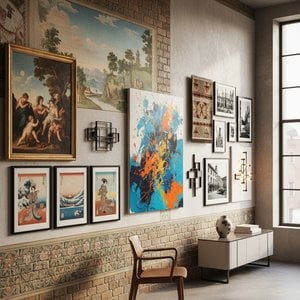
Transforming Spaces: A Comprehensive Exploration of Wall Decor Through Art History & Contemporary Practice
Explore the art of transforming spaces with our comprehensive guide to wall decor. From historical movements to contemporary trends, discover how to curate impactful interiors and commission bespoke artwork for a truly personalized aesthetic.

Georges Braque : Les 25 Œuvres Maîtresses du Cubisme et de la Modernité | ArtsDot
Plongez dans l'univers de Georges Braque avec les 25 œuvres incontournables du cubisme. Découvrez l'histoire, les techniques et l'impact de ce maître de l'art moderne. Reproductions d'art exceptionnelles sur ArtsDot.com.

Giclée Prints: Archival Quality & Aesthetic Nuances for the Discerning Collector
Explore the world of giclée prints with ArtsDot. Learn about archival quality, aesthetic nuances & investment potential. Expert guidance for discerning art collectors seeking museum-quality reproductions and lasting value.

Echoes of Time: Exploring the Enduring Appeal & Historical Context of Vintage Art Prints
Explore the captivating world of vintage art prints! Discover their history, collecting tips & enduring appeal. Expert insights on chromolithography and building a legacy collection with ArtsDot.

The Enduring Legacy of Fine Art Prints: Technique, History & Aesthetic Impact
Explore the rich history & techniques of fine art prints. Discover investment potential, assess authenticity, and learn how to preserve your collection with expert guidance. Trusted insights for discerning collectors.


