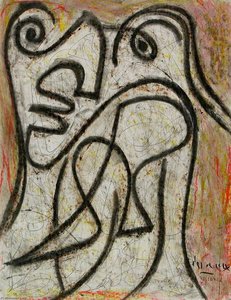
The Silent Resonance of Roy Turner Durrant
In the quiet, rolling landscapes of Lavenham, Suffolk, a profound artistic vision began to take shape within the soul of Roy Turner Durramt. Born on October 4, 1925, Durrant’s early life was deeply intertwined with the pastoral rhythms of the English countryside, a connection that would later serve as the spiritual bedrock for his abstract explorations. He carried with him a lifelong devotion to the act of drawing, fueled by a personal motto he cherished since childhood: "ars longa, vita brevis"—art is never ending, life is short. This sentiment, which he famously inscribed in his books and eventually saw carved upon his own tombstone, perfectly encapsulates the essence of his creative journey, where the fleeting moment of existence is transmuted into the enduring permanence of the canvas.
Durrant’s formal artistic identity was forged at the Camberwell School of Art between 1948 and 1952. It was within these walls that he navigated the complex currents of British Modernism, learning to balance the burgeoning influences of European abstraction with a deep-seated reverence for English literature. This unique duality allowed him to move beyond mere representation, seeking instead to bridge the gap between the visible world and the internal landscape of the mind. His education provided more than just technical mastery; it offered him a language through which he could translate the intangible atmospheres of place into structured, poetic compositions.
The Architecture of Inscape
The hallmark of Durrant’s oeuvre is his celebrated technique known as ‘Inscape.’ Rather than attempting to replicate the literal topography of the Suffolk landscape, Durrant sought to distill the very essence of a location—its stillness, its light, and its emotional weight. His works are not mere depictions of scenery but are meditative explorations of form and tone. Through a meticulous use of geometric abstraction, he employed circles, squares, and rectangles as conduits for spiritual and emotional resonance. These shapes do not act as barriers to reality but rather as windows into a more profound, interior truth.
His palette was intentionally restrained, favoring a sense of quietude over the clamor of bold hues. By utilizing muted tones of blues, greens, and ochres, he achieved a remarkable tonal harmony that evokes a sense of contemplative observation. The texture and gradation of his oil paintings invite the viewer into a state of introspection, where the boundaries between the external environment and the internal psyche begin to blur. In an 'Inscape,' the landscape is no longer something one looks at, but something one experiences from within.
Legacy and Artistic Significance
Throughout his career, Roy Turner Durrant’s work resonated with a quiet power that earned him recognition in prestigious institutions. His pieces have been featured in the collections of Tate and Kettle's Yard, standing as testament to his contribution to 20th-century British abstraction. His ability to pair abstract geometric forms with evocative, poetic titles transformed each painting into a literary experience, inviting viewers to participate in a shared moment of meditation.
The historical significance of Durrant lies in his ability to maintain a sense of profound peace within the often turbulent movement of modern art. He remains a master of the landscape of silence, reminding us that even in the most distilled forms, there is a vastness of emotion waiting to be discovered. His legacy continues to inspire those who seek beauty in the subtle, the still, and the eternal.