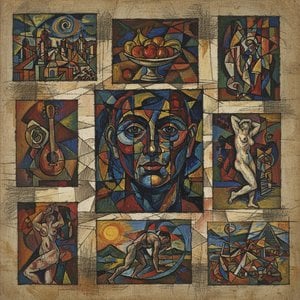
Helen Mayou (1960-77) remains a singular figure in German Expressionist art, her brief but impactful career producing canvases that grapple with profound themes of human existence and the natural world. Born in Germany, Mayou’s artistic journey began amidst the turbulent backdrop of the late 1950s and early 1960s, a period marked by significant social and political upheaval—the Cold War division of Europe and the burgeoning counterculture movement. Despite her tragically premature death at just 37 years old, Mayou’s legacy persists through her distinctive style and enduring exploration of complex ideas.
Early Influences: Mayou's artistic sensibilities were profoundly shaped by the pioneering works of Ernst Ludwig Kirchner and Emil Nolde, artists who championed Expressionism’s emotive power and rejection of academic conventions. Kirchner’s stark landscapes and psychologically charged portraits instilled in Mayou a commitment to conveying inner turmoil alongside external observation.
The ‘Abstract of Man’ Series: Her most celebrated achievement is undoubtedly the ‘Abstract of Man’ series, consisting of approximately 30 paintings created between 1965 and 1968. These canvases are characterized by fragmented Cubist forms rendered in muted grey tones—a deliberate choice reflecting Mayou's preoccupation with mortality and the disintegration of identity.
Technique and Style: Impasto Texture and Dramatic Lighting
Mayou’s technique was defined by a masterful use of impasto – applying paint thickly onto the canvas surface – creating palpable textural variations that heighten the emotional impact of her compositions. This method allowed her to capture not only visual form but also the physicality of feeling, mirroring the turbulent inner landscape she sought to portray. Furthermore, Mayou skillfully employed dramatic lighting—often utilizing stark contrasts between light and shadow—to emphasize compositional elements and amplify the sense of unease inherent in her artwork.
Color Palette: Despite predominantly working in grayscale, Mayou occasionally incorporated splashes of color – notably crimson – to punctuate her canvases with moments of visceral intensity. These hues served as symbolic representations of passion, vulnerability, and perhaps even impending doom.
Compositional Considerations: Her paintings frequently feature distorted figures—often depicted in profile—positioned against backgrounds that evoke desolate landscapes or claustrophobic interiors. This compositional strategy underscores Mayou’s exploration of psychological states and challenges viewers to confront uncomfortable truths about the human condition.
Symbolism and Themes: Mortality, Fragmentation, and Biblical Allusions
Mayou's artistic vision consistently centered on themes of mortality, fragmentation, and biblical allegory. The ‘Abstract of Man’ series directly references Genesis 3:15—the “seed of discord”—suggesting that humanity is perpetually beset by conflict and suffering. The fractured Cubist forms symbolize the disintegration of individual identity as individuals confront their own vulnerability and inevitable demise. Recurring motifs include doves—representing peace and hope amidst despair—and stylized human figures grappling with existential anxieties.
Legacy and Significance: A Quiet Voice Amidst Expressionism’s Giants
Despite her tragically short life, Helen Mayou's contribution to German Expressionist art remains noteworthy. Her uncompromising commitment to conveying emotional depth through innovative technique—particularly impasto—and symbolic imagery distinguishes her from many of her contemporaries. Though she produced relatively few works during her lifetime, Mayou’s canvases continue to resonate with viewers today, prompting contemplation on fundamental questions about human existence and the enduring power of art to confront uncomfortable realities. Her work is held in several museums across Germany and continues to inspire artists interested in exploring psychological landscapes and conveying profound emotional resonance.