


 Visa i rummet
 Skicka
 Dela
Dela
 Detaljer
 Studentguide för konstverk

 Ladda ner
 Liknande objekt
 Röntgen
 Bildspel
 Besökstatistik
Julia Reading


 Läs mer
Giclée / Konsttryck
Giclée- eller canvasprint av museumskvalitet med snabb produktion och flexibla ytbehandlingsalternativ. ( Köp handmålat konstverk Byt till digital bildförsäljning)




P118B Skr10

P118H Skr10

P118W Skr10

P438Z Skr10

P508JH Skr12

P508YH Skr12

P805H Skr10

P805Z Skr10

P919BZ Skr10

P919G Skr10

P919XJ Skr10

P959ZH Skr10

P968JZ Skr12

W106C Skr8

W218G Skr10

W218JH Skr8

W218Y Skr10

W307PJ Skr10

W316G Skr10

W316PJ Skr8

W316Y Skr10

W398PJ Skr8

W4111J Skr10

W500HY Skr15

W500JH Skr15

W692G Skr12

W849H Skr8

W940BG Skr15

W953PJ Skr8




Välj bland våra förinställda storlekar som motsvarar konstverkets ursprungliga proportioner.

Ange den bredd och höjd du behöver, för att passa din ram eller din vägg. Ett tryck kan endast beskäras, aldrig göras större än bilden, vilket innebär att ett format med en annan formform leder till att en del av bilden går förlorad. Vi skickar en digital mockup för godkännande innan vi trycker något. Bilden som visas på denna sida visar inte den faktiska beskärningen — det är endast mockuppen som gör det.
Leverans över hela världen () på 2 veckor istället för standard 4/5 veckor. (23 oktober)

Fri expressfrakt över hela världen

Högkvalitativ linnecanvas

Fullständig fraktförsäkring

Garantier för återbetalning av tullavgifter

Garantier för exakt färgåtergivning

100 dagars returrätt vid fabrikationsfel

100% pengarna tillbaka-garanti

Mängdrabatt erbjuds
 Glasalternativet är endast tillgängligt i storlekar under 110 cm.

Julia Reading
Giclée / Konsttryck
Reproduktionsstorlek
-


Totalpris
Skr 615
A Snapshot of Urban Life: Unveiling "Julia Reading"
William James Glackens’ “Julia Reading,” painted in 1916, isn't merely a portrait; it’s a meticulously crafted window into the burgeoning dynamism and subtle social currents of early 20th-century New York City. Born during the height of the Ashcan School movement, Glackens rejected the idealized depictions favored by the National Academy of Design, instead choosing to capture the gritty reality of everyday life – the bustling streets, the casual interactions, and the quiet moments within a rapidly changing metropolis. “Julia Reading” exemplifies this approach, offering a glimpse into a specific scene that simultaneously feels intimate and profoundly connected to the larger urban narrative.
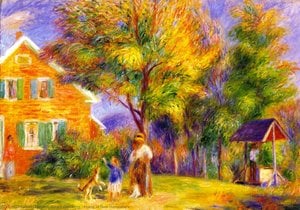
The painting immediately draws the eye to its central figure, a woman engrossed in a book. Her posture – slightly turned towards the viewer, her hand resting delicately on the page – conveys a sense of quiet contemplation amidst the implied activity around her. Glackens’ masterful use of light and shadow establishes a strong focal point, directing our gaze to Julia's face and highlighting the subtle details of her expression. The inclusion of two other individuals—a man standing behind her and another seated further back—adds layers of narrative complexity without disrupting the primary focus. These figures, though less defined, contribute to the sense of a shared space, a moment captured within the larger tapestry of urban life.
The Ashcan School: A Rejection of Tradition
Glackens was a key figure in the Ashcan School, a movement that challenged the established norms of American art. Rejecting the polished surfaces and grand narratives of academic painting, the Ashcan artists sought to depict the realities of urban life with honesty and immediacy. They favored working-class subjects, unvarnished scenes, and often employed a darker palette—a deliberate choice reflecting the sometimes bleak conditions of city living. “Julia Reading” embodies this spirit perfectly; it’s not a romanticized vision of New York, but rather a realistic portrayal of a woman finding solace in literature within its crowded streets.
The painting's style is characterized by loose brushstrokes and an emphasis on capturing the essence of the scene. Glackens employed a technique reminiscent of Impressionism, using broken color and subtle gradations to create a sense of movement and atmosphere. The composition itself—a slightly off-center arrangement with overlapping planes—adds to the painting’s dynamism and invites the viewer to become part of the scene.
Symbolism and Context: A Moment in Time
The book Julia is reading likely symbolizes escape, knowledge, or perhaps simply a moment of respite from the demands of city life. It's a small detail that speaks volumes about the human desire for intellectual stimulation amidst the chaos of urban existence. The setting itself—a public space filled with implied activity—suggests a sense of anonymity and connection within a large population. “Julia Reading” was painted during a period of rapid industrialization and urbanization in America, a time of significant social and economic change. The painting reflects this transformation, capturing the spirit of a city grappling with modernity while still retaining its inherent human qualities.
A Legacy of Realism: Glackens' Enduring Influence
William James Glackens’ work continues to resonate today because it offers a powerful and honest portrayal of American life. “Julia Reading” stands as a testament to his skill as an artist and his commitment to capturing the realities of the urban experience. His legacy extends beyond individual paintings; he helped pave the way for future generations of artists who sought to depict America with greater authenticity and social awareness. Reproductions of this evocative piece offer a valuable window into a bygone era, inviting viewers to contemplate the timeless themes of human connection, solitude, and the enduring power of art.
Frågor och svar
Vilken fas i William James Glackenss karriär tillhör "Julia Reading" (1916)?
"Julia Reading", skapat år 1916, tillhör den Early Period av William James Glackenss karriär.
Hur hittar jag konstverk som liknar "Julia Reading" av William James Glackens?
Konstverk som liknar "Julia Reading" av William James Glackens finns samlade på verkets sida Liknande verk.
Vilken teknik användes för "Julia Reading" av William James Glackens?
William James Glackens använde tekniken Acrylic On Canvas för "Julia Reading". Tekniken definierar det ursprungliga verkets materiella karaktär.
Liknande konstverk


Om konstnären
A Pioneer of Ashcan Realism
William James Glackens (1870 – 1938) stands as a cornerstone of American realist painting, indelibly shaping the artistic landscape of his era and leaving behind a legacy celebrated for its unflinching portrayal of urban life. Born in Philadelphia, Pennsylvania, on March 13th, 1870, Glackens’ formative years instilled within him an enduring fascination with visual representation—a passion that would propel him toward a distinguished career as both artist and illustrator.Early Influences & Artistic Formation
Glackens' artistic journey commenced at the Pennsylvania Academy of Fine Arts, where he honed his skills under the tutelage of Thomas Anshutz, a pivotal figure in establishing Ashcan School realism. Anshutz’s unwavering commitment to capturing the gritty realities of New York City profoundly impacted Glackens’ approach to painting—a dedication to detail and an uncompromising gaze at the everyday experiences of ordinary people. This formative influence cemented his belief that art should serve as a mirror reflecting society, not merely embellishing it.The Ashcan School & Its Vision
Glackens was among the founders of the Ashcan School, a movement that decisively rejected the prevailing artistic conventions of its time. Rejecting idealized beauty and academic formalism, the Ashcan School championed a raw, honest depiction of urban life—particularly in New York City during the pre-World War I years. Artists like Glackens sought to portray the struggles and triumphs of ordinary individuals amidst the bustling streets and tenements of the metropolis, capturing not glamour but grit and truth. His canvases became windows into the lives of laborers, immigrants, and marginalized communities – a courageous stance for its time.Notable Works & Artistic Style
Glackens’ artistic style is characterized by its subdued palette—often dominated by earthy tones—and masterful technique. He meticulously rendered scenes of urban life with remarkable precision, capturing textures and nuances that conveyed the palpable atmosphere of his subjects. His most celebrated paintings include “The Shoppers,” a poignant depiction of a New York City grocery store teeming with shoppers—a piece now housed in the Chrysler Museum of Art’s New Realism Collection. Similarly, “View of Haarlem with Bleaching Grounds” showcases Glackens' ability to convey mood and atmosphere through subtle color choices and masterful brushwork – currently residing at Forzza Castle in Milan, Italy. Furthermore, he collaborated extensively with Albert C. Barnes, assisting him in assembling a significant collection of European paintings that would become instrumental in shaping American art history.Legacy & Enduring Significance
William James Glackens’ contribution to American art extends beyond his individual oeuvre; he championed the Ashcan School's ethos—a commitment to portraying life as it truly is—and fostered a dialogue between American and European artistic traditions. His unflinching realism continues to inspire artists today, reminding us that profound beauty can be found in confronting uncomfortable truths and celebrating the dignity of ordinary existence. Glackens’ work remains a testament to the power of art to illuminate social realities and elevate the human experience.
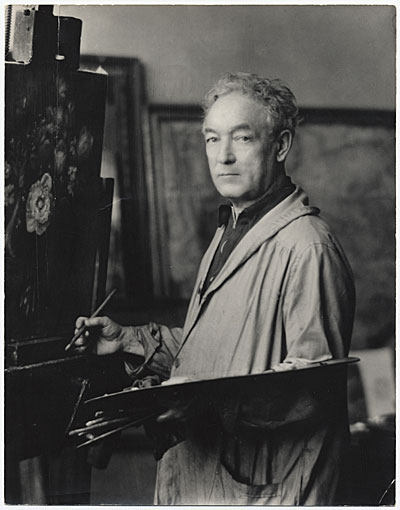
William James Glackens
1870 - 1938 , USA
Snabbfakta
- Artistic Movement Or Style: Ashcan School
- Artists Or Movements Influenced By This Artist: ['Pierre Auguste Renoir']
- Artists Who Influenced This Artist: ['Thomas Anshutz']
- Date Of Birth: Philadelphia, USA (1870)
- Date Of Death: Westport, CT (1938)
- Full Name: William James Glackens
- Nationality: Amerikaner
- Notable Artworks:
- The Shoppers
- View of Haarlem
- Place Of Birth: Philadelphia, Pennsylvania
Relaterade artiklar

The Ashcan School: Realism, Urban Life & the Democratization of American Art
Explore the revolutionary Ashcan School! Discover how artists like Henri & Sloan challenged tradition with gritty realism, capturing urban life in early 20th-century America. Learn about their impact on American art history.

Amerikansk realism: Topp 10 mästerverk som definierade en rörelse – konsttryck hos ArtsDot
Utforska de 10 mästerverk som definierade amerikansk realism! Lär känna Winslow Homer, Edward Hopper & andra ikoniska konstnärer. Högkvalitativa konsttryck och inredningsinspiration hos ArtsDot.com – upptäck tidlösa tavlor online.

Grant Wood & American Regionalism: Identity, Myth & the Rural Landscape
Explore the world of Grant Wood & American Regionalism with ArtsDot. Discover the symbolism behind 'American Gothic', recurring themes, and the movement's lasting impact on art history. High-quality reproductions available.

American Realism: Social Commentary & Artistic Representation in Early 20th-Century Painting
Explore the powerful social commentary & artistic representation of American Realism. Discover key artists like Bellows & Sloan, and understand the movement's lasting impact on 20th-century art history.
William Glackens: Capturing Modern American Life with Ashcan Realism
Explore the life & art of William Glackens, a pioneer of American Realism and founding member of the Ashcan School. Discover his vibrant depictions of early 20th-century New York & Paris. Learn about his influences & lasting legacy.

