

 Förhandsvisa
 Skicka
 Dela
Dela
 Visa detaljer
 Guide
Guide

 Ladda ner
 Liknande objekt
 Röntgen
 Bildspel
 Frågor och svar
 Statistik
Untitled (102)

 Visa mer
Konstverket som visas på denna sida skyddas av upphovsrättslagen, vilket innebär att vi inte lagligt kan skapa eller sälja en identisk reproduktion. Detta skydd upprätthålls genom internationella avtal såsom den Bernkonventionen och genom nationella lagar, inklusive de som fastställs av Amerikansk upphovsrättslag – Titel 17. Alla rättigheter förbehållna. Återgivning av konstverk är förbjuden utan skriftligt tillstånd från WahooArt.
Denna metod följer fullt ut upphovsrättsliga regler eftersom den inte innebär kopiering eller duplicering av det skyddade konstverket. Istället är det en kreativ nytolkning – en ny målning som är influerad av originalet men inte identisk med det.
Giclée / Konsttryck
Giclée- eller canvasprint av museumskvalitet med snabb produktion och flexibla ytbehandlingsalternativ. ( Beställ handmålad reproduktion Byt till digital bild)




P118B Skr10

P118H Skr10

P118W Skr10

P438Z Skr10

P508JH Skr12

P508YH Skr12

P805H Skr10

P805Z Skr10

P919BZ Skr10

P919G Skr10

P919XJ Skr10

P959ZH Skr10

P968JZ Skr12

W106C Skr8

W218G Skr10

W218JH Skr8

W218Y Skr10

W307PJ Skr10

W316G Skr10

W316PJ Skr8

W316Y Skr10

W398PJ Skr8

W4111J Skr10

W500HY Skr15

W500JH Skr15

W692G Skr12

W849H Skr8

W940BG Skr15

W953PJ Skr8




Välj bland våra förinställda storlekar som motsvarar konstverkets ursprungliga proportioner.

Ange den bredd och höjd du behöver för att passa din ram eller vägg. Ett tryck kan endast beskäras, aldrig göras större än originalbilden, vilket innebär att ett format med en annan proportion leder till att en del av bilden går förlorad. Vi skickar en digital mockup för godkännande innan vi påbörjar tryckningen. Bilden som visas på denna sida visar inte den faktiska beskärningen — det är endast mockuppen som gör det.
Leverans över hela världen () på 2 veckor istället för standard 4/5 veckor. (8 november)

Fri expressfrakt över hela världen

Högkvalitativ linnecanvas

Fullständig fraktförsäkring

Garantier för återbetalning av tullavgifter

Garantier för exakt färgåtergivning

100 dagars returrätt (endast vid fel)

100% pengarna tillbaka-garanti

Mängdrabatt erbjuds
 Glasalternativet är endast tillgängligt i storlekar under 110 cm.

Untitled (102)
Giclée / Konsttryck
Storlek på reproduktion
-


Slutgiltigt pris
Skr 629
Liknande konstverk


Konstnärsbiografi
A Life Woven from Fragments
Domenico “Mimmo” Rotella, born in Catanzaro, Italy, on October 7th, 1918, wasn’t simply an artist; he was a chronicler of the urban pulse. His life unfolded as a deliberate dismantling – not just of posters plastered across Roman walls, but also of conventional artistic notions. From his early years immersed in the vibrant, politically charged art scene of post-war Rome, Rotella developed a singular approach: the ‘décollage,’ a technique that transformed fleeting advertisements into enduring works of art. This wasn’t mere collage; it was an interrogation of consumer culture, a visual archaeology of the city's ephemeral narratives.
His initial artistic explorations leaned towards figurative painting, influenced by movements like Cubism and Futurism. However, a pivotal moment arrived in 1953 – what he termed “Zen illumination.” Observing the relentless cycle of posters being torn down and replaced, Rotella recognized a potent metaphor: the transient nature of images and their constant recontextualization within the urban landscape. This insight led him to abandon traditional painting, embracing instead the act of tearing and pasting, transforming discarded advertisements into layered, complex compositions.
The Language of the Street
Rotella’s ‘décollages’ weren't random acts of destruction. Each tear, each overlapping image, carried a deliberate weight. He meticulously selected posters – film stills, fashion advertisements, political slogans – capturing moments of cultural significance and projecting them onto canvas with an almost obsessive precision. The resulting works are not simply reproductions; they are reinterpretations, imbued with the artist’s own sensibility and a profound understanding of the city's visual language.
Influenced by Dadaism and Surrealism, Rotella’s work moved beyond mere representation. He sought to capture the *feeling* of the street – its frenetic energy, its constant flux, its inherent contradictions. The fragmented images, often juxtaposed with unexpected elements, created a sense of disorientation and intrigue, inviting viewers to actively engage with the artwork and decipher its hidden meanings.
From Rome to Paris: A New Realism
In 1961, Rotella’s work gained international recognition when he was invited by critic Pierre Restany to join the Nouveau Réalisme movement in Paris. This marked a significant shift in his artistic trajectory, pushing him towards greater experimentation and collaboration. The ‘Mec-Art’ process, developed during this period, involved projecting negative images onto emulsion-coated canvases – a technique that further emphasized the materiality of the artwork and its relationship to the urban environment.
Rotella's engagement with Nouveau Réalisme extended beyond purely aesthetic considerations. He was deeply interested in exploring the intersection between art, media, and society. His work often addressed themes of consumerism, mass culture, and political propaganda, reflecting the turbulent social and cultural landscape of post-war Europe.
Legacy and Influence
Mimmo Rotella’s contribution to 20th-century art is undeniable. He redefined the boundaries of collage and assemblage, transforming discarded materials into powerful works of art that continue to resonate today. His ‘décollages’ offer a unique perspective on urban life, revealing the hidden narratives embedded within the visual culture of the city.
Beyond his technical innovations, Rotella's legacy lies in his willingness to challenge conventional artistic practices and embrace the unexpected. He demonstrated that beauty could be found in decay, that meaning could emerge from chaos, and that even the most mundane objects – a torn poster – could hold profound significance.

Mimmo Rotella
1918 - 2006
Kortfakta
- Full Name: Domenico "Mimmo" Rotella
- Nationality: Italian
- Date Of Birth: 1918
- Date Of Death: 2006
- Place Of Birth: Catanzaro, Italy
- Notable Artworks:
- Cinecittà series
- Artypos series
- Plastiforme
- Artistic Movement Or Style:
- Décollage
- Nouveau Réalisme
- Artists Who Influenced This Artist:
- Cubism
- Futurism
- Kandinsky
- Mondrian
- Artists Or Movements Influenced By This Artist:
- Yves Klein
- Pierre Restany
Relaterade artiklar

The Enduring Legacy of Fine Art Prints: Technique, History & Aesthetic Impact
Explore the rich history & techniques of fine art prints. Discover investment potential, assess authenticity, and learn how to preserve your collection with expert guidance. Trusted insights for discerning collectors.

Giclée Prints: Archival Quality & Aesthetic Nuances for the Discerning Collector
Explore the world of giclée prints with ArtsDot. Learn about archival quality, aesthetic nuances & investment potential. Expert guidance for discerning art collectors seeking museum-quality reproductions and lasting value.

Mästverk i svart: Topp 10 målningar som fascinerar – ArtsDot.se
Utforska 10 ikoniska målningar dominerade av svart – från Rembrandts djupa skuggor till Munchs ångest. Lär känna historien bakom mästerverken och hitta inspiration för din inredning på ArtsDot.se. Upptäck hela kollektionen online!
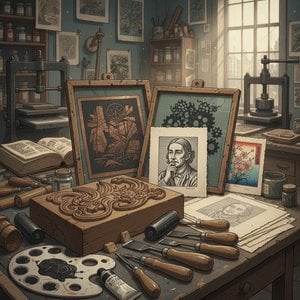
The Enduring Legacy of Printmaking: Techniques, Themes & Artistic Innovation Across Centuries
Explore the rich history of printmaking with ArtsDot. Discover techniques from intaglio to lithography, learn about collecting valuable prints & find museum-quality reproductions. Expert insights for art enthusiasts and collectors.

Echoes of Time: Exploring the Enduring Appeal & Historical Context of Vintage Art Prints
Explore the captivating world of vintage art prints! Discover their history, collecting tips & enduring appeal. Expert insights on chromolithography and building a legacy collection with ArtsDot.