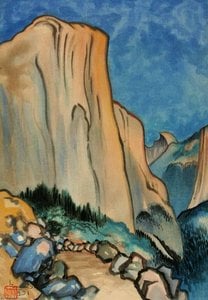
Chiura Obata (1885-1975): Celebrated Japanese-American Painter, UC Berkeley Professor, & Master of Sumi-e
Chiura Obata’s life story is one of extraordinary perseverance and artistic synthesis—a poignant illustration of how cultural exchange can flourish even amidst profound challenges. Born Zoroku Sato in Okayama Prefecture, Japan, on November 18, 1885, his formative years were steeped in the traditions of Japanese ink painting (sumi-e), a discipline that would shape his entire artistic vision. From the tender age of seven, he was entrusted to Rokuichi Obata, his older brother—a fellow artist—who instilled within him not merely technical proficiency but also an unwavering reverence for nature and a philosophical underpinning of art that would guide his creative endeavors throughout his life. While initially destined for military service by his brother’s influence, Obata possessed an innate yearning for artistic freedom, propelling him to abandon his family home at fourteen to pursue formal studies in Tokyo under luminaries like Tanryo Murata, Kogyo Terasaki, and Gaho Hashimoto. These formative years exposed him not only to the nuanced aesthetics of Japan but also to burgeoning Western artistic currents—a duality that would become central to Obata’s distinctive style.Early Life and Artistic Foundations
The influence of Rokuichi Obata's artistic guidance proved invaluable. He began his artistic education with sumi-e, mastering the delicate art of brushwork and pigment blending – techniques he would carry forward into his mature oeuvre. At fourteen, driven by a desire for independence and fueled by an admiration for Western art, Obata bravely left Okayama to enroll in Tokyo’s Nihon Bijutsuin (Japan Art Institute), where he honed his skills under masters who championed both Eastern and Western traditions. This dual exposure profoundly impacted his artistic sensibilities, fostering a synthesis of styles that would characterize his groundbreaking work. Shortly thereafter, he embarked on an ambitious journey—traveling to the United States in 1903—with aspirations of immersing himself in American art before continuing his explorations across Europe.Illustrator and Designer: Establishing Roots in America
In San Francisco, Obata initially secured employment as a houseboy to sustain himself while simultaneously pursuing independent artistic endeavors. He quickly gained recognition for his illustration work, contributing to Japanese newspapers like *The New World* and *The Japanese American*, documenting the devastating aftermath of the 1906 earthquake with meticulous sketches—a testament to his observational skills and commitment to capturing reality. Simultaneously, he honed his design expertise collaborating with prominent department stores such as Gump’s and The Emporium, demonstrating versatility and adaptability in diverse professional contexts. However, it was a transformative encounter with Yosemite National Park and the Sierra Nevada mountains in 1927 that truly ignited Obata's artistic passion—inspiring him to dedicate himself to portraying California’s breathtaking landscapes on silk canvases.The Yosemite Inspiration and Landscape Painting
This summer expedition served as a catalyst for Obata’s artistic evolution, cementing his fascination with the grandeur of nature and propelling him toward a distinctive style characterized by vibrant color palettes and masterful brushwork. He established the East West Art Society in San Francisco—a collaborative venture aimed at fostering intercultural dialogue among artists—reflecting his belief in the transformative power of art as a bridge between cultures. His artistic output expanded to encompass watercolors, ink sketches, and woodblock prints—each piece infused with the spirit of Yosemite’s majesty. Notably, Obata's celebrated “World Landscape Series,” comprising thirty-five exquisitely detailed colored woodblock prints depicting Californian vistas—particularly Yosemite—became an emblem of his artistic vision. These prints, produced with painstaking craftsmanship at Takamizawa Print Works, garnered international acclaim and solidified Obata’s reputation as a pioneer in blending Japanese techniques with Western subject matter.Teaching Legacy and WWII Interruption
From 1932 to 1954, Chiura Obata served as an instructor at UC Berkeley—a role that profoundly shaped his artistic philosophy and nurtured generations of students. He imparted not only technical skills but also a deep appreciation for observation, discipline, and the intrinsic beauty of the natural world—values he championed throughout his life’s work. Tragically, Obata's academic pursuits were interrupted by World War II when he and his family endured unjust incarceration at Tanforan Detention Center and subsequently Topaz Relocation Camp in Utah—a harrowing experience that nevertheless reaffirmed his unwavering belief in art as a means of preserving cultural identity and expressing human resilience. Despite the hardships imposed upon him, Obata persevered—establishing an art school within Topaz—demonstrating extraordinary fortitude and offering creative outlets to fellow detainees—a testament to his enduring commitment to artistic expression amidst adversity.A Lasting Impression: Artistic Achievement and Enduring Influence
Chiura Obata’s legacy extends far beyond the canvases he created; it resides in his profound contribution to American art, his unwavering dedication to teaching, and his steadfast belief in art's capacity to inspire and uplift audiences—a conviction that continues to resonate powerfully today. His distinctive style—characterized by a harmonious blend of Japanese tradition and Western innovation—remains an enduring testament to his artistic genius. Obata’s meticulous depictions of Yosemite National Park stand as iconic representations of California’s wilderness, capturing its sublime beauty with unparalleled artistry. Furthermore, his establishment of the Topaz Art School exemplifies his unwavering commitment to fostering creativity and preserving cultural heritage during a period of national crisis—a poignant reminder of art's transformative power in confronting adversity. Chiura Obata’s artistic achievements—coupled with his inspirational teaching career—have cemented his place as one of America’s foremost Asian American artists, ensuring that his vision continues to inspire future generations.Frågor & svar
Var kan jag se Chiura Obatas konstverk i ett 3D-galleri?
Ett virtuellt besök är möjligt: sidan 3D-museum för Chiura Obata presenterar konstnärens verk i ett tredimensionellt galleri.
Var kommer Chiura Obata ifrån?
Chiura Obata föddes i Japan.
Hur hittar jag alla verk av Chiura Obata inom ett visst medium?
För att hitta alla verk av Chiura Obata inom ett visst medium, besök artistens Alla medier-sida.