

 Visa i rummet
 Skicka
 Dela
Dela
 Detaljer
 Studentguide för konstverk

 Ladda ner
 Liknande objekt
 Röntgen
 Bildspel
 Besökstatistik
Avatar
 Oil On Canvas
- WallArt
- Symbolism
 1916
1916- Modern
 102.0 x 128.0 cm
 Royal Scottish Academy of Art - Architecture
 Läs mer
Konstverket som visas på denna sida skyddas av upphovsrättslagen, vilket innebär att vi inte lagligt kan skapa eller sälja en identisk reproduktion. Detta skydd upprätthålls genom internationella avtal såsom den Bernkonventionen och genom nationella lagar, inklusive de som fastställs av Amerikansk upphovsrättslag – Titel 17. Alla rättigheter förbehållna. Återgivning av konstverk är förbjuden utan skriftligt tillstånd från WahooArt.
Som ett respektfullt och lagligt alternativ erbjuder vi skräddarsydda, handmålade konstverk inspirerade av originalet. Våra skickliga och professionella konstnärer studerar noggrant originalets stil, stämning och konstnärliga essens för att skapa ett nytt, unikt verk som väcker samma känsla – samtidigt som det förblir en originell skapelse i egen rätt.
Denna metod följer fullt ut upphovsrättsliga regler eftersom den inte innebär kopiering eller duplicering av det skyddade konstverket. Istället är det en kreativ nytolkning – en ny målning som är influerad av originalet men inte identisk med det.
Handgjord oljereproduktion
Handmålad olja på duk i din valda storlek och ram, tillverkad efter beställning av våra konstnärer. ( Byt till tryckta exemplar Byt till digital bildförsäljning)




P118B Skr10

P118H Skr10

P118W Skr10

P438Z Skr10

P508JH Skr12

P508YH Skr12

P805H Skr10

P805Z Skr10

P919BZ Skr10

P919G Skr10

P919XJ Skr10

P959ZH Skr10

P968JZ Skr12

W106C Skr8

W218G Skr10

W218JH Skr8

W218Y Skr10

W307PJ Skr10

W316G Skr10

W316PJ Skr8

W316Y Skr10

W398PJ Skr8

W4111J Skr10

W500HY Skr15

W500JH Skr15

W692G Skr12

W849H Skr8

W940BG Skr15

W953PJ Skr8




Välj bland våra förinställda storlekar som motsvarar konstverkets ursprungliga proportioner.

Ange den bredd och höjd du behöver för att passa din ram eller din vägg. Eftersom detta är handmålat kan konstnären vid en annan form måla lite mer runt bilden eller beskära den något – du väljer själv. Vi skickar en digital mockup för godkännande innan målningen påbörjas. Bilden som visas på denna sida representerar inte det slutgiltiga resultatet — det är endast mockuppen som visar det.
Efter beställning kommer ArtsDot.com team att mejla kunden för instruktioner och tillhandahålla en skissförhandsvisning
Leverans över hela världen () på 3–4 veckor istället för standard 5 veckor. (23 oktober). Inga kompromisser med kvaliteten.

Fri expressfrakt över hela världen

Högkvalitativ linnecanvas

Fullständig fraktförsäkring

Garantier för återbetalning av tullavgifter

Garantier för exakt färgåtergivning

100 dagars returrätt vid fabrikationsfel

100% pengarna tillbaka-garanti

Mängdrabatt erbjuds
 Glasalternativet är endast tillgängligt i storlekar under 110 cm.

Avatar
Tryckteknik
Reproduktionsstorlek
-


Totalpris
Skr 3101
A Vision of Ethereal Unity
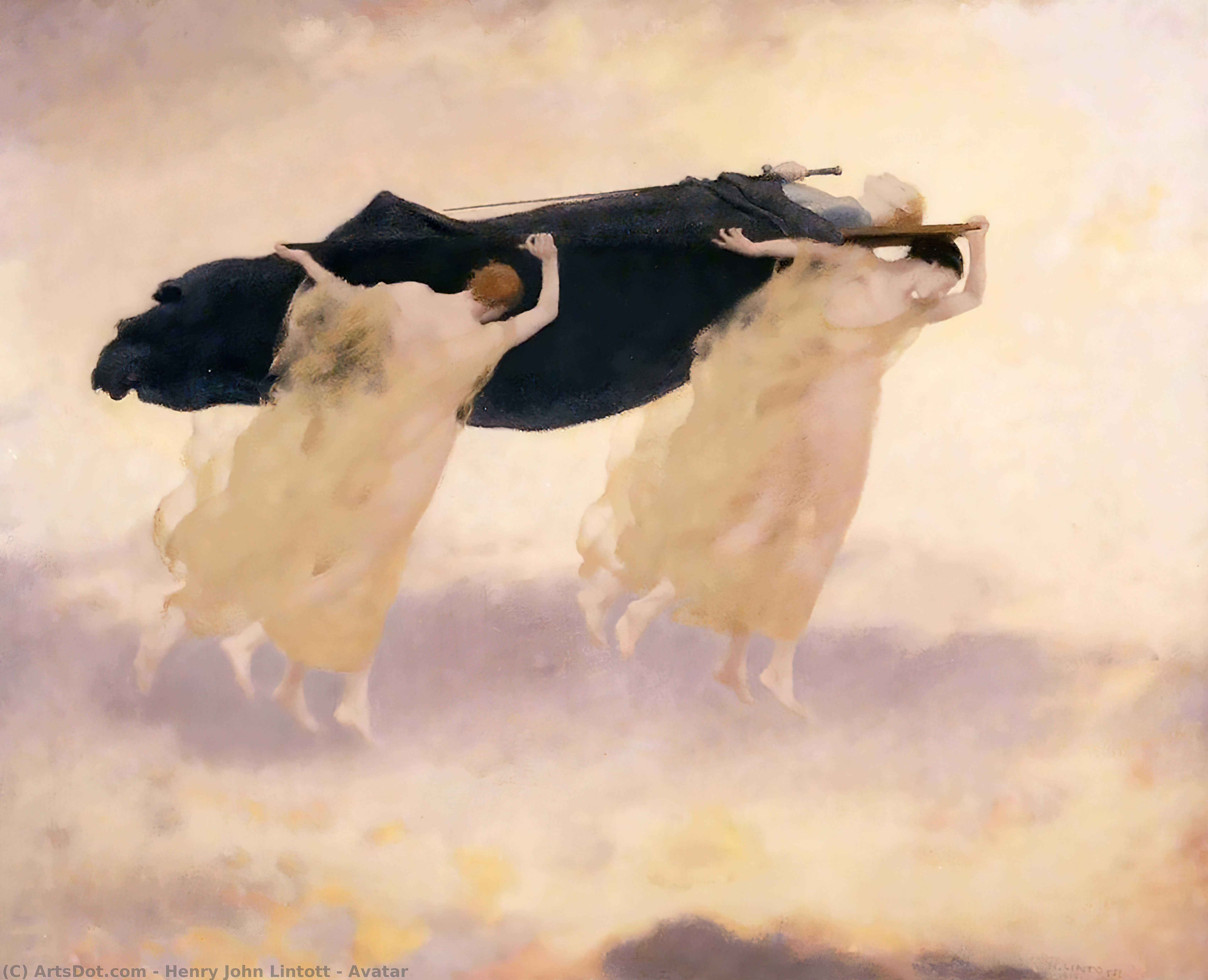
In the vast, misty corridors of art history, few works manage to bridge the gap between the tangible world and the realm of the spirit as gracefully as Henry John Lintott’s 1916 masterpiece, "Avatar." This captivating oil on canvas is not merely a painting; it is a window into a dreamscape where the boundaries of form and shadow dissolve. At its heart, the composition presents three female figures, positioned with a deliberate, rhythmic balance that guides the eye across a landscape of uncertainty. They appear to be engaged in a shared, sacred task, bearing a large, dark, boat-like object that anchors the ethereal scene. There is an undeniable sense of weight and purpose in their movement, yet they seem to glide through a hazy, atmospheric void, as if caught in a moment of suspended animation between heaven and earth.
The style of "Avatar" is a profound dialogue between Symbolism and Romanticism. Lintott eschews the sharp, clinical lines of realism in favor of soft, curvilinear forms and a palette of pale yellows, muted blues, and ghostly whites. The brushwork is loose and evocative, creating a textured surface where light does not strike objects so much as it permeates them. This technique produces a diffused, glowing effect, making the clouds appear to swirl with a life of their own. For the discerning collector or interior designer, this piece offers a sophisticated layer of depth; its lack of rigid boundaries allows it to integrate seamlessly into spaces that value atmosphere and mood, providing a focal point that invites quiet contemplation rather than demanding loud attention.
Symbolism and the Strength of Connection
Beyond its visual beauty, "Avatar" serves as a powerful allegory for human resilience and collective endeavor. The central theme is one of unity. The way the three women work in concert to carry their mysterious burden symbolizes the strength found in solidarity—the idea that even the most daunting journeys through life's shadows are made possible through cooperation. The dark, enigmatic object they carry acts as a profound symbol; it could represent the heavy responsibilities of existence, or perhaps a vessel for the soul navigating the turbulent currents of fate. This tension between the lightness of the angelic figures and the gravity of their task creates an emotional resonance that is both melancholic and deeply inspiring.
Historically, this work reflects Lintott’s position within the Scottish art scene and his exposure to the burgeoning Symbolist movements in London and Paris. As a prominent figure at the Royal Scottish Academy, Lintott was a master of capturing the struggle between light and darkness. In "Avatar," this struggle is not depicted through violent contrast, but through a subtle, atmospheric haze that suggests the ephemeral nature of life itself. To possess a reproduction of this work is to bring a piece of this historical introspection into a modern home—a reminder of the enduring power of connection and the beauty found in the pursuit of common goals.
An Invitation to the Sublime
For those seeking to curate an environment of peace, mystery, or intellectual depth, "Avatar" offers unparalleled inspiration. The painting’s shallow perspective and flattened space create an intimate experience, drawing the viewer into a world where the physical laws of gravity seem secondary to the emotional laws of the spirit. It is a piece that rewards repeated viewing, revealing new nuances in its layered glazes and soft shadows each time the light hits it. Whether placed in a grand gallery-style living room or a quiet study, this reproduction serves as a testament to the timeless allure of the sublime, making it an exquisite choice for anyone looking to infuse their surroundings with a sense of poetic grace and historical significance.
Frågor och svar
Vilket format har "Avatar" av Henry John Lintott?
"Avatar" av Henry John Lintott har ett Landscape-format. Formatet beskriver kompositionens proportioner.
Hur samverkar kontrast och harmoni i "Avatar"?
Färgkompositionen i "Avatar" av Henry John Lintott förenar en Bold kontrast med en Strong Color Unity harmoni.
Vilket stämningsläge och vilken känsla förenas i "Avatar"?
"Avatar" av Henry John Lintott förmedlar en Ethereal känsla inom en övergripande Ethereal stämning.
Liknande konstverk


Om konstnären
Henry John Lintott: A Weaver of Scottish Dreams
Henry John Lintott (1877-1965) wasn’t a name that dominated the art world during his lifetime, yet within the rich tapestry of 20th-century British painting, particularly in Scotland, he remains a quietly significant figure. More than simply a painter, Lintott was an educator and a mentor, shaping the artistic trajectories of generations through his tenure at the Edinburgh College of Art. His work—a captivating blend of portraiture, landscape, and allegorical scenes—offers a glimpse into a world where observation is paramount, emotion subtly rendered, and the ethereal intertwines with the everyday.
Born in Brighton, Lintott’s artistic journey began with formal training at the local school. He then broadened his horizons, studying in London and Paris – experiences that undoubtedly exposed him to the burgeoning currents of Impressionism and Symbolism. It was a move north to Edinburgh in 1902 that proved pivotal, establishing a long and influential career within Scotland’s artistic heartland. He quickly ascended to a position of respect, becoming one of the initial staff members at the College, where he spent over four decades nurturing talent and refining his own practice.
The Language of Light and Shadow
Lintott's style is immediately recognizable—a deliberate eschewing of bold, assertive brushstrokes in favor of a meticulously layered technique. He favored soft, diffused light, often employing a muted palette dominated by blues, greens, and browns, creating an atmosphere of quiet contemplation. His landscapes aren’t merely depictions of scenery; they are imbued with a dreamlike quality, as if viewed through a hazy memory or a half-remembered vision. This is particularly evident in works like “St Bernard’s Crescent from Studio Window,” where the urban scene dissolves into a wash of atmospheric color, suggesting both familiarity and an underlying sense of mystery.
His portraits are equally compelling. Lintott avoided the conventional formality often associated with portraiture, instead capturing his subjects with a gentle intimacy. He seemed to seek not just likeness but also something deeper—a hint of personality, emotion, or inner life. The “Self Portrait,” for instance, reveals an older man reflecting on his own journey, his gaze imbued with a quiet dignity and perhaps a touch of melancholy.
Influences and Artistic Circle
Lintott’s artistic development was undoubtedly shaped by the prevailing movements of his time – Impressionism and Symbolism. However, he forged his own distinctive voice, blending these influences with a distinctly Scottish sensibility. He was part of The Society of Eight, a group of artists who shared a commitment to exploring subjective experience and challenging conventional artistic norms. This circle fostered a spirit of experimentation and collaboration, contributing significantly to the vibrant artistic scene in Edinburgh.
His influence extended far beyond his immediate colleagues. He mentored a remarkable cohort of young Scottish artists, including Anne Redpath, John Maxwell, and William MacTaggart—artists who went on to achieve considerable recognition in their own right. Lintott’s emphasis on observation, sensitivity, and the exploration of inner landscapes undoubtedly played a role in shaping their artistic visions.
Legacy and Enduring Appeal
Henry John Lintott may not have achieved widespread fame during his lifetime, but his work continues to resonate with viewers today. His paintings possess a quiet beauty and emotional depth that transcends time. They invite us to slow down, to observe closely, and to contemplate the subtle nuances of light, color, and form. The National Galleries of Scotland recognize Lintott’s importance, describing him as “a painter of portraits, landscapes and allegorical subjects,” whose method was “slow and meticulous” and his style “often soft and dream-like.”
His legacy lies not only in the works he created but also in the artists he nurtured. Lintott’s influence can be seen throughout the Scottish art landscape, a testament to his skill as an educator and his profound understanding of the power of visual language. His paintings remain a poignant reminder that true artistry often resides in the quiet moments—the subtle shifts in light, the unspoken emotions, and the enduring beauty of the everyday world.

Henry John Lintott
1877 - 1965
Snabbfakta
- Artistic Movement Or Style: British Impressionism/Post-Impressionism
- Artists Or Movements Influenced By This Artist: ['Scottish School']
- Artists Who Influenced This Artist:
- Anne Redpath
- John Maxwell
- William MacTaggart
- Date Of Birth: 1877
- Date Of Death: 1965
- Full Name: Henry John Lintott
- Nationality: British
- Notable Artworks:
- Avatar
- Self Portrait
- St Bernard’s Crescent
- Place Of Birth: Brighton, UK
Relaterade artiklar

Henry Lamb: Reassessing Modern British Primitivism & the Poetics of Discomfort
Explore the compelling work of Henry Lamb, a key figure in British Primitivism. Discover his unsettling portraits, poignant war art & unique artistic vision. A deep dive into his life and legacy.

Henri Matisse: Topp 25 mästerverk – Konst för ditt hem | ArtsDot
Utforska Henri Matisse' 25 mest ikoniska målningar! Lär känna Fauvismens färgstarka värld och hans tidlösa konst. Upptäck historien bakom varje mästerverk & hitta inspiration för din inredning på ArtsDot.com.

John Henry Twachtman: Atmospheric Impressionism & the American Landscape
Explore the captivating landscapes of John Henry Twachtman, a pivotal American Impressionist & Tonalist painter. Discover his artistic evolution, key works, and lasting influence on early 20th-century art.

John Singer Sargents 25 Mästerverk: Porträtt & Impressionism för Hemmet | ArtsDot
Utforska John Singer Sargents 25 mest ikoniska målningar! Lär känna porträttkonsten, impressionismen och hans unika ljusspel. Hitta inspiration & köp högkvalitativa konsttryck på ArtsDot.com – för en elegant heminredning.

John Constables 25 Mästerverk: En Konstnärlig Resa i Det Engelska Landskapet | ArtsDot
Utforska John Constables 25 mest ikoniska målningar – romantikens mästare av det engelska landskapet. Upptäck historien, tekniken & skönheten i verk som 'Hay Wain'. Köp exklusiva konsttryck på ArtsDot.com.