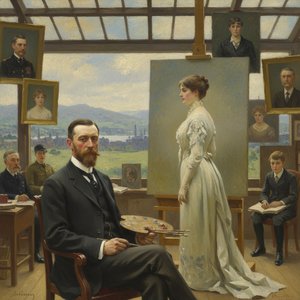
Ett arv av kolonial porträttkonst
John Smibert står som en monumental gestalt i den amerikanska konsthistorien, erkänd som den första akademiskt utbildade konstnären som förde med sig sina förfinade färdigheter till de tretton kolonierna. Född i Edinburgh, är hans resa från en ung lärling i Skottland till en hyllad porträttmålare i den nya världen en berättelse om en djupgående konstnärlig migration. Hans tidiga år formades av hantverkets praktiska verklighet, efter att ha arbetat som lärling hos en husmålare och stuckatör innan han flyttade till London. Det var i Londons livfulla konstnärliga atmosfär som Smibert verkligen började förfina sin vision; genom att arbeta som vagnmålare och kopist, för att slutligen studera under den högt aktade Sir Godfrey Kneller vid Great Queen Street Academy. Denna rigorösa akademiska grund gav honom den tekniska skicklighet som senare skulle komma att definiera hans karriär.
Hans resor genom Europa berikade ytterligare hans estetiska sinnen. Mellan 1719 och 1722 reste Smibert till Italien, där han fördjupade sig i studiet av de gamla mästarna. Genom att kopiera verk i storhertigen av Toscanas samling, sög han åt sig nyanserna i ljus, skugga och klassisk komposition. Denna period av intensiv observation gjorde det möjligt för honom att utveckla en stil kännetecknad av noggrann detaljrikedom och en mästerlig hantering av chiaroscuro, vilket resulterade i porträtt som besatt både fysisk precision och en djup, psykologisk resonans.
Ankomsten till Amerika och konstnärlig mognad
Smiberts livsbana förändrades oåterkalleligt när han lockades av biskop Berkeley att följa med honom till Amerika. Även om den ambitiösa planen att etablera ett college på Bermuda aldrig förverkligades, ledde flytten till att Smibert bosatte sig i Boston, där han skulle lämna ett outplånligt avtryck i det koloniala landskapet. I denna nya miljö blev han en hörnsten i den framväxande amerikanska konstscenen och etablerade en porträtttradition som skulle influera generationer av konstnärer, däribland hans son, Nathaniel Smibert.
Smiberts arbete i Boston präglades av en förmåga att fånga sina subjekts värdighet och sociala ställning. Hans porträtt, såsom de av Rev. Joseph Sewall och Richard Bill, är mer än bara likheter; de är noggrant konstruerade studier av karaktär och status. I dessa verk kan man observera:
- Användningen av rika färger och texturer som förmedlar elegansen i 1700-talets klädedräkt.
- En sofistikerad kontroll över ljus och skugga för att ge motiven en känsla av realism och djup.
- En balanserad komposition som ofta utnyttjar subtila gester och bakgrundselement för att antyda subjektets sociala position och inre kontemplation.
Ett av hans mest inflytelserika verk förblir Dean George Berkeley and His Entourage, även känt som The Bermuda Group. Denna målning fungerar som ett livsviktigt historiskt dokument som fångar ett specifikt ögonblick av kolonial ambition och sammanlänkningen i den atlantiska världen. Genom sin pensel målade Smibert inte bara ansikten; han fångade själva essensen av en era och överbryggade gapet mellan den europeiska akademiska traditionen och den framväxande identiteten i det koloniala Amerika.
Frågor och svar
I vilken stad och vilket land föddes Johann Harper?
Johann Harper föddes i Stockholm, i Sverige.
Kan jag bläddra i Johann Harpers verk efter teknik?
För att hitta alla verk av Johann Harper inom ett visst medium, besök artistens Alla tekniker-sida.
Hur hittar jag verk av Johann Harper inom ett specifikt tema?
För att hitta verk av Johann Harper inom ett specifikt tema, besök artistens sida för Efter nyckelord, där konstverken är grupperade efter nyckelord.