
- Domov

- Reprodukcija oljne slike
- Joaquin Sorolla
- Typical Lagarterans or Lagarteran BrideShare

 Kupi tiskanino Kupi digitalno sliko
 Pošlji
 Deli
Deli
 Details
 Dodaj v priljubljene

 Prenesi
 Podobni izdelki
 X-Ray
X-Ray
 Predvajaj diaporama
Typical Lagarterans or Lagarteran BrideShare


Ročno izdelana oljna reprodukcija
Ročno slikano olje na platnu v vaši izbiri velikosti in okvirja, izdelano po naročilu naših umetnikov.




P118B $10

P118H $10

P118W $10

P438Z $10

P508JH $12

P508YH $12

P805H $10

P805Z $10

P919BZ $10

P919G $10

P919XJ $10

P959ZH $10

P968JZ $12

W106C $8

W218G $10

W218JH $8

W218Y $10

W307PJ $10

W316G $10

W316PJ $8

W316Y $10

W398PJ $8

W4111J $10

W500HY $15

W500JH $15

W692G $12

W849H $8

W940BG $15

W953PJ $8




 Preberi več
Izberite eno od naših vnaprej določenih velikosti, ki ustrezajo prvotnim proporcijam umetničkega dela.

Svoje dimenzije lahko vnesete tako, da se prilagodite določenemu okvirju ali prostoru. Če izbrana velikost ne ustreza razmerjem originalne slike, bomo umetniško delo obrezali ali sliko dopolnili z dodatnimi ročno naslikanimi elementi. Pred začetkom proizvodnje vam bo poslan digitalni osnutek v odobritev.
Upoštevajte, da predogled na zaslonu ne odraža dejanskega obrezovanja ali podaljšanja. Le osnutek bo natančno prikazal končno kompozicijo.
Čeprav so na voljo velikosti po meri, priporočamo izbiro dimenzije s preddefiniranega seznama, da ohranimo originalne razmere.
Po oddaji naročila bo ekipa ArtsDot.com stranki po e-pošti poslala navodila in predogled digitalnega predogleda.
Svetska dostava () za 3/4 nedelje umesto uobičajenih 5 nedelja. (1 julij). Bez kompromisa po pitanju kvaliteta.

Brezplačna ekspresna dostava po vsem svetu

Visokokakovostno laneno platno

Popolno zavarovanje pošiljke

Garancija povračila carine in uvoznih davkov

Garancija popolnega ujemanja barv

60-dnevna politika vračanja (le v primeru napak)

Garancija 100% povračila denarja

Popust pri večjem naročilu
 Možnost stekla je na voljo le za velikosti pod 110 cm

Typical Lagarterans or Lagarteran BrideShare
Tehnika reprodukcije
Velikost reprodukcije
-


Skupna končna cena
-
Opis umetninine
A Glimpse into Spanish Life: Sorolla's Captivating Portrait
Joaquin Sorolla y Bastida, a name synonymous with the radiant light and vibrant energy of Spain, gifted us with an extraordinary series of paintings that capture the essence of his nation’s soul. “Typical Lagarterans or Lagarteran BrideShare,” painted in 1912, is more than just a portrait; it's a meticulously observed study of regional identity, a testament to Sorolla’s mastery of light and color, and a poignant window into the lives of ordinary people.
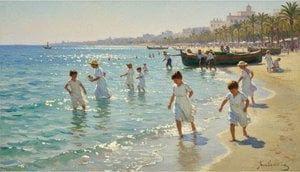
The canvas depicts a group of individuals from the Lagartera region of Valencia, Spain – a community known for its distinctive traditions and attire. Sorolla doesn't present them as subjects to be admired; instead, he places them in a remarkably candid setting, almost photographic in its immediacy. The figures are arranged in loose groupings, some conversing, others observing, creating a dynamic tableau of everyday life. Notice the careful attention to detail: the richly embroidered shawls, the wide-brimmed hats shielding faces from the sun, and the subtle variations in clothing that immediately signal regional differences. Sorolla’s skill lies not just in rendering these details accurately but in imbuing them with a sense of warmth and authenticity.
The Painter's Process: A Preparatory Study
It’s crucial to understand the context of this painting – “Typical Lagarterans” is revealed as a preparatory study for a larger panel, "Castile. The Bread Festival," destined for the Hispanic Society of America in New York. This reveals Sorolla's methodical approach: he wasn't simply aiming for a finished artwork but rather a detailed investigation into his subject matter. The canvas itself is a testament to this process – it’s not overly polished or idealized; instead, it retains traces of the artist’s preliminary sketches and studies, offering a rare glimpse into the evolution of an artistic vision.
The masculine figure to the right, initially sketched in more detail in preparatory drawings, ultimately finds its place as a central element within the final panel. This deliberate layering speaks volumes about Sorolla's considered approach – he wasn’t merely capturing a fleeting moment but constructing a narrative, carefully building his composition with painstaking precision.
Light and Color: Sorolla’s Signature Style
Sorolla was renowned for his ability to capture the ephemeral qualities of light. In “Typical Lagarterans,” this is immediately apparent. The scene is bathed in a warm, golden glow, characteristic of the Spanish summers that inspired so much of his work. He employs broken brushstrokes and vibrant hues – ochres, yellows, and blues – to create an illusion of shimmering light reflecting off surfaces and illuminating faces. The effect isn’t photographic realism; it's something more evocative—a feeling of warmth, vitality, and the joy of shared experience.
Observe how he uses shadow to define form and create depth. The interplay of light and shade adds a remarkable sense of three-dimensionality to the figures, bringing them vividly to life. This masterful manipulation of color and light is what truly distinguishes Sorolla’s work and sets it apart from many of his contemporaries.
Symbolism and Social Commentary
Beyond its aesthetic beauty, “Typical Lagarterans” offers a subtle commentary on Spanish society at the turn of the 20th century. Sorolla wasn't simply documenting regional dress; he was celebrating cultural diversity and highlighting the unique traditions of communities like Lagartera. The painting subtly underscores the importance of preserving local heritage in an era of increasing modernization and globalization.
The figures themselves, dressed in their distinctive attire, represent a tangible link to the past—a reminder of the rich tapestry of Spanish culture. Sorolla’s work serves as both a celebration of regional identity and a poignant reflection on the enduring power of tradition.
Sorodna umetniška dela


Biografija umetnika
Joaquín Sorolla y Bastida - A Life Bathed in Light
Joaquín Sorolla y Bastida, a name synonymous with the radiant light and vibrant energy of Spain, was more than just a painter; he was a chronicler of his nation’s soul. Born in Valencia in 1863, Sorolla's early life was marked by tragedy. Orphaned at the tender age of two following a cholera epidemic that claimed both parents, young Joaquín and his sister were raised by their maternal aunt and uncle. This early experience with loss perhaps instilled within him a profound appreciation for the fleeting beauty of life – a sentiment that would permeate his art. Though hardship shadowed his beginnings, it did not dim the spark of artistic talent that quickly became apparent. He received initial instruction in Valencia, demonstrating an aptitude that led to studies under established artists like Cayetano Capuz and José Benlliure, eventually culminating in a four-year grant to study in Rome. It was there, amidst the classical grandeur of Italy, that Sorolla began to forge his unique artistic path, absorbing influences while simultaneously developing a style distinctly his own.Early Life and Influences
Joaquín Sorolla’s formative years were shaped by profound loss and circumstance. Born on February 27th, 1863, in Valencia, Spain, he descended from a modest family – his father was a tradesman, and his wife Concepción Bastida. Tragically, both parents succumbed to cholera just two years later, leaving Joaquín and his sister under the care of their maternal aunt and uncle. This early exposure to grief undoubtedly instilled within him an awareness of mortality and a deep sensitivity to human emotion—themes that would recur throughout his oeuvre. Recognizing Sorolla’s exceptional talent from a young age, he commenced formal artistic training at Valencia's School of Artisans, where he honed his skills under the tutelage of prominent Valencian painters. Subsequently, he pursued further studies in Madrid with Salustiano Asenjo, immersing himself in the artistic traditions of Spain’s capital. His fascination with Velázquez—particularly the masterful use of light and shadow—became a cornerstone of his artistic vision. This admiration for the Old Master profoundly impacted Sorolla's technique and compositional choices.Rome and Impressionistic Exploration
At eighteen, Sorolla embarked on a transformative journey to Rome, Italy, securing a prestigious scholarship from the Valencian government. During his four-year residency, he absorbed the influence of Italian Renaissance art while simultaneously encountering the burgeoning currents of Impressionism—a movement that would revolutionize European painting. He found inspiration in artists such as Francisco Pradilla Ortiz, the director of the Spanish Academy in Rome, who championed Sorolla’s artistic ambitions and encouraged him to experiment with innovative approaches. Exposure to Parisian exhibitions featuring Jules Bastien-Lepage and Adolph von Menzel further broadened his horizons, introducing him to new stylistic ideas and techniques. Sorolla skillfully blended these influences into a distinctive style characterized by loose brushstrokes, vibrant color palettes, and an unwavering dedication to capturing the ephemeral effects of sunlight—a hallmark of Luminism, as championed by artists like Claude Monet and Frederic Bazille.The Valencian Coast: A Celebration of Light
Sorolla’s artistic focus shifted decisively upon his return to Valencia in 1888, where he married Clotilde García del Castillo, daughter of Antonio García Peris—a supporter who recognized Sorolla's prodigious talent and championed his endeavors. Together they established a family in Madrid, relocating there in 1890, and Sorolla dedicated the subsequent decade to producing monumental canvases depicting scenes from the Valencian coast—a region he adored for its dazzling sunlight and expansive horizon. He became renowned for his depictions of bathing children and adolescents, meticulously studying the interplay between light and color as it illuminated skin and reflected on water surfaces. Paintings like *Children on the Seashore* exemplify Sorolla’s unparalleled ability to convey atmosphere and emotion with breathtaking immediacy—a testament to his unwavering commitment to plein air painting and Luminist principles. His meticulous observation of nature served not merely as subject matter but as a catalyst for artistic innovation, propelling him to the forefront of Spanish Impressionism.Major Achievements and Legacy
Sorolla’s career blossomed throughout the late 1890s and early 20th century, marked by prolific exhibitions in Madrid, Paris, Venice, Munich, Berlin, and Chicago—each showcasing his mastery of technique and capturing the spirit of his time. He garnered considerable acclaim for *The Return from Fishing*, acquired by the Musée du Luxembourg, cementing his reputation as a leading figure on the international stage. Sorolla’s artistic prowess was recognized with numerous honors and commissions, including the Grand Prix and medal of honor at the Universal Exhibition in Paris for *Sad Inheritance*. His monumental mural cycle commissioned by the Hispanic Society of America—*Vision of Spain*, completed posthumously—stands as an enduring symbol of his artistic vision and technical brilliance. Sorolla’s influence extended far beyond his lifetime, inspiring generations of artists who embraced Luminism and sought to emulate his distinctive style. Today, his paintings reside in prestigious museums worldwide—most notably the Museo Sorolla in Valencia—where they continue to captivate audiences with their luminous beauty and profound emotional resonance—a testament to Joaquín Sorolla y Bastida’s enduring legacy as one of Spain's greatest painters.
Joaquin Sorolla
1863 - 1923 , Španija
Hitri podatki
- Artistic Movement Or Style: Luminizem, Impresionizem
- Artists Or Movements Influenced By This Artist: ['Špansko impresionistično umetnost']
- Artists Who Influenced This Artist:
- Francisco Pradilla
- Jules Bastien-Lepage
- Date Of Birth: 27 februarja 1863
- Date Of Death: 10 avgusta 1923
- Full Name: Joaquín Sorolla y Bastida
- Nationality: Špansko
- Notable Artworks:
- Marguerite
- Povratek iz ribolova
- Ženska na plaži
- Place Of Birth: Valencia, Španija
Sorodni članki
Joaquín Sorolla: Capturing Spanish Light & Life – A Legacy of Impressionism
Explore the luminous world of Joaquín Sorolla, Spanish master of Impressionism. Discover his life, techniques & legacy – a guide for art collectors and enthusiasts. Invest in timeless beauty.


The Enduring Gaze: A Historical & Artistic Exploration of Portrait Painting Across Cultures
Explore the rich history of portrait painting with expert insights into Renaissance masterpieces & modern innovations. Discover artists, movements & commission a custom oil painting at ArtsDot.

ArtsDot.com F.A.Q.: Ročno naslikane oljne slike – materiali, tehnike in umetniška dediščina v podrobnostih za zahtevne zbiratelje
Odkrijte izjemno kakovost ročno naslikanih oljnih slik pri ArtsDot.com. Tradicionalne tehnike, vrhunski materiali in ohranjanje umetniške dediščine za zahtevne zbiratelje. Naročite svojo unikatno reprodukcijo ali sliko po meri!

Echoes of Heritage: Continuity & Innovation in Traditional Art Forms
Explore the rich history of cultural heritage & folk art traditions worldwide! Discover inspiring artists, preservation efforts, and museum collections. Find handmade oil paintings & expert insights at ArtsDot.

The Enduring Presence of Figures in Art History: Representation, Emotion & Cultural Significance
Explore the rich history of figure painting with ArtsDot. Discover Renaissance masterpieces, portraiture's evolution & the enduring power of human representation in art. Expert insights for collectors.



