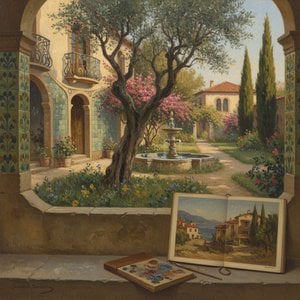
Joaquín Sorolla y Bastida - A Life Bathed in Light
Joaquín Sorolla y Bastida, a name synonymous with the radiant light and vibrant energy of Spain, was more than just a painter; he was a chronicler of his nation’s soul. Born in Valencia in 1863, Sorolla's early life was marked by tragedy. Orphaned at the tender age of two following a cholera epidemic that claimed both parents, young Joaquín and his sister were raised by their maternal aunt and uncle. This early experience with loss perhaps instilled within him a profound appreciation for the fleeting beauty of life – a sentiment that would permeate his art. Though hardship shadowed his beginnings, it did not dim the spark of artistic talent that quickly became apparent. He received initial instruction in Valencia, demonstrating an aptitude that led to studies under established artists like Cayetano Capuz and José Benlliure, eventually culminating in a four-year grant to study in Rome. It was there, amidst the classical grandeur of Italy, that Sorolla began to forge his unique artistic path, absorbing influences while simultaneously developing a style distinctly his own.Early Life and Influences
Joaquín Sorolla’s formative years were shaped by profound loss and circumstance. Born on February 27th, 1863, in Valencia, Spain, he descended from a modest family – his father was a tradesman, and his wife Concepción Bastida. Tragically, both parents succumbed to cholera just two years later, leaving Joaquín and his sister under the care of their maternal aunt and uncle. This early exposure to grief undoubtedly instilled within him an awareness of mortality and a deep sensitivity to human emotion—themes that would recur throughout his oeuvre. Recognizing Sorolla’s exceptional talent from a young age, he commenced formal artistic training at Valencia's School of Artisans, where he honed his skills under the tutelage of prominent Valencian painters. Subsequently, he pursued further studies in Madrid with Salustiano Asenjo, immersing himself in the artistic traditions of Spain’s capital. His fascination with Velázquez—particularly the masterful use of light and shadow—became a cornerstone of his artistic vision. This admiration for the Old Master profoundly impacted Sorolla's technique and compositional choices.Rome and Impressionistic Exploration
At eighteen, Sorolla embarked on a transformative journey to Rome, Italy, securing a prestigious scholarship from the Valencian government. During his four-year residency, he absorbed the influence of Italian Renaissance art while simultaneously encountering the burgeoning currents of Impressionism—a movement that would revolutionize European painting. He found inspiration in artists such as Francisco Pradilla Ortiz, the director of the Spanish Academy in Rome, who championed Sorolla’s artistic ambitions and encouraged him to experiment with innovative approaches. Exposure to Parisian exhibitions featuring Jules Bastien-Lepage and Adolph von Menzel further broadened his horizons, introducing him to new stylistic ideas and techniques. Sorolla skillfully blended these influences into a distinctive style characterized by loose brushstrokes, vibrant color palettes, and an unwavering dedication to capturing the ephemeral effects of sunlight—a hallmark of Luminism, as championed by artists like Claude Monet and Frederic Bazille.The Valencian Coast: A Celebration of Light
Sorolla’s artistic focus shifted decisively upon his return to Valencia in 1888, where he married Clotilde García del Castillo, daughter of Antonio García Peris—a supporter who recognized Sorolla's prodigious talent and championed his endeavors. Together they established a family in Madrid, relocating there in 1890, and Sorolla dedicated the subsequent decade to producing monumental canvases depicting scenes from the Valencian coast—a region he adored for its dazzling sunlight and expansive horizon. He became renowned for his depictions of bathing children and adolescents, meticulously studying the interplay between light and color as it illuminated skin and reflected on water surfaces. Paintings like *Children on the Seashore* exemplify Sorolla’s unparalleled ability to convey atmosphere and emotion with breathtaking immediacy—a testament to his unwavering commitment to plein air painting and Luminist principles. His meticulous observation of nature served not merely as subject matter but as a catalyst for artistic innovation, propelling him to the forefront of Spanish Impressionism.Major Achievements and Legacy
Sorolla’s career blossomed throughout the late 1890s and early 20th century, marked by prolific exhibitions in Madrid, Paris, Venice, Munich, Berlin, and Chicago—each showcasing his mastery of technique and capturing the spirit of his time. He garnered considerable acclaim for *The Return from Fishing*, acquired by the Musée du Luxembourg, cementing his reputation as a leading figure on the international stage. Sorolla’s artistic prowess was recognized with numerous honors and commissions, including the Grand Prix and medal of honor at the Universal Exhibition in Paris for *Sad Inheritance*. His monumental mural cycle commissioned by the Hispanic Society of America—*Vision of Spain*, completed posthumously—stands as an enduring symbol of his artistic vision and technical brilliance. Sorolla’s influence extended far beyond his lifetime, inspiring generations of artists who embraced Luminism and sought to emulate his distinctive style. Today, his paintings reside in prestigious museums worldwide—most notably the Museo Sorolla in Valencia—where they continue to captivate audiences with their luminous beauty and profound emotional resonance—a testament to Joaquín Sorolla y Bastida’s enduring legacy as one of Spain's greatest painters.Vprašanja in odgovori
Kje in leta je se rodil/a Joaquin Sorolla?
Joaquin Sorolla se je rodil/a v Valencija leta 1863.
Kje so dela umetnika Joaquin Sorolla organizirana po barvah?
Stran Spektralni indeks razvršča dela umetnika Joaquin Sorolla po barvah.
V katerem mestu in državi se je rodil/a Joaquin Sorolla?
Joaquin Sorolla se je rodil/a v Valencija v državi Španija.
Ali obstaja kronološki pregled dela umetnika Joaquin Sorolla?
Kronološki pregled dela umetnika Joaquin Sorolla je na njegovi strani Kronika, kjer se dela pojavljajo v vrstnem redu nastanka, razdeljena po poglavjih.
Od kod prihaja Joaquin Sorolla?
Joaquin Sorolla se je rodil/a v državi Španija.
Ali lahko dela umetnika Joaquin Sorolla brskam po barvni paleti?
Delo umetnika Joaquin Sorolla si lahko ogledate po barvni paleti na njegovi strani Po barvnih paletah.
Ali obstaja pregled vseh motivov, ki jih je Joaquin Sorolla naslikal?
Atlas motivov umetnika Joaquin Sorolla je stran, ki razvršča umetnikova dela glede na njihove teme.