
- Acasă

- Reproducere Tablou în Ulei
- William Lionel Wyllie
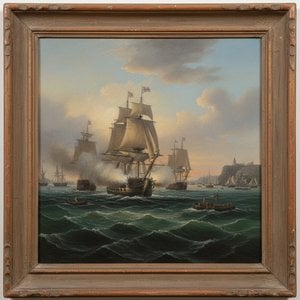
- The 'gloucester Hulk' At Chatham

 Comandă tipăritul Cumpără imaginea
 Trimite
 Distribuie
 Details
 Adaugă la favorite

 Descarcă
 Similare
 X-Ray
X-Ray
 Diaporama
The 'gloucester Hulk' At Chatham

Reproducere manuală în ulei
Pictură în ulei pe pânză, pictată manual, la dimensiunea și ramele dorite de dumneavoastră, realizată la comandă de artiștii noștri.




































 Citește mai mult
Alegeți dintre dimensiunile noastre prestabilite, care respectă proporțiile originale ale operei de artă.

Puteți introduce propriile dimensiuni pentru a se potrivi unui anumit cadru sau spațiu. Dacă dimensiunea selectată nu corespunde proporțiilor imaginii originale, vom decupa opera de artă sau vom extinde pictura cu elemente suplimentare pictate manual. O simulare digitală vă va fi trimisă pentru aprobare înainte de începerea producției.
Vă rugăm să rețineți că previzualizarea de pe ecran nu reflectă decuparea sau extinderea reală. Doar macheta va arăta cu exactitate compoziția finală.
Deși sunt disponibile dimensiuni personalizate, vă recomandăm să selectați o dimensiune din lista predefinită pentru a păstra proporțiile originale.
După plasarea comenzii, echipa ArtsDot.com va trimite clientului instrucțiuni prin e-mail și îi va furniza o previzualizare a machetei
Livrare în întreaga lume () în 3/4 săptămâni, în loc de cele 5 săptămâni standard. (1 Iulie). Fără compromisuri în ceea ce privește calitatea.

Livrare expres gratuită la nivel mondial

Pânză de in de înaltă calitate

Asigurare completă pentru transport

Garanție de rambursare a taxelor vamale

Garanția fidelității culorilor

Politica de retur de 60 de zile (doar pentru defecte)

Garanție 100% de rambursare

Reducere la comenzi multiple
 Opțiunea cu sticlă este disponibilă doar pentru dimensiuni de sub 110 cm

The 'gloucester Hulk' At Chatham
Tehnică de reproducere
Dimensiune reproducere
-


Preț total calculat
-
Opere de artă similare


Biografie artist
A Life Immersed in the Maritime World
William Lionel Wyllie, born in Camden Town, London, on July 5th, 1851, was destined to become Britain’s premier marine artist. His artistic lineage was firmly established from the start; his father, William Morrison Wyllie, was a painter of genre scenes, and the family summers spent in France instilled an early appreciation for light and atmosphere that would profoundly shape the younger Wyllie's aesthetic vision. Encouragement came not only from his father but also from his stepbrother, Lionel Smythe, fostering a burgeoning talent for drawing. Formal training followed at Heatherley School of Fine Art and then the prestigious Royal Academy Schools, where he studied under luminaries like Edwin Henry Landseer, John Everett Millais, and Frederic Leighton. Even in these formative years, Wyllie’s passion for the sea began to emerge, nurtured by shared sailing adventures with his brother Charles William – a pursuit that would become inextricably linked to his artistic identity. This early promise culminated in 1869 when he won the coveted Turner Gold Medal for *Dawn after a Storm*, signaling the arrival of a significant new talent.From Illustrator to Master of Maritime Scenes
Wyllie’s career blossomed in the 1870s, initially through his work as an illustrator for *The Graphic*. This period honed his observational skills and provided a platform for showcasing maritime subjects – warships, fishing boats, bustling harbors – that increasingly captivated him. He wasn't merely documenting vessels; he was capturing the very essence of life at sea, the interplay of light on water, the moods of the sky, and the human stories unfolding within these dynamic environments. His style evolved to be characterized by a sensitive observation of atmosphere, evoking tranquility and peace in his seascapes. The influence of artists like James Abbott McNeill Whistler and J.M.W. Turner became apparent, as Wyllie sought to emulate their ability to capture fleeting atmospheric effects and imbue landscapes with emotional resonance. He steadily gained recognition within the art world, becoming a member of several prestigious societies: the Society of British Artists (1875), the Royal Institute of Painters in Watercolours (1882), the New English Art Club (1887), the Royal Academy (1907) and the Royal Society of Painter-Etchers and Engravers (1903). His etchings and watercolors, particularly those depicting working life on the Thames and Medway, proved immensely popular, resonating with a public fascinated by Britain’s maritime heritage.The Trafalgar Panorama and Lasting Legacy
While Wyllie produced an extensive body of work throughout his career, it is arguably *The Trafalgar Panorama* that cemented his place in art history. This monumental undertaking – a 42-foot depiction of the Battle of Trafalgar – was unveiled in 1930 with great fanfare and remains a popular attraction at the National Museum of the Royal Navy in Portsmouth, drawing approximately 100,000 visitors annually. The panorama is not simply a historical record; it’s an immersive experience, transporting viewers to the heart of one of Britain's most iconic naval battles. The scale of this project demanded immense technical skill and artistic vision, showcasing Wyllie’s ability to synthesize detailed observation with dramatic composition. Beyond this masterpiece, Wyllie demonstrated his deep commitment to maritime history through his active involvement with the Society for Nautical Research and his tireless campaigning for the restoration of HMS Victory. He even painted a mural depicting “Blocking of Zeebrugge Waterway” for the Royal Exchange in London, further showcasing his dedication to commemorating naval events. Upon his death on April 6th, 1931, Wyllie received full naval honors – a testament to his close association with the Royal Navy and his profound contribution to its historical narrative. He was laid to rest at St Mary’s Church within the grounds of Portchester Castle, a fitting final resting place for a man so deeply connected to the sea.A Historical Record in Paint
William Lionel Wyllie’s significance extends far beyond his artistic skill. His work provides invaluable visual documentation of British maritime life and naval history during a period of immense change – the late 19th and early 20th centuries. He captured not only grand battleships and majestic sailing vessels but also the everyday lives of sailors, fishermen, and dockworkers, offering a comprehensive portrait of a nation inextricably linked to the sea. *The Trafalgar Panorama*, in particular, stands as a unique historical record and an extraordinary artistic achievement, allowing viewers to experience the drama and intensity of that pivotal event in a way few other artworks can. Wyllie’s paintings and etchings are held in numerous prestigious institutions – the Tate, the Royal Academy, the Imperial War Museum, and the National Maritime Museum among them – ensuring his legacy endures for generations to come. He helped popularize marine art, fostering a greater appreciation for the sea's beauty, power, and importance within British culture. Wyllie was truly “the most distinguished marine artist of his day,” and his work continues to inspire awe and admiration today.Influences and Style
Wyllie’s artistic development reveals a fascinating interplay of influences. His early exposure to the French Impressionists, particularly Whistler, instilled in him a sensitivity to light and color—a desire to capture fleeting atmospheric effects rather than precise detail. This is evident in his seascapes, where he often employed loose brushstrokes and subtle tonal variations to evoke mood and atmosphere. The influence of Turner is also readily apparent, particularly in Wyllie’s depictions of storms and shipwrecks, which are characterized by dramatic lighting, swirling clouds, and a sense of turbulent energy. However, unlike Turner, who frequently prioritized spectacle over realism, Wyllie maintained a strong commitment to observational accuracy, meticulously rendering the details of ships, rigging, and coastal landscapes. His work is often described as “atmospheric” or “impressionistic,” but it also possesses a remarkable degree of technical skill and compositional control. He was particularly adept at capturing the reflections on water—a skill that contributed significantly to the realism and beauty of his seascapes.Key Works
Among Wyllie’s most celebrated works are:- *Dawn after a Storm* (1869) – The painting that earned him the Turner Gold Medal, showcasing his early mastery of atmospheric effects.
- *The Trafalgar Panorama* (1930) – A monumental achievement demonstrating his ability to synthesize historical research with artistic vision.
- Numerous etchings and watercolors depicting scenes from British maritime life, including harbor views, fishing boats, and naval vessels.
Legacy
William Lionel Wyllie’s legacy extends beyond his individual artworks. He played a crucial role in popularizing marine art during the late Victorian and Edwardian periods, inspiring a generation of artists to explore the sea as a subject matter. His meticulous observation, atmospheric rendering, and commitment to historical accuracy set him apart from his contemporaries, establishing him as one of Britain’s most important marine painters. Today, his work continues to be admired for its beauty, technical skill, and evocative power—a testament to the enduring appeal of the sea and the artist who so brilliantly captured its essence.
William Lionel Wyllie
1851 - 1931 , Regatul Unit al Marii Britanii și Irlandei
Detalii rapide
- Artistic Movement Or Style: Artă marină, Impresionism
- Artists Or Movements Influenced By This Artist: ['Turner']
- Artists Who Influenced This Artist:
- Whistler
- Turner
- Date Of Birth: 5 iulie 1851
- Date Of Death: 6 aprilie 1931
- Full Name: William Lionel Wyllie
- Nationality: Britanic
- Notable Artworks:
- Dimineața după furtună
- Panorama Trafalgar
- Place Of Birth: Camden, Marea Britanie
Articole conexe

Henry Thomas Dawson: Navigating Light, Sea & Sentiment in Victorian Marine Painting
Explore the captivating world of Henry Thomas Dawson (1811-1878), a master of Victorian marine painting. Discover his evocative coastal scenes, landscapes & lasting artistic legacy. Learn about collecting Dawson's work and find reproductions at ArtsDot.

Thomas Butterworth (1768–1842): Navigating the Aesthetics of British Marine Painting
Explore the captivating maritime art of Thomas Butterworth (1768–1842). Discover his stunning depictions of Napoleonic naval battles and life at sea, commissioned works for the East India Company, and enduring legacy. Learn more today!

Navigating the Depths of Representation: A Historical Exploration of Marine Painting
Explore the rich history of marine painting with ArtsDot. Discover Dutch Masters, Romantic seascapes & renowned artists like Wyllie and Harris. Expert guidance for collectors & custom reproductions.

John Frederick Lewis: Orientalism, Detail & Genre Painting in 19th-Century British Art
Explore the captivating Orientalist paintings of John Frederick Lewis! Discover his mastery of detail, genre scenes & influence on 19th-century British art. Learn about his life, techniques & legacy at ArtsDot.

Thomas George Webster: Navigating Genre Boundaries & American Identity in 19th-Century Landscape Painting
Explore the captivating genre scenes of Thomas George Webster, a Victorian painter bridging British traditions with American themes. Discover his style, influences & legacy in 19th-century art history.

