


 Vezi în context
 Trimite
 Distribuie
 Detalii
 Ghidul

 Descarcă
 Produse similare
 Radiografie
 Diaporama
 Statistici
Compus muzical


 Citește mai mult
Reproducere pictată manual în ulei
Pictură în ulei pe pânză, realizată manual de artiștii noștri la dimensiunea și ramele dorite de dumneavoastră, pe comandă. ( Comută pe versiunea Print Treci la imagine digitală)




P118B lei10

P118H lei10

P118W lei10

P438Z lei10

P508JH lei12

P508YH lei12

P805H lei10

P805Z lei10

P919BZ lei10

P919G lei10

P919XJ lei10

P959ZH lei10

P968JZ lei12

W106C lei8

W218G lei10

W218JH lei8

W218Y lei10

W307PJ lei10

W316G lei10

W316PJ lei8

W316Y lei10

W398PJ lei8

W4111J lei10

W500HY lei15

W500JH lei15

W692G lei12

W849H lei8

W940BG lei15

W953PJ lei8




Alegeți dintre dimensiunile noastre prestabilite, care respectă proporțiile originale ale operei de artă.

Introduceți lățimea și înălțimea de care aveți nevoie, pentru a se potrivi ramei sau peretelui dumneavoastră. Această lucrare este pictată manual, așa că pentru o dimensiune cu o formă diferită, artistul poate picta puțin mai mult în jurul imaginii sau poate tăia puțin din margini — dumneavoastră decideți. Vă vom trimite o simulare digitală pentru aprobare înainte de a începe pictarea. Imaginea afișată pe această pagină nu reprezintă rezultatul real — doar simularea este reprezentativă.
După plasarea comenzii, echipa ArtsDot.com va contacta clientul prin e-mail pentru instrucțiuni și îi va furniza o previzualizare a machetei
Livrare în întreaga lume () în 3-4 săptămâni, în loc de cele 5 săptămâni standard. (21 Octombrie). Fără compromisuri în ceea ce privește calitatea.

Livrare expres gratuită la nivel mondial

Pânză de in premium

Asigurare completă pentru transport

Garanție de rambursare a taxelor vamale

Garanția fidelității culorilor

Politica de retur în 100 de zile (doar pentru defecte)

Garanție de rambursare 100%

Reducere pentru comenzi multiple
 Opțiunea cu sticlă este disponibilă doar pentru dimensiuni de sub 110 cm

Compus muzical
Tip de reproducere
Dimensiune reproducere
-


Preț total
lei 1209
A Window into Dutch Baroque Society
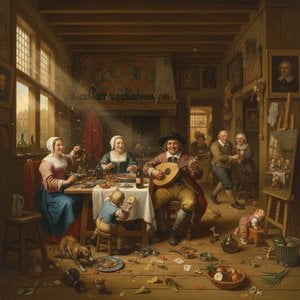
Jan van Bijlert’s “Music Making Company,” completed in 1629, transcends mere depiction; it's a meticulously crafted snapshot of aristocratic life during the Dutch Golden Age. Housed within the Academy of Fine Arts Vienna, this oil on wood painting offers more than just visual pleasure—it invites contemplation about social dynamics and artistic innovation.
The artwork immediately captivates with its warm palette dominated by earthy tones – ochre, umber, and Sienna – skillfully blended to create a serene atmosphere reminiscent of the nocturnes championed by Rembrandt and other masters. Light emanates from a window on the right side, illuminating the central figure—a woman elegantly posed at a table, absorbed in playing a lute.
The Utrecht Caravaggist Style: Drama Within Restraint
Van Bijlert’s approach firmly establishes him as a prominent exponent of Utrecht Caravaggism. This distinctive style inherited the dramatic chiaroscuro technique from Caravaggio—the masterful use of light and shadow—but tempered it with a distinctly Dutch sensibility, prioritizing clarity and compositional balance. Unlike the turbulent expressions often found in Italian Baroque paintings, “Music Making Company” exudes tranquility, reflecting the humanist ideals prevalent during this period.
Detailed Observation: Composition and Symbolism
The painting’s composition is remarkably balanced; figures are positioned strategically across the canvas to guide the viewer's gaze. The woman at the lute occupies the center stage, symbolizing feminine grace and artistic cultivation—a common motif in Baroque art reflecting the importance of refined sensibilities. Surrounding her are several gentlemen engaged in conversation, adding depth and context to the scene. Notice the violin and flute instruments – tangible representations of musical performance and social conviviality.
A Legacy of Artistic Excellence
“Music Making Company” stands as a testament to Jan van Bijlert’s artistic prowess and his contribution to Dutch Baroque art history. Its meticulous detail, harmonious color scheme, and masterful use of light exemplify the highest standards of artistic achievement. Consider this piece alongside similar works by Rembrandt and Jacob Jordaens – artists who similarly captured the spirit of their time—to appreciate the breadth and depth of the Golden Age’s artistic legacy.
- Artist: Jan Hermansz van Bijlert
- Year: 1629
- Medium: Oil on Wood
- Location: Akademie der bildenden Künste, Vienna
Întrebări și răspunsuri
Din ce este realizată „Compus muzical”?
Tehnica utilizată pentru "Compus muzical" de Jan van Bijlert este Acrilic pe pânză întinsă. Reproduucerile urmăresc să reproducă aspectul acestei tehnici.
Ce culori domină în "Compus muzical" de Jan van Bijlert?
"Compus muzical" de Jan van Bijlert folosește o paletă de culori Tonalități pământii, având culoarea Espresso (#3e241e) ca nuanță dominantă.
Pot vedea "Compus muzical" de Jan van Bijlert pe propriul meu perete înainte de achiziție?
„Compus muzical” are o previzualizare în realitate augmentată: pagina Previzualizare AR a operei artistice o prezintă în propriul tău spațiu, pe un dispozitiv compatibil.
Opere similare


Biografie artist
Jan van Bijlert: A Utrecht Caravaggist’s Dramatic Vision
Jan Hermansz van Bijlert, born in Utrecht around 1598 and passing away in the same city in 1671, stands as a pivotal figure within the vibrant artistic landscape of the Dutch Golden Age. Initially influenced by the intense realism and dramatic lighting of Caravaggio, van Bijlert evolved into one of the most prominent practitioners of what became known as Utrecht Caravaggism – a distinctly regional style that combined Italian Baroque principles with a uniquely Dutch sensibility. His prolific output, numbering approximately 200 paintings, offers a compelling glimpse into a period of artistic experimentation and the burgeoning influence of Italian masters on Northern European art. Van Bijlert’s early life remains somewhat shrouded in mystery, though it's believed he received some initial training from his father, Herman Beernts van Bijlert, a skilled stained-glass worker. This foundational experience likely instilled within him an appreciation for detail and craftsmanship – qualities that would later manifest powerfully in his paintings. He subsequently studied under Abraham Bloemaert, a respected Utrecht painter known for his meticulous depictions of mythological scenes and portraits. Crucially, van Bijlert’s artistic journey extended beyond the borders of the Netherlands, with significant periods spent in France and Italy. These experiences proved transformative, exposing him to the revolutionary techniques and dramatic intensity championed by Caravaggio, whose influence would irrevocably shape his style.The Bentvueghel Circle and Early Roman Years
Van Bijlert’s arrival in Rome in 1621 marked a significant turning point. He quickly became integrated into the *Bentvueghels*, a notoriously convivial circle of artists – Dutch, Flemish, and Italian – who established a shared identity through adopted nicknames. Van Bijlert chose “Aeneas,” a reference to the Roman hero known for his strength and resilience. The Bentvueghels were not merely artistic collaborators; they were also avid socialites, exchanging witty verses, satirical prints, and, of course, paintings. This environment fostered an atmosphere of intense exchange and experimentation, allowing artists to push boundaries and develop their individual styles. During this period in Rome, van Bijlert honed his skills, mastering Caravaggio’s signature techniques: the stark contrast between light and shadow (chiaroscuro), the dramatic cropping of compositions to create a sense of immediacy, and an unwavering commitment to realistic representation. His early works from this era are characterized by these elements, depicting scenes of intense emotion and often featuring figures caught in moments of action or contemplation.A Shift Towards Classicism and Genre Scenes
Around 1630, van Bijlert’s artistic trajectory shifted noticeably. While retaining the core principles of Caravaggism – particularly the dramatic use of light – he began to incorporate elements of classicizing style, possibly influenced by fellow Utrecht artist Cornelis van Poelenburch. This evolution manifested in a lightening of his palette and a move towards more elevated subject matter, including religious scenes and allegorical compositions. Interestingly, this period also saw the emergence of van Bijlert’s fascination with genre scenes. He produced a series of paintings depicting intimate moments from everyday life – brothels, musical gatherings, and tavern scenes – often populated by small figures rendered with remarkable detail and psychological insight. These works, reminiscent of those created by Jacob Duck, offered a glimpse into the social fabric of Utrecht society and demonstrated van Bijlert’s ability to capture human emotion and interaction with subtle grace.Guild Life, Patronage, and Legacy
Van Bijlert's life was deeply intertwined with the civic and religious institutions of Utrecht. He joined the schutterij (a citizen militia) in 1625 and became a member of the Utrecht Guild of St. Luke in 1630, serving as deacon from 1632 to 1637 and later appointed regent of the Sint-Jobsgasthuis in 1634. His involvement extended beyond artistic pursuits; he played a role in establishing the “Schilders-College” (painter’s school) in 1639, serving as its regent and mentoring a new generation of artists, including Bartram de Fouchier and Ludolf Leendertsz de Jongh. This dedication to both art and community underscores his position as a respected figure within Utrecht's cultural elite. Jan van Bijlert’s legacy is firmly rooted in the Utrecht Caravaggisti movement. His paintings, characterized by their dramatic lighting, realistic depictions of human figures, and exploration of emotional intensity, continue to captivate viewers today. His work stands as a testament to the dynamic exchange of artistic ideas that flourished during the Dutch Golden Age – a period when Italian Baroque principles were embraced, adapted, and ultimately transformed into a uniquely Northern European style. His approximately 200 paintings provide a rich and detailed record of this fascinating artistic evolution.
Jan van Bijlert
1598 - 1671 , Netherlands
Informații rapide
- Full Name: Jan Hermansz van Bijlert
- Nationality: Dutch
- Date Of Birth: 1598
- Date Of Death: 1671
- Place Of Birth: Utrecht, Netherlands
- Notable Artworks:
- Virgin and Child
- Portrait of a Woman
- Artistic Movement Or Style: Utrecht Caravaggisti
- Artists Who Influenced This Artist: ['Caravaggio']
- Artists Or Movements Influenced By This Artist: ['Utrecht Caravaggisti']
Articole conexe

Rembrandt van Rijn: Cele Mai Frumoase 25 de Capodopere – Artă, Istorie și Decorațiuni Interioare
Descoperă cele mai frumoase 25 de picturi ale lui Rembrandt van Rijn! Explorează capodopere baroce, portrete emoționante și peisaje iconice. Reproduceri de artă de calitate muzeală pentru un design interior rafinat. Descoperă toate operele pe ArtsDot.com!
Jan Steen: A Master of Dutch Genre Painting & the Golden Age
Explore the life & art of Jan Steen, a leading Dutch Golden Age painter renowned for his humorous genre scenes & insightful social commentary. Discover his techniques, legacy, and collecting tips.

Golden Age Reflections: Dutch Baroque Painting & Cultural Innovation
Explore the Dutch Golden Age of painting! Discover key artists like Vermeer & ter Borch, their innovative techniques, and the rich cultural context behind these Baroque masterpieces. Learn about collecting & appreciating this iconic art period.

Epoca de Aur Olandeză: 10 Capodopere Care Au Definit Arta și Decorațiunea Interioară
Descoperiți Epoca de Aur Olandeză prin 10 capodopere Rembrandt, Vermeer și alți pictori olandezi. Aflați poveștile din spatele acestor tablouri baroce iconice și inspirați-vă pentru decorațiuni interioare unice. Explorează colecția completă pe ArtsDot.com!

Top 10 Capodopere Baroc Olandez: Artă, Istorie și Decorațiuni Interioare de Lux
Descoperă top 10 capodopere Baroc Olandez! Rembrandt, Vermeer și alți maeștri. Explorează istoria artei, tehnicile unice și atmosfera luxoasă a picturilor baroce. Reproduceri de artă de calitate muzeală pe ArtsDot.com.
