
- Acasă

- Reproducere Tablou în Ulei
- charles amédée philippe van loo
- Zéphyr et Flore, ou Le Printemps

 Comandă tipăritul Cumpără imaginea
 Trimite
 Distribuie
 Details
 Adaugă la favorite

 Descarcă
 Similare
 X-Ray
X-Ray
 Diaporama
Zéphyr et Flore, ou Le Printemps

Reproducere manuală în ulei
Pictură în ulei pe pânză, pictată manual, la dimensiunea și ramele dorite de dumneavoastră, realizată la comandă de artiștii noștri.




P118B $10

P118H $10

P118W $10

P438Z $10

P508JH $12

P508YH $12

P805H $10

P805Z $10

P919BZ $10

P919G $10

P919XJ $10

P959ZH $10

P968JZ $12

W106C $8

W218G $10

W218JH $8

W218Y $10

W307PJ $10

W316G $10

W316PJ $8

W316Y $10

W398PJ $8

W4111J $10

W500HY $15

W500JH $15

W692G $12

W849H $8

W940BG $15

W953PJ $8




 Citește mai mult
Alegeți dintre dimensiunile noastre prestabilite, care respectă proporțiile originale ale operei de artă.

Puteți introduce propriile dimensiuni pentru a se potrivi unui anumit cadru sau spațiu. Dacă dimensiunea selectată nu corespunde proporțiilor imaginii originale, vom decupa opera de artă sau vom extinde pictura cu elemente suplimentare pictate manual. O simulare digitală vă va fi trimisă pentru aprobare înainte de începerea producției.
Vă rugăm să rețineți că previzualizarea de pe ecran nu reflectă decuparea sau extinderea reală. Doar macheta va arăta cu exactitate compoziția finală.
Deși sunt disponibile dimensiuni personalizate, vă recomandăm să selectați o dimensiune din lista predefinită pentru a păstra proporțiile originale.
După plasarea comenzii, echipa ArtsDot.com va trimite clientului instrucțiuni prin e-mail și îi va furniza o previzualizare a machetei
Livrare în întreaga lume () în 3/4 săptămâni, în loc de cele 5 săptămâni standard. (1 Iulie). Fără compromisuri în ceea ce privește calitatea.

Livrare expres gratuită la nivel mondial

Pânză de in de înaltă calitate

Asigurare completă pentru transport

Garanție de rambursare a taxelor vamale

Garanția fidelității culorilor

Politica de retur de 60 de zile (doar pentru defecte)

Garanție 100% de rambursare

Reducere la comenzi multiple
 Opțiunea cu sticlă este disponibilă doar pentru dimensiuni de sub 110 cm

Zéphyr et Flore, ou Le Printemps
Tehnică de reproducere
Dimensiune reproducere
-


Preț total calculat
-
Opere de artă similare




Biografie artist
Charles Amédée Philippe Vanloo: A Master of Rococo Grace and Dramatic Narrative
The world of 18th-century French art is often associated with opulent grandeur, intricate detail, and a profound sense of theatricality. At the heart of this vibrant scene stood Charles Amédée Philippe Vanloo (1719 – 1795), a painter whose career spanned decades and encompassed a remarkable range of subjects—from allegorical scenes brimming with mythological figures to strikingly realistic portraits that captured the essence of his aristocratic patrons. More than just a skilled craftsman, Vanloo was a master storyteller, weaving narratives of power, virtue, and human drama into every canvas he touched.
Born in Aix-en-Provence, Vanloo’s artistic journey began under the tutelage of his father, Jean-Baptiste van Loo—himself a respected painter—in Turin and Rome. This early immersion in the traditions of the Baroque and Roman art academies proved invaluable, providing him with a solid foundation in technique and composition. A pivotal moment in his development arrived in 1738 when he secured the Prix de Rome, a prestigious award that opened doors to the artistic circles of Rome and allowed him to hone his skills amidst some of Europe’s leading artists. His time in Rome wasn't merely academic; it was a period of intense observation and experimentation, shaping his distinctive style – characterized by its elegant lines, dynamic poses, and masterful use of light and shadow.
Vanloo’s early career saw him working primarily in Aix-en-Provence, where he gained recognition for his allegorical paintings—subjects that were immensely popular during the Rococo period. These works often depicted scenes from classical mythology or biblical stories, rendered with a captivating blend of elegance and drama. His ability to infuse these narratives with human emotion was particularly noteworthy; figures weren’t simply presented as idealized archetypes but rather as individuals grappling with complex feelings and situations. He quickly gained favor within the French court, eventually being invited to join the Académie Royale de Peinture et de Sculpture in 1747 – a testament to his rising reputation.
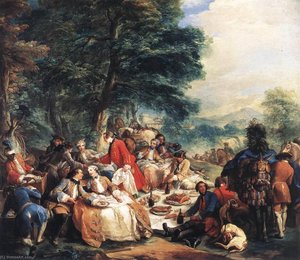
A significant turning point in Vanloo’s career occurred when he accepted an invitation from Frederick the Great of Prussia in 1748. He spent several years at the Prussian court, where he produced numerous works for the royal collection, including a monumental hunting scene—the “Halt de Chasse”—now housed in the Louvre Museum. This commission showcased his ability to capture movement and atmosphere with remarkable precision, solidifying his reputation as one of the most sought-after painters in Europe. His time in Berlin also allowed him to refine his technique and experiment with new approaches to composition and color.
Upon returning to Paris in 1763, Vanloo continued to serve as a court painter, executing portraits of prominent figures—including the Marquis de Sade (a portrait that remains remarkably candid for its time) and members of the royal family. His portraits were distinguished by their psychological depth and ability to reveal the inner lives of his subjects. He also undertook numerous commissions for churches and private collectors, demonstrating a versatility that spanned various genres. Notably, he was commissioned to restore frescoes in the Palace of Fontainebleau, showcasing his skills in both painting and decorative arts.
Vanloo’s legacy extends beyond his individual works; he played a crucial role in shaping the artistic landscape of 18th-century France. He was a student of Jean-Baptiste van Loo, who himself had been mentored by Louis-Michel van Loo—creating a lineage of talented painters within the family. His influence can be seen in the work of his successors, particularly Charles-André van Loo, and he contributed significantly to the development of Rococo painting in France. His ability to seamlessly blend classical influences with contemporary sensibilities ensured that his art remained relevant and engaging for generations to come.
Key Works and Notable Achievements
- The Camera Obscura (1764): This captivating painting, now housed in the Louvre, exemplifies Vanloo’s mastery of light and shadow. It depicts a young man contemplating a camera obscura—a device used to project images onto a surface—creating a sense of intellectual curiosity and wonder.
- Soap Bubbles (1764): Another iconic work from the Louvre, this painting captures a fleeting moment of childhood joy as children chase soap bubbles. The delicate rendering of the bubbles’ iridescent surfaces is a testament to Vanloo's technical skill and his ability to capture ephemeral beauty.
- Portrait of the Marquis de Sade (c. 1778): This remarkably unflinching portrait offers a rare glimpse into the life of this controversial figure. Vanloo’s depiction is far from flattering, revealing a man with piercing eyes and a somewhat unsettling gaze—a stark contrast to the idealized portraits that were common at the time.
- Portrait of Louis XV (various dates): Vanloo painted several portraits of Louis XV, capturing the king’s regal bearing and commanding presence. These works are considered masterpieces of court portraiture, showcasing his skill in conveying power and authority.
Influences and Artistic Style
Vanloo's artistic style was deeply rooted in the traditions of the Baroque and Roman art academies, but he also drew inspiration from the work of contemporary artists such as Nicolas Lancret and Jean-Honoré Fragonard. He skillfully blended these influences to create a distinctive Rococo style characterized by its elegance, grace, and theatricality. His compositions are often dynamic and asymmetrical, creating a sense of movement and energy. He was particularly adept at using light and shadow to enhance the drama of his scenes and to draw attention to key figures.
Historical Significance
Charles Amédée Philippe Vanloo’s work represents a pivotal moment in the history of French art. He embodies the spirit of the Rococo period—a time of artistic experimentation, social change, and political upheaval. His paintings reflect the values and sensibilities of the aristocracy, while also offering glimpses into the complexities of human nature. His legacy continues to inspire artists today, demonstrating the enduring power of beauty, drama, and narrative in art.

charles amédée philippe van loo
1719 - 1795
Detalii rapide
- Artistic Movement Or Style: Rococo, Portraiture
- Artists Or Movements Influenced By This Artist:
- Louis-Michel van Loo
- Charles-André van Loo
- Artists Who Influenced This Artist:
- Jean-Baptiste van Loo
- Michel Lebrun
- Date Of Birth: August 25, 1719
- Date Of Death: November 15, 1795
- Full Name: Charles-Amédée-Philippe van Loo
- Nationality: French
- Notable Artworks:
- Camera Obscura
- Soap Bubbles
- Halt de Chasse
- Place Of Birth: Aix-en-Provence, France
Articole conexe

The Art of Emphasis: Scaling Artwork for Impactful Statement Walls
Elevate your interiors with impactful statement walls! Expert guide on scaling artwork for perfect proportions & design harmony. Custom solutions & free consultations at ArtsDot.


Reflections of Power: Aristocratic Life in Western Art & the Rococo Era
Explore the captivating world of aristocratic life through Western art history. Discover Rococo masterpieces & portraits of European nobility. Expert insights for collectors and enthusiasts.

Hugo van der Goes: Devotion, Innovation & the Psychological Depth of Early Netherlandish Painting
Explore the revolutionary art of Hugo van der Goes – a master of Early Netherlandish painting renowned for his dramatic realism, psychological depth & profound influence on Renaissance artists. Discover his iconic works and lasting legacy.

Arta Narativelor Stratificate: Armonia Spațială și Coerența Vizuală în Aranjamentele Multiple de Piese de Artă
Descoperiți secretele armoniei spațiale și coerenței vizuale în aranjamentele de artă! Ghid expert pentru design interior rafinat, inspirație și consultanță personalizată. Creați un spațiu unic cu ArtsDot.

Echoes of Olympus: Mythological Narratives in Western Art Through the Ages
Explore the captivating history of mythological narratives in Western art! From ancient Greece to modern masterpieces, discover iconic artworks & symbolism. Expert analysis and high-quality reproductions at ArtsDot.

