
 Impressionism
 1870
1870 12.0 x 20.0 cm

The picture follows your choices: , .
Descrição do Item
Discover 'Breakers' by Colin Hunter (1870), an evocative Impressionist seascape featuring turbulent waves & rocky shores. Thick impasto and dynamic brushwork capture nature’s power. A stunning piece for art collectors.
Biografia do Artista
Colin Hunter (1841-1904) was a Scottish Victorian artist renowned for his evocative seascapes, depictions of Scottish fishing life, and landscapes including Niagara Falls. Explore his contributions to 19th-century art.
 Ler mais
Reprodução em Óleo Feita à Mão
Óleo sobre tela pintado à mão no tamanho e moldura de sua escolha, feito sob encomenda pelos nossos artistas. ( Alternar para Impressão Alternar para Imagem Digital)
More about this painting
 Visualizar na parede
 Compartilhar
 Compartilhar
 Detalhes
 Guia
Guia

 Baixar imagem
 Semelhantes
 Raio X
 Ver diaporama
 Q&A
Q&A Estatísticas
Order your painting in four simple steps
Take your time. You can change any answer; the price in your order card follows each choice.
1 Step one of four
Which size would you like?
These sizes keep the proportions of the original painting. The drawing shows your choice on a wall, above a two-metre sofa.
Or give your own measurements
Escolha entre os nossos tamanhos pré-definidos que respeitam as proporções originais da obra de arte.

Insira a largura e a altura desejadas para se ajustarem à sua moldura ou parede. Como esta obra é pintada à mão, para um tamanho com proporções diferentes, o artista poderá pintar um pouco mais ao redor da imagem ou reduzir ligeiramente a composição — você escolhe. Enviamos uma maquete digital para sua aprovação antes de iniciar a pintura. A imagem exibida nesta página não representa o resultado real — apenas a maquete mostra o resultado final.
2 Step two of four
How should it be prepared: rolled, stretched or framed?
The prices below are for the size you chose in step one.
Choose the edges of the stretched canvas
Choose your frame

White €1

Blurside €1

Extended €1

P118B €10

P118H €10

P118W €10

P438Z €10

P508JH €12

P508YH €12

P805H €10

P805Z €10

P919BZ €10

P919G €10

P919XJ €10

P959ZH €10

P968JZ €12

W106C €8

W218G €10

W218JH €8

W218Y €10

W307PJ €10

W316G €10

W316PJ €8

W316Y €10

W398PJ €8

W4111J €10

W500HY €15

W500JH €15

W692G €12

W849H €8

W940BG €15

W953PJ €8

H24-GOLD €30

H24-SILVER €30

H36-GOLD €45

H36-SILVER €45
Com moldura
Moulding: . Overall size with the frame: .
3 Step three of four
Would you like anything changed in the painting?
Most people answer no. Because each painting is made by hand, our artist can also adapt it for you.
After order, ArtsDot.com team will email client for instructions and provide a mockup preview
4 Step four of four
A few finishing options
All of them are optional. The answers already selected cost nothing extra.
Who paints it?
Entrega mundial () em 3 a 4 semanas, em vez das 5 semanas padrão. (30 Outubro). Sem comprometer a qualidade.
A nameplate, as in a museum?
Detalhes da Placa de Bronze Gravada
This elegant plaque features the artist's name and the title of the artwork, finely engraved for a timeless presentation.
It is made from bronze with a refined, elegant finish. The text is precisely laser-engraved for a sharp and permanent result. Measuring 9x2 cm, the plaque is compact yet easy to read. It's built to be durable and scratch-resistant, offering a professional, museum-quality look. Mounting is simple thanks to the included adhesive backing.
Detalhes da Placa de Acrílico Transparente
The plaque includes essential engraved details such as the artist's name, the title of the artwork, the date it was created, the type of media used-like oil on canvas or watercolor-a brief description of the piece, and a QR code that links to the complete artwork information.
It is crafted from clear acrylic, offering a sleek, modern appearance. The text is UV-engraved in black to ensure strong visual contrast. With a size of 10x15 cm, it ensures optimal readability. It comes equipped with two metal hooks for secure wall mounting. The plaque is designed to be weather-resistant, making it suitable for various environments, and it includes interactive features that work seamlessly with smartphone scanning.
Detalhes da Placa de Acrílico Preto
This elegant plaque includes engraved information such as the artist's name, the title of the artwork, the date it was created, the type of media used (like oil on canvas or watercolor), a short description of the artwork, and a QR code for quick access to more information.
The plaque itself is made from refined black acrylic with a premium finish. The text is laser-engraved in white for high contrast and readability. Its size is 10x15 cm, designed to be easy to read. It comes with two metal hooks for professional mounting. The design is sleek and fits any interior style. It is also weather-resistant and durable, with built-in digital integration for mobile compatibility.
A protective varnish?
When do you need it?
✓ Check and order
Your painting, as you ordered it

Breakers
Técnica de Reprodução
Tamanho da Reprodução
-

Artista Sênior de Elite
Mais detalhes, refinamento e tempo de produção adicional
-

Moldura para Reprodução
-
-
Para obras de arte ou reproduções com mais de 105 cm (aproximadamente 41 polegadas) em qualquer um dos lados, a moldura será enviada como um kit desmontado. Este método garante uma entrega segura e evita danos durante o transporte.
Montagem profissional necessária — este não é um produto DIY (faça você mesmo).
O kit deve ser montado e a tela esticada por um profissional de molduraria experiente, utilizando cola de madeira (não inclusa), um alicate de esticar tela e grampos para manter as travessas alinhadas enquanto a cola seca. A montagem incorreta ou a tensão desigual da tela podem danificar permanentemente a obra de arte e não estão cobertas pela nossa garantia.
 Para obras de arte ou reproduções com mais de 105 cm (aproximadamente 41 polegadas) em qualquer um dos lados, a moldura será enviada como um kit desmontado. Este método garante uma entrega segura e evita danos durante o transporte.
Todas as barras de madeira maciça estão incluídas, precisamente cortadas ao tamanho certo.
Montado com os parafusos fornecidos, além de cola para madeira para as junções dos cantos, que não está inclusa e deve ser providenciada pelo seu moldurista.
São necessárias ferramentas profissionais não incluídas: um alicate de estiramento de tela (esticador) e grampos para manter as ripas alinhadas enquanto a cola seca.
Importante:
As junções dos cantos requerem cola para madeira, as ripas devem ser mantidas com grampos até que a cola esteja completamente seca, e o estiramento da tela na moldura montada requer um alicate de esticar tela. Nenhum destes itens está incluído no kit. Por favor, certifique-se de contar com um profissional de molduraria experiente antes de encomendar este tamanho.

Etiqueta de identificação
-
-

Verniz de Proteção
Verniz brilhante (realça as cores e protege contra a luz e a umidade)
-

Personalizar minha obra
Exemplos de alterações possíveis: Substituir o rosto por uma foto do cliente; Adicionar um animal de estimação (ex.: substituir gato por cachorro); Incluir uma mensagem oculta no fundo; Alterar a paisagem ou os elementos do fundo.
-

Urgente
Entrega mundial () em 3 a 4 semanas, em vez das 5 semanas padrão. (30 Outubro). Sem comprometer a qualidade.
-
Envio Expresso
Entrega mundial para em 5 semanas. (6 Novembro).
Com envio incluído
Preço Total
€ 232
A opção de vidro está disponível apenas para tamanhos inferiores a 110 cm
Included with every order
- Envio expresso gratuito para todo o mundo
- Tela de Linho de Alta Qualidade
- Seguro de transporte completo
- Garantia de Reembolso de Impostos Alfandegários
- Garantia de Fidelidade Cromática
- Política de Devolução em 100 Dias (Apenas para Defeitos)
- Garantia de reembolso de 100%
- Oferta de desconto por quantidade


Obras Relacionadas


Colin Hunter
1841 - 1904
Biografia do Artista
The Visionary of the Scottish Shore
Born in Glasgow in 1841, Colin Hunter emerged as one of the most evocative voices of the Victorian era, a painter whose soul seemed inextricably linked to the rhythmic pulse of the sea. His early years were shaped by the coastal atmosphere of Helensburgh, where the Firth of Clyde provided a natural classroom for a young boy captivated by the interplay of light and water. Before dedicating himself to the brush, Hunter worked as a clerk in a shipping office, a role that perhaps deepened his intimate understanding of maritime life and the vital connection between humanity and the ocean. This period of observation would later manifest in his canvases as a profound, lived-in realism, far beyond mere academic imitation.
Hunter’s artistic journey was marked by a transition from the structured world of commerce to the boundless freedom of the studio. After leaving his clerical post at twenty, he sought formal training, eventually finding himself in the Parisian studio of Leon Bonnat. While the French influence introduced him to new perspectives on form and light, Hunter remained fundamentally anchored to his Scottish roots. His style evolved into a masterful blend of Luminism and atmospheric realism, where the primary subject was not just the physical landscape, but the very air that moved across it. He possessed a rare ability to capture the ephemeral—the mist clinging to a rugged cliffside, the spray of a breaking wave, or the soft, melancholic glow of dawn over a quiet bay.
Mastery of Light and Maritime Life
The true heart of Hunter’s oeuvre lies in his celebrated seascapes and his tender depictions of coastal communities. He did not merely paint the ocean; he painted the struggle and the serenity of those who lived by its grace. His works often feature the hardworking fisher-folk of the Scottish coast, rendered with a dignity that elevates their daily labors to the level of epic drama. Through subtle gradations of tone and delicate blending, he achieved a sense of movement that makes the water feel alive, capturing both the terrifying dynamism of a storm and the tranquil stillness of a summer morning.
Beyond the shores of Scotland, Hunter’s curiosity led him to explore diverse landscapes, including the breathtaking majesty of Niagara Falls. This versatility demonstrated his ability to adapt his atmospheric technique to different scales of grandeur. His technical prowess was recognized on the global stage, as he exhibited his works in major international arenas such as Berlin, Vienna, and Philadelphia. These exhibitions solidified his reputation as an artist capable of communicating universal emotions through specific, localized scenes.
Legacy and Artistic Circle
Hunter’s significance extends beyond his individual canvases to his role within the vibrant artistic community of late 19th-century London. Residing in the prestigious Melbury Road enclave in Kensington, he lived among a circle of esteemed contemporaries, including:
- Lord Leighton, whose academic excellence complemented Hunter's atmospheric approach.
- George Frederic Watts, a fellow master of symbolic and emotive painting.
- Luke Fildes, with whom he shared a commitment to narrative and social realism.
His ascent within the prestigious Royal Academy, becoming an Associate Member in 1884, stands as a testament to his enduring influence and technical mastery. When Colin Hunter passed away in 1904, he left behind a legacy of paintings that serve as windows into a vanished era of maritime tradition. His work remains a profound meditation on the relationship between man and nature, reminding us that even in the most rugged landscapes, there exists a delicate, luminous beauty waiting to be discovered by those who know how to look.
Artigos Relacionados

The Enduring Legacy of Oil on Canvas: Technique, History & Aesthetic Impact
Explore the rich history & techniques of oil painting – from Renaissance masters to Impressionism. Discover pigments, layering methods, and why this timeless medium endures. Expert insights for artists & art enthusiasts.

Oil on Canvas: A Historical & Technical Exploration of a Timeless Artistic Medium
Explore the rich history & enduring techniques of oil painting on canvas. Discover the science behind its longevity, conservation practices, and contemporary relevance. Expert insights for art enthusiasts.
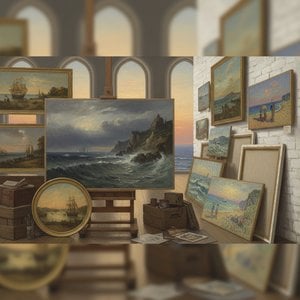
Evoking the Horizon: A Historical & Artistic Exploration of Coastal Scenes in Painting
Explore the rich history of coastal scenes in painting! Discover Impressionist masterpieces, American realism & contemporary visions. Learn about renowned artists and find your perfect seascape at ArtsDot.