


 Se i rommet
 Del som digitalt kort
 Del
Del
 Detaljer
 Studentguide

 Last ned
 Liknende objekter
 Røntgen
 Lysbildefremvisning
 Besøksstatistikk
Spring


 Les mer
Håndlaget oljereproduksjon
Håndmalt olje på lerret i din valgte størrelse og ramme, laget på bestilling av våre kunstnere. ( Bytt til trykkversjon Gå til digitalt bilde)




P118B Nkr10

P118H Nkr10

P118W Nkr10

P438Z Nkr10

P508JH Nkr12

P508YH Nkr12

P805H Nkr10

P805Z Nkr10

P919BZ Nkr10

P919G Nkr10

P919XJ Nkr10

P959ZH Nkr10

P968JZ Nkr12

W106C Nkr8

W218G Nkr10

W218JH Nkr8

W218Y Nkr10

W307PJ Nkr10

W316G Nkr10

W316PJ Nkr8

W316Y Nkr10

W398PJ Nkr8

W4111J Nkr10

W500HY Nkr15

W500JH Nkr15

W692G Nkr12

W849H Nkr8

W940BG Nkr15

W953PJ Nkr8




Velg mellom våre forhåndsdefinerte størrelser som bevarer kunstverkets opprinnelige proporsjoner.

Skriv inn bredden og høyden du trenger, slik at den passer til din ramme eller vegg. Dette er håndmalt, så for en størrelse med en annen form kan kunstneren male litt mer rundt bildet, eller beskjære det noe — du velger selv. Vi sender deg en digital mockup for godkjenning før maleriet påbegynnes. Bildet som vises på denne siden viser ikke det faktiske resultatet — kun mockuppen gjør det.
Etter bestilling vil ArtsDot.com-teamet sende e-post til kunden for instruksjoner og sende et utkast (mockup) som forhåndsvisning.
Verdensomspennende levering () på 3–4 uker i stedet for standard 5 uker. (23 October). Ingen kompromisser med kvaliteten.

Gratis ekspressfrakt over hele verden

Lerretsduk av høykvalitets lin

Full transportforsikring

Garanti for refusjon av toll og importavgifter

Garantert fargeekthet

100 dagers returrett ved fabrikasjonsfeil

100% pengene tilbake-garanti

Mengderabatt
 Glassalternativet er kun tilgjengelig i størrelser under 110 cm

Spring
Reproduksjonsmetode
Format på reproduksjon
-


Totalpris
Nkr 2493
A Vision of Spring's Gentle Embrace
Dwight William Tryon’s Spring, painted in 1893, is more than just a depiction of a season; it is an immersion into a state of profound tranquility. The canvas breathes with the soft promise of renewal, capturing that delicate moment when the earth shakes off the slumber of winter. One gazes upon this landscape and feels an immediate sense of peace wash over the spirit. Tryon masterfully renders a serene vista—a field gently rolling towards a distant treeline under a diffused, atmospheric sky. The composition guides the eye softly across planes of muted greens, warm browns, and nascent yellows, colors that speak eloquently of life returning to the world.
Tonalism and the Art of Atmosphere
As an artist deeply rooted in the Tonalist tradition, Tryon possessed a unique gift for capturing light not as a harsh beam, but as a pervasive, enveloping atmosphere. His technique is characterized by delicate brushstrokes that build up color and mood rather than sharp outlines. The overall effect is one of soft focus, where shapes—the undulating grass, the clustered trees—are rendered with an almost dreamlike softness. While the subject matter celebrates spring's vibrancy, the execution leans into a subtle melancholy, suggesting the beautiful impermanence inherent in all natural cycles. This masterful handling of light and shadow gives the scene its depth, inviting contemplation.
Symbolism of Renewal and Passage
The inclusion of two distant figures adds a vital human element to this pastoral tableau. They are subtle, almost spectral, yet they anchor the scale and suggest a shared journey or quiet companionship within nature’s embrace. Symbolically, Spring speaks volumes about transition itself—the passage from dormancy to bloom, from shadow to light. For the modern collector, owning this piece is acquiring not merely an object of art, but a tangible embodiment of hope and rebirth. It serves as a perennial reminder that even after the deepest quiet, beauty inevitably returns.
A Timeless Presence for Any Interior
The soft, harmonious color palette—dominated by earth tones softened by yellow-gold accents—makes this painting incredibly versatile for interior design. Whether placed in a sunlit drawing room or a tranquil study, its gentle energy will complement sophisticated decor without overwhelming the space. The visible texture of the oil paint and the loose brushwork lend an immediate sense of history and artisanal quality to any setting. Reproductions allow art lovers and designers alike to bring this enduring vision of natural grace into their homes, making a statement that is both deeply personal and universally beautiful.
Spørsmål og svar
Hva er dateringen og stilen til "Spring" av Dwight William Tryon?
"Spring" av Dwight William Tryon er datert 1893 og tilhører Tonalist.
Hvilken følelse er "Spring" forbundet med?
"Spring" er forbundet med en Tranquil følelse. Den emosjonelle tonen beskriver inntrykket verket gir.
Hvem skapte "Spring" og i hvilket år?
Dwight William Tryon laget "Spring" i 1893.
Relaterte kunstverk


Kunstnerbiografi
Early Life and Artistic Beginnings
Dwight William Tryon’s artistic journey began in the quiet, rural landscapes of Connecticut, born in Hartford in 1849 to Anson Tryon and Delia O. Roberts. The early years of his life were marked by a poignant loss – the untimely death of his father cast a long shadow, shaping his upbringing on the family’s farm in East Hartford. This immersion in the rhythms of rural life proved profoundly formative, instilling within him an enduring connection to nature that would become the very foundation of his artistic vision. Remarkably, Tryon's artistic inclinations emerged organically; he wasn’t formally trained at first, but rather discovered a passion for drawing through a local bookstore where he worked as an employee. It was there, amidst the shelves of instructional manuals, that he began to cultivate his talent independently. His early explorations weren’t confined to study alone – he spent countless hours sketching the surrounding countryside, meticulously translating the subtle shifts in light and shadow onto paper. This dedication culminated in his first sale in 1870, a modest beginning that nonetheless ignited his ambition and signaled the emergence of a burgeoning talent destined for wider recognition. His acceptance into the National Academy of Design in 1873 marked a significant milestone, providing him with formal training and a platform to showcase his work within the established art world.European Influences and the Shaping of a Style
Driven by an intense desire for structured artistic education, Tryon embarked on a transformative journey to France in 1876. This pivotal move allowed him to immerse himself fully in the vibrant currents of European art, studying under Jacquesson de la Chevreuse at the École des Beaux-Arts in Paris. However, his education extended far beyond the confines of the classroom; he actively sought guidance from a constellation of influential artists, including Charles-François Daubigny, Henri Harpignies, and Jean Baptiste-Antoine Guillemet. These encounters exposed him to diverse techniques and philosophies, broadening his artistic horizons. Initially, Tryon’s style leaned towards Luminism – a movement characterized by its emphasis on atmospheric effects and the evocative use of radiant light. Yet, his artistic path soon diverged, drawn to the principles of the Barbizon School—a revolutionary movement that prioritized direct observation of nature and a more subdued, contemplative palette. The Barbizon School, emerging from the rural landscapes of France, offered an alternative to the grand scale and often theatrical compositions of academic painting. The influence of James McNeill Whistler proved particularly profound during this period. Whistler’s tonalist style—characterized by its subtle manipulation of color and tone to create a harmonious and emotionally resonant experience – deeply resonated with Tryon's artistic sensibilities, shaping his approach to composition and color harmony.Mature Style and Atmospheric Landscapes
By the late 1880s, Dwight William Tryon had fully realized his distinctive artistic style—a signature approach that would define his legacy as a leading American Tonalist. His canvases frequently depict serene landscapes and seascapes rendered in soft, harmonious colors. A recurring compositional element is a carefully arranged grouping or broken row of trees positioned in the middle distance, acting as a visual bridge between a luminous sky above and a foreground marsh or pasture below. These scenes are often imbued with autumnal hues—ochres, browns, and muted greens—evoking a sense of tranquility, melancholy, and the passage of time. Beyond landscapes, Tryon also excelled at capturing the beauty of the sea, utilizing pastel to create evocative depictions of water, sky, and shoreline under varying weather conditions. His mastery lay not in dramatic brushstrokes or bold colors, but rather in his ability to convey atmosphere—the subtle shifts in light, the delicate interplay of color, and the overall mood of a scene. *Salt-Marsh, December*, which garnered first prize at the Tennessee Centennial Exposition in 1897, stands as a prime example of this skill, showcasing his talent for capturing the serene beauty of the natural world with remarkable subtlety and depth. His paintings were consistently exhibited nationally, gaining recognition at prestigious venues such as the Pennsylvania Academy of Fine Arts and the Montross Gallery.Patronage, Recognition, and Lasting Legacy
The trajectory of Tryon’s career was significantly bolstered by his relationship with Charles Lang Freer, a discerning collector who became his most important patron. Freer acquired dozens of Tryon's works and even collaborated with the artist on interior design projects for his Detroit home. This generous support allowed Tryon to fully dedicate himself to his art, enabling him to produce a substantial body of work that continues to be celebrated today. Further recognition came in 1908 when he received the Carnegie Prize at the Carnegie Exhibition—a prestigious award recognizing outstanding achievement in American art. Throughout his career, Tryon remained an active member of several prominent art organizations, including the Society of American Artists, the American Watercolor Society, and the National Institute of Arts and Letters (now the American Academy of Arts and Letters). In 1887, he established a summer home in South Dartmouth, Massachusetts—a place that would serve as his primary residence for the remainder of his life. Notably, Tryon also dedicated himself to education, teaching painting and drawing at Smith College from 1886 to 1923, where he founded the Tryon Gallery of Art. Dwight William Tryon passed away in 1925, leaving behind a rich artistic legacy defined by his contribution to American Tonalism and his exceptional ability to capture atmospheric landscapes and seascapes with delicate color and refined feeling. His works continue to be exhibited and collected worldwide, ensuring that his vision endures for generations to come.
Dwight William Tryon
1849 - 1925 , USA
Kort om kunstneren
- Artistic Movement Or Style: Tonalisme, Barbizon
- Artists Or Movements Influenced By This Artist: ['Amerikansk Tonalisme']
- Artists Who Influenced This Artist:
- Daubigny
- Whistler
- Date Of Birth: 13. august 1849
- Date Of Death: 1. juli 1925
- Full Name: Dwight William Tryon
- Nationality: Amerikansk
- Notable Artworks:
- Salt-Marsh, Desember
- Vår
- Place Of Birth: Hartford, USA
Relaterte artikler

Grant Wood & American Regionalism: Identity, Myth & the Rural Landscape
Explore the world of Grant Wood & American Regionalism with ArtsDot. Discover the symbolism behind 'American Gothic', recurring themes, and the movement's lasting impact on art history. High-quality reproductions available.

William Stanley Haseltine: Evoking Atmosphere & Light in American Tonalism
Explore the captivating landscapes of William Stanley Haseltine, a master of American Luminism & Tonalism. Discover his serene coastal scenes and Italian vistas – available as museum-quality reproductions at ArtsDot.

William Bradford: Navigating Faith, Landscape & Artistic Innovation in Early American Painting
Explore the captivating world of William Bradford, American Romanticist painter renowned for his dramatic Arctic seascapes & ship portraits. Discover his artistic evolution, influences, and lasting legacy with ArtsDot.
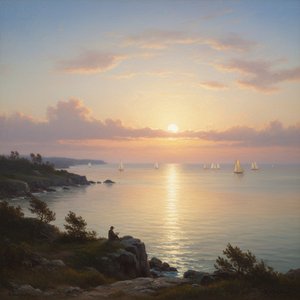
William Trost Richards: Luminism, Spirituality & the American Landscape Tradition
Explore the captivating landscapes of William Trost Richards, a master of Luminism associated with both the Hudson River School & American Pre-Raphaelite movements. Discover his spiritual connection to nature and lasting influence on American art.

Evocations of Place: A Historical Journey Through Landscape Art
Explore the rich history of landscape art with ArtsDot. Discover renowned artists, movements like Impressionism & Romanticism, and expert guidance for collecting timeless pieces. Find your perfect serene escape today!