Early Life and Artistic Beginnings
Dwight William Tryon’s artistic journey began in the quiet, rural landscapes of Connecticut, born in Hartford in 1849 to Anson Tryon and Delia O. Roberts. The early years of his life were marked by a poignant loss – the untimely death of his father cast a long shadow, shaping his upbringing on the family’s farm in East Hartford. This immersion in the rhythms of rural life proved profoundly formative, instilling within him an enduring connection to nature that would become the very foundation of his artistic vision. Remarkably, Tryon's artistic inclinations emerged organically; he wasn’t formally trained at first, but rather discovered a passion for drawing through a local bookstore where he worked as an employee. It was there, amidst the shelves of instructional manuals, that he began to cultivate his talent independently. His early explorations weren’t confined to study alone – he spent countless hours sketching the surrounding countryside, meticulously translating the subtle shifts in light and shadow onto paper. This dedication culminated in his first sale in 1870, a modest beginning that nonetheless ignited his ambition and signaled the emergence of a burgeoning talent destined for wider recognition. His acceptance into the National Academy of Design in 1873 marked a significant milestone, providing him with formal training and a platform to showcase his work within the established art world.European Influences and the Shaping of a Style
Driven by an intense desire for structured artistic education, Tryon embarked on a transformative journey to France in 1876. This pivotal move allowed him to immerse himself fully in the vibrant currents of European art, studying under Jacquesson de la Chevreuse at the École des Beaux-Arts in Paris. However, his education extended far beyond the confines of the classroom; he actively sought guidance from a constellation of influential artists, including Charles-François Daubigny, Henri Harpignies, and Jean Baptiste-Antoine Guillemet. These encounters exposed him to diverse techniques and philosophies, broadening his artistic horizons. Initially, Tryon’s style leaned towards Luminism – a movement characterized by its emphasis on atmospheric effects and the evocative use of radiant light. Yet, his artistic path soon diverged, drawn to the principles of the Barbizon School—a revolutionary movement that prioritized direct observation of nature and a more subdued, contemplative palette. The Barbizon School, emerging from the rural landscapes of France, offered an alternative to the grand scale and often theatrical compositions of academic painting. The influence of James McNeill Whistler proved particularly profound during this period. Whistler’s tonalist style—characterized by its subtle manipulation of color and tone to create a harmonious and emotionally resonant experience – deeply resonated with Tryon's artistic sensibilities, shaping his approach to composition and color harmony.Mature Style and Atmospheric Landscapes
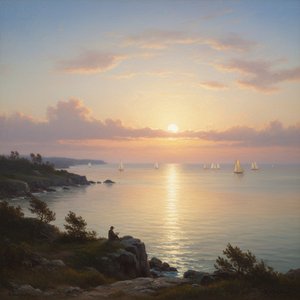
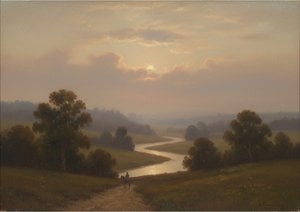
By the late 1880s, Dwight William Tryon had fully realized his distinctive artistic style—a signature approach that would define his legacy as a leading American Tonalist. His canvases frequently depict serene landscapes and seascapes rendered in soft, harmonious colors. A recurring compositional element is a carefully arranged grouping or broken row of trees positioned in the middle distance, acting as a visual bridge between a luminous sky above and a foreground marsh or pasture below. These scenes are often imbued with autumnal hues—ochres, browns, and muted greens—evoking a sense of tranquility, melancholy, and the passage of time. Beyond landscapes, Tryon also excelled at capturing the beauty of the sea, utilizing pastel to create evocative depictions of water, sky, and shoreline under varying weather conditions. His mastery lay not in dramatic brushstrokes or bold colors, but rather in his ability to convey atmosphere—the subtle shifts in light, the delicate interplay of color, and the overall mood of a scene. *Salt-Marsh, December*, which garnered first prize at the Tennessee Centennial Exposition in 1897, stands as a prime example of this skill, showcasing his talent for capturing the serene beauty of the natural world with remarkable subtlety and depth. His paintings were consistently exhibited nationally, gaining recognition at prestigious venues such as the Pennsylvania Academy of Fine Arts and the Montross Gallery.Patronage, Recognition, and Lasting Legacy
The trajectory of Tryon’s career was significantly bolstered by his relationship with Charles Lang Freer, a discerning collector who became his most important patron. Freer acquired dozens of Tryon's works and even collaborated with the artist on interior design projects for his Detroit home. This generous support allowed Tryon to fully dedicate himself to his art, enabling him to produce a substantial body of work that continues to be celebrated today. Further recognition came in 1908 when he received the Carnegie Prize at the Carnegie Exhibition—a prestigious award recognizing outstanding achievement in American art. Throughout his career, Tryon remained an active member of several prominent art organizations, including the Society of American Artists, the American Watercolor Society, and the National Institute of Arts and Letters (now the American Academy of Arts and Letters). In 1887, he established a summer home in South Dartmouth, Massachusetts—a place that would serve as his primary residence for the remainder of his life. Notably, Tryon also dedicated himself to education, teaching painting and drawing at Smith College from 1886 to 1923, where he founded the Tryon Gallery of Art. Dwight William Tryon passed away in 1925, leaving behind a rich artistic legacy defined by his contribution to American Tonalism and his exceptional ability to capture atmospheric landscapes and seascapes with delicate color and refined feeling. His works continue to be exhibited and collected worldwide, ensuring that his vision endures for generations to come.Spørsmål og svar
Hvordan finner jeg verk av Dwight William Tryon i en bestemt fargepalett?
For å finne verk av Dwight William Tryon i en bestemt fargepalett, bruk kunstnerens Etter fargepalett-side.
Kan jeg utforske Dwight William Tryon sine verk etter fargespekter?
Siden Spektralindeks organiserer Dwight William Tryon sine kunstverk etter farge.
Hvor er Dwight William Tryon sine kunstverk gruppert etter teknikk?
Dwight William Tryon sine verk kan bla gjennom etter medium på Dwight William Tryon sin Alle medier-side.