

 Forhåndsvisning
 Send
Send Del
Del
 Vis detaljer
 Utskriftsvennlig guide

 Last ned bilde
 Liknende objekter
 Røntgenundersøkelse
 Lysbildefremvisning
 Spørsmål og svar
 Statistikk
Burnt Village


 Vis hele teksten
Giclée / Kunsttrykk
Giclée- eller lerretsprint av museumskvalitet med rask produksjon og fleksible valgmuligheter for etterbehandling. ( Kjøp håndmalt maleri Bytt til digitalt bilde)




































Velg mellom våre forhåndsdefinerte størrelser som bevarer kunstverkets opprinnelige proporsjoner.

Skriv inn ønsket bredde og høyde for å tilpasse trykket til din ramme eller vegg. Et trykk kan kun beskjæres, aldri skaleres opp utover motivets opprinnelige størrelse, noe som betyr at et format med andre proporsjoner vil føre til tap av deler av bildet. Vi sender deg en digital mockup for godkjenning før vi starter trykkeprosessen. Bildet som vises på denne siden viser ikke den faktiske beskjæringen — det er kun mockuppen som viser dette.
Verdensomspennende levering () på 2 uker i stedet for standard 4/5 uker. (7 November)

Gratis ekspressfrakt over hele verden

Lerretsduk av lin av høy kvalitet

Full transportforsikring

Garanti for refusjon av toll og importavgifter

Garantert fargegjengivelse

100 dagers returrett ved fabrikasjonsfeil

100% pengene tilbake-garanti

Rabatt ved flere kjøp
 Glassalternativet er kun tilgjengelig i størrelser under 110 cm

Burnt Village
Giclée / Kunsttrykk
Størrelse på reproduksjon
-


Totalpris for valgte alternativer
Nkr 602
Albert Edelfelt’s “Burnt Village”: A Frozen Moment of Sorrow and Resilience
Albert Edelfelt's "Burnt Village," painted in 1879, is more than just a winter landscape; it’s a poignant tableau that speaks to the enduring spirit of a people facing devastation. This oil-on-canvas masterpiece, created during a period of significant artistic exploration for Edelfelt, offers a glimpse into a pivotal moment in Finnish history – the aftermath of the Cudgel War (1596–1597), a brutal peasant uprising against Swedish rule. The painting depicts an imagined scene, meticulously rendered with a realism that borders on photographic detail, capturing the stark beauty and profound sadness of a village reduced to ashes.
The central figures – a woman in a vibrant red skirt, her gaze fixed upwards, and an older man supporting himself with what appears to be a staff – immediately draw the viewer’s attention. Their postures convey a sense of quiet dignity amidst unimaginable loss. The snow-covered ground, the imposing rock formation hinting at a shoreline, and the overcast sky contribute to a palpable atmosphere of coldness and isolation. Edelfelt's masterful use of color—the dominant cool tones of white, gray, and blue punctuated by the warm red – heightens the emotional impact, emphasizing both the bleakness of the scene and the enduring warmth of human resilience.
Realism and the Finnish Artistic Landscape
Edelfelt’s artistic journey was shaped by his time in Antwerp and Paris, where he honed his skills in history painting. However, it's within the context of Realism that “Burnt Village” truly shines. Following the influence of Jean-Léon Gérôme during his Parisian studies, Edelfelt returned to Finland with a commitment to depicting everyday life and historical events with unflinching honesty. This approach was revolutionary for its time, moving away from idealized depictions towards a more grounded and socially conscious representation of the Finnish people.
The painting’s meticulous detail – the textures of the snow, the folds in the clothing, the expressions on the faces – are hallmarks of Edelfelt's technique. He employed a layering method, building up thin glazes of paint to achieve remarkable luminosity and depth. This painstaking process is evident in every brushstroke, contributing significantly to the painting’s enduring power.
Symbolism and Historical Context
"Burnt Village" isn’t simply a depiction of a historical event; it's laden with symbolic meaning. The title itself immediately evokes images of destruction and loss, reflecting the brutal realities of the Cudgel War. The peasant family, frozen in this moment, represents not just individual suffering but also the broader struggle for freedom and self-determination that characterized Finnish history. The woman’s upward gaze suggests a yearning for hope amidst despair, while the older man's support symbolizes the importance of community and tradition in times of crisis.
Interestingly, the painting was created during a period when Finland was transitioning from Swedish rule towards greater autonomy. Edelfelt’s work, therefore, can be seen as subtly advocating for this burgeoning national identity. The Cygnaeus Gallery's acquisition of the piece further underscores its significance within Finnish cultural heritage.
A Timeless Masterpiece – Perfect for Your Space
ArtsDot offers a stunning hand-painted reproduction of Albert Edelfelt’s “Burnt Village,” allowing you to bring this powerful and evocative artwork into your home or office. Each reproduction is created by skilled artisans, meticulously replicating Edelfelt's original technique and color palette. Whether you are an art collector, an interior designer seeking a statement piece, or simply someone who appreciates the beauty of historical painting, this reproduction offers a unique opportunity to own a fragment of Finnish artistic history – a testament to resilience, sorrow, and the enduring power of the human spirit.
Spørsmål og svar
Er "Burnt Village" av Albert Edelfelt et lyst eller mørkt kunstverk?
"Burnt Village" av Albert Edelfelt er registrert med bright, og har en luminans på Bright Balance.
Finnes det en guide for "Burnt Village" av Albert Edelfelt?
En Faktablad for studenter-side er tilgjengelig for "Burnt Village" av Albert Edelfelt: et utskrivbart faktablad om kunstverket, designet for studenter og bruk i klasserommet.
Hva anbefales brukt til "Burnt Village" av Albert Edelfelt?
Anbefalt bruk for "Burnt Village" av Albert Edelfelt er Statement. Den kan også brukes til andre formål.
Lignende kunstverk


Om kunstneren
Early Life and Education
Albert Gustaf Aristides Edelfelt, a renowned Finnish painter, was born on July 21, 1854, in Porvoo, Finland. His parents, Carl Albert Edelfelt, an architect of Swedish descent, and Alexandra Edelfelt (née Brandt), a kjøpmannsdatter from Borgå, faced considerable financial hardship after his father’s untimely death when Albert was young. Despite these difficulties, Alexandra tirelessly cared for her children, fostering Albert's innate passion for art from a tender age. He began formal artistic studies in 1869 at the Drawing School of the Finnish Art Society in Helsinki, where he honed his skills under the guidance of Adolf von Becker. This early training instilled in him a dedication to realism and observation—principles that would define his entire oeuvre.Artistic Journey
Edelfelt’s artistic trajectory led him through several prestigious institutions, shaping his understanding of European art history and technique: Antwerp Academy of Art (1873-74), where he immersed himself in the study of monumental history painting under Jean-Léon Gérôme; École nationale des beaux-arts in Paris (1874-78), where he benefited from Gérôme’s mentorship, refining his draftsmanship and mastering the nuances of tonal gradation. A brief period spent in Saint Petersburg exposed him to Russian artistic traditions and broadened his visual vocabulary. These formative experiences cemented Edelfelt's commitment to capturing the essence of human experience with meticulous detail and emotional resonance.Rise to Prominence and Notable Works
Edelfelt’s breakthrough arrived at the Paris Universal Exposition of 1889, securing him a gold medal—a testament to his burgeoning talent and artistic vision. Among his most celebrated paintings are “Portrait of Louis Pasteur,” which garnered him the Legion of Honour in 1886, capturing Pasteur's intellectual intensity with remarkable accuracy; “Young Woman in Her Boudoir,” an evocative depiction of feminine grace and vulnerability; and “Under the Birches,” a poignant landscape masterpiece that embodies Finnish rural life and conveys a profound sense of tranquility. His influence extended to younger Finnish artists like Akseli Gallen-Kallela and Gunnar Berndtson, whom he assisted in establishing their careers in Paris—a legacy that continues to inspire artistic creativity today.Legacy and Impact
Albert Edelfelt stands as one of Finland’s foremost painters from the late 19th century, marking a pivotal moment in Finnish art history. He championed realism as a means of portraying the natural world and human emotion with uncompromising honesty—a stylistic choice that resonated deeply with his contemporaries and established him as a pioneer of Finnish artistic expression. His works are housed in prominent museums across Finland, including Ateneum Museum in Helsinki, ensuring that Edelfelt’s artistic legacy endures for generations to come. Furthermore, his birth anniversary was commemorated with €100 albert edelfelt commemorative coin in 2004—a symbolic gesture honoring his enduring contribution to Finnish culture and art.Museum Collections and Commemoration
Edelfelt's paintings are showcased in Ateneum Museum in Helsinki, Finland, where visitors can admire masterpieces like “Young Woman in Her Boudoir” and “Under the Birches.” His artistic achievements were honored with a €100 albert edelfelt commemorative coin in 2004, celebrating his 150th birth anniversary—a lasting testament to his significance as a cultural icon.
Albert Edelfelt
1854 - 1905 , Finland
Kort om kunstneren
- Artistic Movement Or Style: Realism
- Artists Or Movements Influenced By This Artist:
- Akseli Gallen-Kallela
- Gunnar Berndtson
- Artists Who Influenced This Artist: ['Jean-Léon Gérôme']
- Date Of Birth: July 21, 1854
- Date Of Death: August 18, 1905
- Full Name: Albert Gustaf Aristides Edelfelt
- Nationality: Finnish
- Notable Artworks:
- Portrait of Louis Pasteur
- Young woman in her boudoir
- Under the birches
- Place Of Birth: Porvoo, Finland
Relaterte artikler

The Evocative Embrace of Reality: Exploring Romantic Realism in 19th-Century Painting
Explore the captivating world of Romantic Realism! Discover key artists like Courbet & Millet, masterpieces, and the social context behind this influential art movement. Expert insights for collectors at ArtsDot.

Romantic Realism's Finest: 10 Masterpieces for Your Home | ArtsDot
Explore 10 defining masterpieces of Romantic Realism! Discover Courbet, Millet & Daumier's powerful paintings—capturing emotion and social realities. Find museum-quality reproductions for your home at ArtsDot.com.
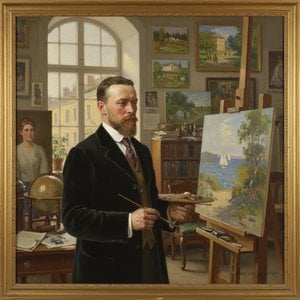
Albert Edelfelt: A Pioneer of Finnish Realism & International Impressionist Circles
Explore the life & work of Albert Edelfelt, a pioneering Finnish Realist painter who bridged Impressionism & national identity. Discover his masterpieces and lasting influence on art history.

Echoes of Society: Exploring Social Realism's Enduring Legacy in Art
Explore the powerful world of Social Realism art! Discover key artists, masterpieces & its profound social commentary. Expert insights into this influential movement's history and enduring legacy.

The Poetic Truth of Observation: Exploring 19th-Century Realism in Painting
Explore the captivating world of 19th-century Realism! Discover key artists like Courbet & Millet, masterpieces, and the powerful social commentary behind this influential art movement. Expert insights at ArtsDot.
