


Bildet følger dine valg: , .
Beskrivelse av objektet
Albert Edelfelt's 'Burnt Village' (1879) depicts a poignant scene of Finnish peasants after a devastating fire, showcasing realism and historical detail. A powerful genre painting by a master.
 Vis hele teksten
Om kunstneren
Albert Edelfelt var en finsk realistisk maler kjent for sine portretter og landskap, spesielt «Under Birken». Hans verk inspirerte yngre finländska konstnärer och är nu väl representerade i museer som Ateneum i Helsingfors.
Håndlaget oljereproduksjon
Håndmalt olje på lerret i din valgte størrelse og ramme, laget på bestilling av våre kunstnere. ( Bytt til trykk Bytt til digitalt bilde)
Les mer om dette maleriet
 Forhåndsvisning
 Send
Send Del
Del
 Vis detaljer
 Utskriftsvennlig guide

 Last ned bilde
 Liknende objekter
 Røntgenundersøkelse
 Lysbildefremvisning
 Spørsmål og svar
 Statistikk
Bestill maleriet ditt i fire enkle trinn
Ta deg god tid. Du kan endre alle svar; prisen i handlekurven din oppdateres etter hvert valg.
1 Trinn én av fire
Hvilken størrelse ønsker du?
Disse størrelsene bevarer de originale proporsjonene til maleriet. Tegningen viser ditt valg på en vegg, over en to meter lang sofa.
Eller oppgi egne mål
Velg mellom våre forhåndsdefinerte størrelser som bevarer kunstverkets opprinnelige proporsjoner.

Skriv inn ønsket bredde og høyde for å tilpasse bildet til din ramme eller vegg. Siden dette er håndmalt, kan kunstneren male litt mer rundt motivet eller beskjære det noe dersom du velger et annet format — valget er ditt. Vi sender deg en digital mockup til godkjenning før maleriet påbegynnes. Bildet som vises på denne siden representerer ikke det faktiske resultatet — kun mockuppen viser det endelige uttrykket.
2 Trinn to av fire
Hvordan skal det klargjøres: rullet, strukket eller innrammet?
Prisene nedenfor gjelder for størrelsen du valgte i trinn én.
Velg kantutførelse på lerretet
Velg din ramme

Hvit kant Nkr1

Uskarp kantfinish Nkr1

Fortsatt motiv Nkr1

P118B Nkr10

P118H Nkr10

P118W Nkr10

P438Z Nkr10

P508JH Nkr12

P508YH Nkr12

P805H Nkr10

P805Z Nkr10

P919BZ Nkr10

P919G Nkr10

P919XJ Nkr10

P959ZH Nkr10

P968JZ Nkr12

W106C Nkr8

W218G Nkr10

W218JH Nkr8

W218Y Nkr10

W307PJ Nkr10

W316G Nkr10

W316PJ Nkr8

W316Y Nkr10

W398PJ Nkr8

W4111J Nkr10

W500HY Nkr15

W500JH Nkr15

W692G Nkr12

W849H Nkr8

W940BG Nkr15

W953PJ Nkr8

H24-GOLD Nkr30

H24-SILVER Nkr30

H36-GOLD Nkr45

H36-SILVER Nkr45
Innrammet
Profil: . Total størrelse med ramme: .
3 Trinn tre av fire
Ønsker du at noe skal endres i maleriet?
De fleste svarer nei. Siden hvert maleri er håndlaget, kan kunstneren vår også tilpasse det for deg.
Etter bestilling vil ArtsDot.com-teamet sende e-post til kunden for instruksjoner og sende et utkast som forhåndsvisning
4 Trinn fire av fire
Noen valgmuligheter for finish
Alle er valgfrie. Svarene som allerede er valgt, medfører ingen ekstra kostnad.
Hvem har malt det?
Verdensomspennende levering () på 3–4 uker i stedet for standard 5 uker. (7 November). Ingen kompromisser med kvaliteten.
En navneplate, som på et museum?
Detaljer om gravert bronseplate
This elegant plaque features the artist's name and the title of the artwork, finely engraved for a timeless presentation.
It is made from bronze with a refined, elegant finish. The text is precisely laser-engraved for a sharp and permanent result. Measuring 9x2 cm, the plaque is compact yet easy to read. It's built to be durable and scratch-resistant, offering a professional, museum-quality look. Mounting is simple thanks to the included adhesive backing.
Detaljer om gjennomsiktig akrylplate
The plaque includes essential engraved details such as the artist's name, the title of the artwork, the date it was created, the type of media used-like oil on canvas or watercolor-a brief description of the piece, and a QR code that links to the complete artwork information.
It is crafted from clear acrylic, offering a sleek, modern appearance. The text is UV-engraved in black to ensure strong visual contrast. With a size of 10x15 cm, it ensures optimal readability. It comes equipped with two metal hooks for secure wall mounting. The plaque is designed to be weather-resistant, making it suitable for various environments, and it includes interactive features that work seamlessly with smartphone scanning.
Detaljer om plakett i svart akryl
This elegant plaque includes engraved information such as the artist's name, the title of the artwork, the date it was created, the type of media used (like oil on canvas or watercolor), a short description of the artwork, and a QR code for quick access to more information.
The plaque itself is made from refined black acrylic with a premium finish. The text is laser-engraved in white for high contrast and readability. Its size is 10x15 cm, designed to be easy to read. It comes with two metal hooks for professional mounting. The design is sleek and fits any interior style. It is also weather-resistant and durable, with built-in digital integration for mobile compatibility.
En beskyttende lakk?
Når trenger du det?
✓ Kontroller og bestill
Ditt maleri, slik du bestilte det

Burnt Village
Trykkmetode
Størrelse på reproduksjon
-

Utvalgte mesterkunstnere
Mer detaljrikdom, finesse og ekstra produksjonstid
-

Innramming av reproduksjon
-
-
For kunstverk eller reproduksjoner som er større enn 105 cm (ca. 41 tommer) på noen side, vil rammen bli sendt som et sett som må monteres. Denne metoden sikrer trygg levering og forhindrer skader under transport.
Krever profesjonell montering – dette er ikke et DIY-produkt.
Settet må monteres og lerretet strammes av en erfaren profesjonell rammelegger, ved bruk av trelim (følger ikke med), en lerretstang og klemmer for å holde rammelisten vinkelrett mens limet tørker. Feilaktig montering eller ujevn stramming av lerretet kan påføre kunstverket permanente skader og er
 For kunstverk eller reproduksjoner som er større enn 105 cm (ca. 41 tommer) på noen side, vil rammen bli sendt som et sett som må monteres. Denne metoden sikrer trygg levering og forhindrer skader under transport.
Alle massive trelister er inkludert, presist tilpasset i størrelse.
Monteres med de medfølgende skruene, samt trelim til hjørnene, som ikke er inkludert og må anskaffes av din rammehandler.
Profesjonelt verktøy er nødvendig og er ikke inkludert: en lerretstang (strammer) og klemmer for å holde rammene vinkelrette mens limet tørker.
Viktig:
Hjørnene krever trelim, listene må holdes på plass med tvinger til limet er helt tørt, og stramming av lerretet på den ferdige rammen krever en lerretstang. Ingen av disse produktene er inkludert i settet. Vennligst sørg for tilgang til en erfaren profesjonell rammehandler før du bestiller denne størrelsen.

Navneskilt
-
-

Beskyttende ferniss
Blank lakk (forsterker farger, beskytter mot lys og fuktighet)
-

Tilpass mitt kunstverk
Eksempler på hva som kan endres: Erstatt ansikt med bilde av kunden; Legg til kjæledyr (f.eks. bytt ut katt med hund); Inkluder en skjult melding i bakgrunnen; Endre bakgrunnslandskap eller elementer.
-

Ekspresslevering
Verdensomspennende levering () på 3–4 uker i stedet for standard 5 uker. (7 November). Ingen kompromisser med kvaliteten.
-
Ekspresslevering
Verdensomspennende levering til innen 5 uker. (14 November).
Inkludert frakt
Totalpris for valgte alternativer
Nkr 2515
Glassalternativet er kun tilgjengelig i størrelser under 110 cm
Inkludert med hver bestilling
- Gratis ekspressfrakt over hele verden
- Lerretsduk av lin av høy kvalitet
- Full transportforsikring
- Garanti for refusjon av toll og importavgifter
- Garantert fargegjengivelse
- 100 dagers returrett ved fabrikasjonsfeil
- 100% pengene tilbake-garanti
- Rabatt ved flere kjøp


Albert Edelfelt’s “Burnt Village”: A Frozen Moment of Sorrow and Resilience
Albert Edelfelt's "Burnt Village," painted in 1879, is more than just a winter landscape; it’s a poignant tableau that speaks to the enduring spirit of a people facing devastation. This oil-on-canvas masterpiece, created during a period of significant artistic exploration for Edelfelt, offers a glimpse into a pivotal moment in Finnish history – the aftermath of the Cudgel War (1596–1597), a brutal peasant uprising against Swedish rule. The painting depicts an imagined scene, meticulously rendered with a realism that borders on photographic detail, capturing the stark beauty and profound sadness of a village reduced to ashes.
The central figures – a woman in a vibrant red skirt, her gaze fixed upwards, and an older man supporting himself with what appears to be a staff – immediately draw the viewer’s attention. Their postures convey a sense of quiet dignity amidst unimaginable loss. The snow-covered ground, the imposing rock formation hinting at a shoreline, and the overcast sky contribute to a palpable atmosphere of coldness and isolation. Edelfelt's masterful use of color—the dominant cool tones of white, gray, and blue punctuated by the warm red – heightens the emotional impact, emphasizing both the bleakness of the scene and the enduring warmth of human resilience.
Realism and the Finnish Artistic Landscape
Edelfelt’s artistic journey was shaped by his time in Antwerp and Paris, where he honed his skills in history painting. However, it's within the context of Realism that “Burnt Village” truly shines. Following the influence of Jean-Léon Gérôme during his Parisian studies, Edelfelt returned to Finland with a commitment to depicting everyday life and historical events with unflinching honesty. This approach was revolutionary for its time, moving away from idealized depictions towards a more grounded and socially conscious representation of the Finnish people.
The painting’s meticulous detail – the textures of the snow, the folds in the clothing, the expressions on the faces – are hallmarks of Edelfelt's technique. He employed a layering method, building up thin glazes of paint to achieve remarkable luminosity and depth. This painstaking process is evident in every brushstroke, contributing significantly to the painting’s enduring power.
Symbolism and Historical Context
"Burnt Village" isn’t simply a depiction of a historical event; it's laden with symbolic meaning. The title itself immediately evokes images of destruction and loss, reflecting the brutal realities of the Cudgel War. The peasant family, frozen in this moment, represents not just individual suffering but also the broader struggle for freedom and self-determination that characterized Finnish history. The woman’s upward gaze suggests a yearning for hope amidst despair, while the older man's support symbolizes the importance of community and tradition in times of crisis.
Interestingly, the painting was created during a period when Finland was transitioning from Swedish rule towards greater autonomy. Edelfelt’s work, therefore, can be seen as subtly advocating for this burgeoning national identity. The Cygnaeus Gallery's acquisition of the piece further underscores its significance within Finnish cultural heritage.
A Timeless Masterpiece – Perfect for Your Space
ArtsDot offers a stunning hand-painted reproduction of Albert Edelfelt’s “Burnt Village,” allowing you to bring this powerful and evocative artwork into your home or office. Each reproduction is created by skilled artisans, meticulously replicating Edelfelt's original technique and color palette. Whether you are an art collector, an interior designer seeking a statement piece, or simply someone who appreciates the beauty of historical painting, this reproduction offers a unique opportunity to own a fragment of Finnish artistic history – a testament to resilience, sorrow, and the enduring power of the human spirit.
Spørsmål og svar
Er "Burnt Village" av Albert Edelfelt et lyst eller mørkt kunstverk?
"Burnt Village" av Albert Edelfelt er registrert med bright, og har en luminans på Bright Balance.
Finnes det en guide for "Burnt Village" av Albert Edelfelt?
En Faktablad for studenter-side er tilgjengelig for "Burnt Village" av Albert Edelfelt: et utskrivbart faktablad om kunstverket, designet for studenter og bruk i klasserommet.
Hva anbefales brukt til "Burnt Village" av Albert Edelfelt?
Anbefalt bruk for "Burnt Village" av Albert Edelfelt er Statement. Den kan også brukes til andre formål.
Lignende kunstverk


Albert Edelfelt
1854 - 1905, Finland
Om kunstneren
Early Life and Education
Albert Gustaf Aristides Edelfelt, a renowned Finnish painter, was born on July 21, 1854, in Porvoo, Finland. His parents, Carl Albert Edelfelt, an architect of Swedish descent, and Alexandra Edelfelt (née Brandt), a kjøpmannsdatter from Borgå, faced considerable financial hardship after his father’s untimely death when Albert was young. Despite these difficulties, Alexandra tirelessly cared for her children, fostering Albert's innate passion for art from a tender age. He began formal artistic studies in 1869 at the Drawing School of the Finnish Art Society in Helsinki, where he honed his skills under the guidance of Adolf von Becker. This early training instilled in him a dedication to realism and observation—principles that would define his entire oeuvre.Artistic Journey
Edelfelt’s artistic trajectory led him through several prestigious institutions, shaping his understanding of European art history and technique: Antwerp Academy of Art (1873-74), where he immersed himself in the study of monumental history painting under Jean-Léon Gérôme; École nationale des beaux-arts in Paris (1874-78), where he benefited from Gérôme’s mentorship, refining his draftsmanship and mastering the nuances of tonal gradation. A brief period spent in Saint Petersburg exposed him to Russian artistic traditions and broadened his visual vocabulary. These formative experiences cemented Edelfelt's commitment to capturing the essence of human experience with meticulous detail and emotional resonance.Rise to Prominence and Notable Works
Edelfelt’s breakthrough arrived at the Paris Universal Exposition of 1889, securing him a gold medal—a testament to his burgeoning talent and artistic vision. Among his most celebrated paintings are “Portrait of Louis Pasteur,” which garnered him the Legion of Honour in 1886, capturing Pasteur's intellectual intensity with remarkable accuracy; “Young Woman in Her Boudoir,” an evocative depiction of feminine grace and vulnerability; and “Under the Birches,” a poignant landscape masterpiece that embodies Finnish rural life and conveys a profound sense of tranquility. His influence extended to younger Finnish artists like Akseli Gallen-Kallela and Gunnar Berndtson, whom he assisted in establishing their careers in Paris—a legacy that continues to inspire artistic creativity today.Legacy and Impact
Albert Edelfelt stands as one of Finland’s foremost painters from the late 19th century, marking a pivotal moment in Finnish art history. He championed realism as a means of portraying the natural world and human emotion with uncompromising honesty—a stylistic choice that resonated deeply with his contemporaries and established him as a pioneer of Finnish artistic expression. His works are housed in prominent museums across Finland, including Ateneum Museum in Helsinki, ensuring that Edelfelt’s artistic legacy endures for generations to come. Furthermore, his birth anniversary was commemorated with €100 albert edelfelt commemorative coin in 2004—a symbolic gesture honoring his enduring contribution to Finnish culture and art.Museum Collections and Commemoration
Edelfelt's paintings are showcased in Ateneum Museum in Helsinki, Finland, where visitors can admire masterpieces like “Young Woman in Her Boudoir” and “Under the Birches.” His artistic achievements were honored with a €100 albert edelfelt commemorative coin in 2004, celebrating his 150th birth anniversary—a lasting testament to his significance as a cultural icon.
Relaterte artikler

The Evocative Embrace of Reality: Exploring Romantic Realism in 19th-Century Painting
Explore the captivating world of Romantic Realism! Discover key artists like Courbet & Millet, masterpieces, and the social context behind this influential art movement. Expert insights for collectors at ArtsDot.

Romantic Realism's Finest: 10 Masterpieces for Your Home | ArtsDot
Explore 10 defining masterpieces of Romantic Realism! Discover Courbet, Millet & Daumier's powerful paintings—capturing emotion and social realities. Find museum-quality reproductions for your home at ArtsDot.com.
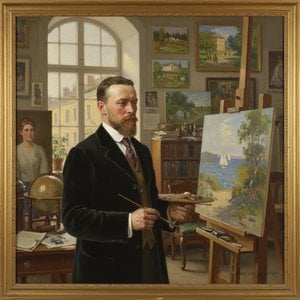
Albert Edelfelt: A Pioneer of Finnish Realism & International Impressionist Circles
Explore the life & work of Albert Edelfelt, a pioneering Finnish Realist painter who bridged Impressionism & national identity. Discover his masterpieces and lasting influence on art history.