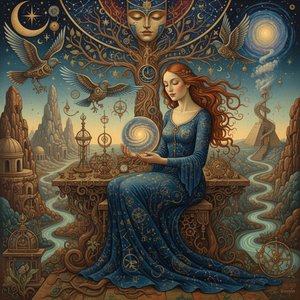
De Precisie van het Onzichtbare
In de stille hoeken van haar atelier werkte Remedios Varo met een nauwgezetheid die de technische tekeningen van haar vader, een waterbouwkundig ingenieur, weerspiegelde. Deze vroege blootstelling aan de mechanica van de wereld liet een blijvende stempel achter op haar hand, een voorkeur voor de fijne lijn en het uiterst precieze detail. Ze schilderde niet louter; ze construeerde. Haar canvas wordt bevolkt door ingewikkelde apparaten, tandwielen en hybride wezens die lijken te functioneren volgens hun eigen interne logica. Er gaat een zekere stilte uit van haar werk, het soort stilte dat men vindt in een laboratorium of een heiligdom, waar elke beweging doelbewust is en elk object een functie heeft.
Haar opvoeding in Anglès, Spanje, bood een fundament van dualiteit. Van haar vader leerde ze de discipline van observatie en de structuur van technisch ontwerp. Van haar moeder erfde ze een gevoel voor het spirituele. Deze spanning tussen het meetbare en het mysterieuze werd de motor van haar creativiteit. Ze bewoog zich door de wereld met een nieuwsgierige blik, waarbij ze de landschappen van haar frequente verhuizingen absorbeerde, evenals de formele opleiding die ze kreeg aan de Real Academia de Bellas Artes de San Fernando in Madrid. Het was daar dat haar technische vaardigheid de ontluikende interesse in het onderbewuste ontmoette, hoewel haar pad altijd het hare zou blijven.
Een Leven in Beweging
De beweging in haar leven werd gedicteerd door de verschuivingen in de geschiedenis. De Spaanse Burgeroorlog en de daaropvolgende bezetting van Frankrijk dwongen haar tot een reeks ontheemdingen, wat haar uiteindelijk naar Mexico-Stad leidde. Deze verhuizing was niet louter een verandering van decor; het was een verschuiving in de essentie van haar werk. In Mexico vond ze een gemeenschap van denkers en kunstenaars, waaronder Leonora Carrington, die haar interesse in het esoterische deelden. Ze werd nooit een Mexicaans staatsburger, maar behield haar Spaanse identiteit, zelfs terwijl haar visie zich uitbreidde naar de filosofieën en inheemse ideeën die zij in haar nieuwe thuis aantrof.
Haar werk bewoog weg van de eenvoudige portretten uit haar vroege jaren naar een taal van symbolen. Ze raakte geïnteresseerd in alchemie, niet als een zoektocht naar goud, maar als een metafoor voor de loutering van het zelf. Haar schilderijen tonen vaak eenzame vrouwen die zich bezighouden met mysterieuze, wetenschappelijke of spirituele taken. Deze figuren zijn niet passief. Het zijn uitvinders en zoekers, vaak omringd door machines die de kloof tussen het fysieke en het metafysische lijken te overbruggen. In werken zoals Creation of birds wordt de daad van het scheppen een kosmisch evenement, een versmelting van het biologische en het magische.
De Architectuur van Dromen
Varo’s stijl wordt vaak omschreven als para-surrealisme, een term die haar afwijking van de standaard surrealistische focus op het onderbewuste treffend weergeeft. Waar anderen probeerden de chaotische impulsen van de geest los te laten, probeerde zij ze juist te ordenen. Haar schilderijen zijn hoogst gestructureerd en maken gebruik van de precisie van een illustrator om het onmogelijke af te beelden. Ze gebruikte olieverf op masoniet om een detailniveau te bereiken dat een nauwgezette, onhaastige blik vereist. Men kan de fijne draden van het lot zien worden geweven, of de subtiele beweging van kosmische energie door haar penseelvoering.
Haar nalatenschap ligt in de manier waarop ze het wetenschappelijke met het mystieke verenigde. Ze keek naar het universum door de lens van een ingenieur en het hart van een zoeker. Haar schilderijen blijven een studie in hoe de menselijke geest probeert het onbekende in kaart te brengen. Door haar ingewikkelde voorstellingen van transformatie en verbinding creëerde ze een visuele taal voor de delen van het bestaan die niet met een liniaal of een klok gemeten kunnen worden, maar die voor degenen die ze nauwgezet observeren, volkomen echt aanvoelen.
Vraag en antwoord
In welke historische periode werkte Remedios Varo?
Remedios Varo werkte in de Moderne tijd-periode. Deze periode plaatst het oeuvre van de kunstenaar in een historisch kader.
Waar en wanneer is Remedios Varo geboren?
Remedios Varo werd geboren in Anglès in 1908.
Welke stemmingen drukken de kunstwerken van Remedios Varo uit?
Op de Sfeercollectie pagina van de kunstenaar vindt u de kunstwerken van Remedios Varo, gerangschikt op basis van hun sfeer.