

- 65.0 x 96.0 cm


Het werk volgt uw keuzes: , .
Beschrijving verzamelobject
Admire Jacob Philippe Hackert’s serene Italian Landscape painting – a masterpiece capturing Tuscan beauty with masterful light and detail. Explore its history & exquisite reproduction at ArtsDot.
 Lees meer
Biografie kunstenaar
Jacob Philipp Hackert (1737-1807): Duitse landschapsschilder beroemd om zijn Italiaanse scènes & klassieke stijl. Hofschilder voor Ferdinand I, beïnvloed door Vernet & Goethe. Ontdek zijn meesterwerken!
Handgemaakte olieverfreproductie
Met de hand geschilderd in olieverf op canvas in uw gewenste maat en lijst, op bestelling gemaakt door onze kunstenaars. ( Schakel over naar print Schakel over naar digitale afbeeldingen)
Meer over dit schilderij
 Voorvertoning
 Verstuur
 Delen
Delen
 Details bekijken
 Gids
Gids

 Download
 Vergelijkbare items
 Röntgenonderzoek
 Diavoorstelling
 Vraag & antwoord
 Statistieken
Bestel uw schilderij in vier eenvoudige stappen
Neem de tijd. U kunt elk antwoord nog wijzigen; de prijs in uw besteloverzicht wordt direct aangepast aan elke keuze.
1 Stap één van de vier
Welke maat wilt u kiezen?
Deze formaten behouden de proporties van het originele schilderij. De tekening laat uw keuze zien op een muur, boven een bank van twee meter.
Of geef uw eigen afmetingen op
Kies uit onze vooraf ingestelde maten die overeenkomen met de originele verhoudingen van het kunstwerk.

Voer de breedte en hoogte in die u nodig heeft, passend bij uw lijst of uw muur. Omdat dit handgeschilderd is, kan de kunstenaar bij een afmeting met een andere beeldverhouding iets meer rondom het schilderij schilderen of juist iets meer weglaten — u kiest zelf. Wij sturen u een digitaal mockup ter goedkeuring voordat het schilderwerk begint. De afbeelding die op deze pagina wordt getoond, is niet het uiteindelijke resultaat — alleen de mockup geeft dit weer.
2 Stap twee van vier
Hoe moet het worden geleverd: gerold, opgespannen of ingelijst?
De onderstaande prijzen zijn voor de maat die u in stap één heeft gekozen.
Kies de randen van het canvas
Kies uw lijst

Wit €1

Vervagende randen €1

Doorlopende rand €1

P118B €10

P118H €10

P118W €10

P438Z €10

P508JH €12

P508YH €12

P805H €10

P805Z €10

P919BZ €10

P919G €10

P919XJ €10

P959ZH €10

P968JZ €12

W106C €8

W218G €10

W218JH €8

W218Y €10

W307PJ €10

W316G €10

W316PJ €8

W316Y €10

W398PJ €8

W4111J €10

W500HY €15

W500JH €15

W692G €12

W849H €8

W940BG €15

W953PJ €8

H24-GOLD €30

H24-SILVER €30

H36-GOLD €45

H36-SILVER €45
Ingelijst
Lijstrand: . Totale afmetingen inclusief lijst: .
3 Stap drie van vier
Wilt u dat er iets aan het schilderij wordt aangepast?
De meeste mensen antwoorden nee. Omdat elk schilderij met de hand wordt gemaakt, kan onze kunstenaar het ook voor u aanpassen.
Na de bestelling zal het team van ArtsDot.com per e-mail contact opnemen met de klant voor instructies en een mockup-voorbeeld verstrekken
4 Stap vier van vier
Enkele afwerkingsopties
Ze zijn allemaal optioneel. De reeds geselecteerde antwoorden brengen geen extra kosten met zich mee.
Wie is de kunstenaar?
Wereldwijde levering () binnen 3 tot 4 weken in plaats van de standaard 5 weken. (7 november). Zonder concessies aan de kwaliteit.
Een naambordje, zoals in een museum?
Details van de gegraveerde bronzen plaat
This elegant plaque features the artist's name and the title of the artwork, finely engraved for a timeless presentation.
It is made from bronze with a refined, elegant finish. The text is precisely laser-engraved for a sharp and permanent result. Measuring 9x2 cm, the plaque is compact yet easy to read. It's built to be durable and scratch-resistant, offering a professional, museum-quality look. Mounting is simple thanks to the included adhesive backing.
Details transparante acrylplaat
The plaque includes essential engraved details such as the artist's name, the title of the artwork, the date it was created, the type of media used-like oil on canvas or watercolor-a brief description of the piece, and a QR code that links to the complete artwork information.
It is crafted from clear acrylic, offering a sleek, modern appearance. The text is UV-engraved in black to ensure strong visual contrast. With a size of 10x15 cm, it ensures optimal readability. It comes equipped with two metal hooks for secure wall mounting. The plaque is designed to be weather-resistant, making it suitable for various environments, and it includes interactive features that work seamlessly with smartphone scanning.
Details zwarte acrylplaat
This elegant plaque includes engraved information such as the artist's name, the title of the artwork, the date it was created, the type of media used (like oil on canvas or watercolor), a short description of the artwork, and a QR code for quick access to more information.
The plaque itself is made from refined black acrylic with a premium finish. The text is laser-engraved in white for high contrast and readability. Its size is 10x15 cm, designed to be easy to read. It comes with two metal hooks for professional mounting. The design is sleek and fits any interior style. It is also weather-resistant and durable, with built-in digital integration for mobile compatibility.
Een beschermende vernis?
Wanneer heeft u het nodig?
✓ Controleren en bestellen
Uw schilderij, zoals u het heeft besteld

Italian Landscape
Druktechniek
Afmetingen reproductie
-

Geselecteerde topkunstenaars
Meer detail, verfijning en extra productietijd
-

Lijst voor reproductie
-
-
Voor kunstwerken of reproducties die aan één zijde groter zijn dan 105 cm (ongeveer 41 inch), wordt de lijst als een losse set verzonden. Deze methode garandeert een veilige levering en voorkomt schade tijdens het transport.
Professionele montage vereist - dit is geen doe-het-zelfproduct.
De set moet worden gemonteerd en het canvas moet worden gespannen door een ervaren professionele lijstenmaker, met gebruik van houtlijm (niet inbegrepen), een doekspanter en klemmen om de sponningen recht te houden terwijl de lijm droogt. Onjuiste montage of een ongelijkmatige spanning op het canvas kan het kunstwerk permanent beschadigen en wordt niet gedekt door onze garantie.
 Voor kunstwerken of reproducties die aan één zijde groter zijn dan 105 cm (ongeveer 41 inch), wordt de lijst als een losse set verzonden. Deze methode garandeert een veilige levering en voorkomt schade tijdens het transport.
Alle massief houten onderdelen zijn inbegrepen, nauwkeurig op maat gesneden voor montage.
Te monteren met de meegeleverde schroeven, plus houtlijm voor de hoekverbindingen, die niet wordt meegeleverd en door uw lijstenmaker moet worden aangeschaft.
Professioneel gereedschap is vereist en niet inbegrepen: een spanner voor canvas en klemmen om de latten recht te houden terwijl de lijm droogt.
Belangrijk:
De hoekverbindingen vereisen houtlijm, de latten moeten met lijmklemmen worden vastgehouden tot de lijm volledig is opgedroogd, en het spannen van het canvas op het samengestelde frame vereist een doekspanter. Geen van deze artikelen is inbegrepen in de set. Wij adviseren u om een ervaren professionele lijstenmaker te raadplegen voordat u deze maat bestelt.

Naamplaatje
-
-

Beschermende vernislaag
Glanzende vernis (versterkt de kleuren en biedt bescherming tegen licht en vocht)
-

Mijn kunstwerk aanpassen
Voorbeelden van aanpassingen: vervang het gezicht door een eigen foto; voeg een huisdier toe (bijv. vervang de kat door een hond); verwerk een verborgen boodschap in de achtergrond; wijzig het landschap of andere elementen op de achtergrond.
-

Spoedlevering
Wereldwijde levering () binnen 3 tot 4 weken in plaats van de standaard 5 weken. (7 november). Geen concessies aan de kwaliteit.
-
Spoedlevering
Wereldwijde levering naar binnen 5 weken. (14 november).
Inbegrepen
Eindtotaal
€ 235
De optie voor glas is alleen beschikbaar bij een formaat kleiner dan 110 cm.
Inbegrepen bij elke bestelling
- Gratis wereldwijde expressverzending
- Hoogwaardig linnen canvas
- Volledige verzendverzekering
- Garantie op terugbetaling van invoerrechten
- Garantie op exacte kleurweergave
- Retourbeleid van 100 dagen (alleen bij defecten)
- 100% Geld-terug-garantie
- Korting bij meerdere afnames


A Symphony of Light and Tranquility
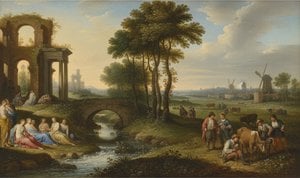
In the vast tapestry of the Romantic movement, few works capture the ethereal essence of the Italian countryside as profoundly as Jacob Philippe Hackert’s Italian Landscape. Created in 1795, this oil on canvas masterpiece serves as a window into an idealized Arcadia, where the grandeur of nature and the quietude of pastoral life exist in perfect, undisturbed harmony. As one gazes upon the canvas, there is an immediate sense of being transported to a world far removed from the industrializing tensions of the late 18th century. The painting does not merely represent a location; it evokes a feeling of timelessness, inviting the viewer to linger within its sun-drenched valleys and misty mountain peaks.
The composition is a masterclass in balanced tension, guiding the eye through a meticulously layered journey. In the foreground, a tranquil river meanders with a gentle grace, its surface acting as a mirror for the clear blue sky and the lush greenery that lines its banks. The presence of grazing cows adds a touch of pastoral intimacy, grounding the epic scale of the landscape in the humble, rhythmic reality of rural life. As the gaze moves toward the middle ground, rolling hills draped in verdant vegetation lead the viewer upward toward a majestic mountain range. These peaks, partially veiled by an atmospheric haze, command the horizon with an imposing power that speaks to the Romantic fascination with the sublime—the awe-inspiring and sometimes overwhelming beauty of the natural world.
The Mastery of Atmosphere and Technique
Hackert’s technical prowess is most evident in his sophisticated use of sfumato, a technique he refined under the influence of his mentor, Claude Joseph Vernet. By subtly blurring the boundaries between distant mountains and the sky, Hackert creates a palpable sense of depth and atmospheric perspective. This soft, smoky transition prevents the landscape from feeling static; instead, it breathes with moisture and light. The artist’s ability to marry minute, realistic details—such as the individual textures of foliage and the rugged contours of rocks—with this expansive, misty atmosphere is what distinguishes this work as a pinnacle of his era.
The color palette is a deliberate study in serenity, dominated by harmonious shades of emerald, forest green, and deep azure. These cool tones are punctuated by the warm, golden light that seems to filter through the clouds, illuminating the classical architecture nestled among the trees. This interplay of light and shadow does more than define form; it establishes a mood of profound peace. For the discerning collector or interior designer, this painting offers a sophisticated focal point that brings a sense of calm and classical elegance to any space, acting as an anchor of tranquility in a modern environment.
Historical Resonance and Lasting Legacy
To understand the Italian Landscape is to understand the heart of a traveling artist. Hackert, born in Germany but deeply enamored with the Mediterranean spirit, spent much of his career capturing the light of Italy. His work reflects the transition from Neoclassical precision toward the more expressive, emotional observations of the Romantic era. The inclusion of classical architectural elements—columns and structures that hint at a storied past—serves as a poignant reminder of humanity's historical connection to the land. These man-made wonders do not intrude upon the scenery but rather blend seamlessly into the natural topography, suggesting a world where civilization and nature exist in a state of grace.
Owning a reproduction of such a significant work allows one to possess a fragment of art history. It is an invitation to daily contemplation, a piece that rewards repeated viewing with new discoveries of light, shadow, and texture. Whether placed in a grand library or a contemporary living suite, Hackert’s vision of the Italian landscape remains a timeless testament to the enduring power of beauty and the quiet majesty of the earth.
Veelgestelde vragen
Wat is de dominante kleur van "Italian Landscape"?
"Italian Landscape" neigt naar een Ochre to Sepia tint.
Welke sfeer brengt een reproductie van "Italian Landscape" door Jacob Philippe Hackert in een kamer?
Met zijn Serene karakter is "Italian Landscape" een aanrader voor de Living Room.
Voor welke kamer wordt "Italian Landscape" door Jacob Philippe Hackert aanbevolen?
De aanbevolen ruimte voor "Italian Landscape" door Jacob Philippe Hackert is een Living Room. Dit advies kan uiteraard worden aangepast aan uw interieur.
Vergelijkbare kunstwerken


Jacob Philippe Hackert
1737 - 1807, Duitsland
Biografie kunstenaar
Early Life and Artistic Foundations
Jacob Philipp Hackert emerged onto the artistic landscape in 1737, born in Prenzlau, Brandenburg – a region now nestled within Germany. His upbringing was steeped in artistry; his father, Philipp Hackert, practiced as both a portraitist and an animal painter, laying the initial groundwork for young Jacob’s creative journey. This familial influence extended to his uncle, under whose guidance he further honed his skills. Formal training followed at the prestigious Prussian Academy of Arts in Berlin beginning in 1758, where he diligently developed the technical foundations that would later define his style. However, Hackert's early career wasn’t confined to studio walls. His travels took him through Swedish Pomerania and eventually to Stockholm, where a pivotal commission from Baron Adolf Friedrich von Olthof – decorative murals for the baron’s estate – broadened his artistic horizons and exposed him to diverse aesthetic sensibilities. These formative years were crucial in shaping Hackert's eye and preparing him for the grander stages of his career.The Italian Awakening: Paris, Rome, and Naples
A defining chapter unfolded with Hackert’s relocation to Paris between 1765 and 1768 alongside fellow Swiss artist Balthasar Anton Dunker. This period proved transformative, immersing him in a vibrant artistic milieu. He found himself profoundly influenced by Claude Joseph Vernet, the celebrated painter of landscapes and seascapes, absorbing elements of Vernet’s dramatic compositions and atmospheric effects into his own burgeoning style. Simultaneously, studies under German engraver Johann Georg Wille refined his precision and attention to detail. In 1768, Hackert embarked on a journey that would irrevocably alter his artistic trajectory – he moved to Italy with his brother Georg, establishing himself primarily in Rome and Naples. This move marked the beginning of an extraordinarily prolific period fueled by numerous commissions for views of the Italian countryside, most notably from Sir William Hamilton. He traversed the length and breadth of Italy, meticulously documenting its beauty and gaining recognition as a master landscape painter. The light, the colors, the very essence of the Italian peninsula captivated him, becoming the defining characteristic of his work.Patronage, Recognition, and Artistic Flourishing
Hackert’s artistic career ascended to new heights through a combination of talent and strategic patronage. His ability to capture the sublime beauty of Italy resonated with prominent figures across Europe. A landmark commission arrived from Catherine the Great of Russia – a cycle of paintings depicting the pivotal Battle of Chesma, solidifying his reputation on an international scale. Further bolstering his standing was a fruitful relationship with Pope Pius VI, resulting in significant artistic projects that showcased his skill and versatility. In 1786, Hackert reached the pinnacle of his career when he was appointed court painter to Ferdinand I of the Two Sicilies in Naples. This prestigious role extended beyond mere painting; he was entrusted with advising on the creation of a painting restoration laboratory at the Museo di Capodimonte and overseeing the transfer of the esteemed Farnese collections from Rome to Naples, demonstrating his deep understanding of art history and conservation. He produced notable paintings depicting Caserta and the Royal Palace of Caserta, as well as a series illustrating the Bourbon ports. Intriguingly, Hackert also served as a secret informant for Russia during this time, maintaining contact with Andrey Razumovsky – a testament to the complex political landscape in which he operated. A particularly cherished connection blossomed between Hackert and Johann Wolfgang von Goethe during the latter’s visit to Naples in 1786, forging a friendship that further elevated his intellectual standing.Style, Legacy, and Historical Significance
Jacob Philipp Hackert's artistic style represents a compelling synthesis of classical landscape painting and an emerging Romantic sensibility. Heavily influenced by the works of Claude Lorrain, his compositions are characterized by carefully balanced arrangements that blend observed reality with an idealized aesthetic vision. However, Hackert distinguished himself through an unwavering commitment to botanical accuracy and a desire for recognizable depictions of place. His paintings are marked by sharp renderings of natural details and realistic portrayals of Italian scenery, often bathed in a warm, golden light. He is rightfully considered one of the greatest interpreters of the *vedutismo* genre – paintings that meticulously depict city views and landscapes with topographical precision. Hackert’s historical significance extends beyond his artistic contributions; he served as a vital cultural ambassador between Germany and Italy during the late 18th century, bridging artistic traditions and fostering cross-cultural exchange. He passed away on April 28, 1807, in San Pietro di Careggi near Florence, leaving behind a substantial body of work that continues to inspire awe and admiration for its beauty, technical mastery, and enduring historical importance. His landscapes are not merely representations of scenery; they are windows into a world imbued with both classical grace and Romantic emotion.Gerelateerde artikelen

John Constable's Top 25 Meesterwerken: Landschappen die de Ziel Raaken | ArtsDot
Ontdek de 25 mooiste schilderijen van John Constable, meester van de Engelse Romantiek. Van idyllische landschappen tot iconische Hay Wain – bewonder zijn techniek en emotie. Museumkwaliteit reproducties & decoratie op ArtsDot.com.

Evocations of Place: A Historical Journey Through Landscape Art
Explore the rich history of landscape art with ArtsDot. Discover renowned artists, movements like Impressionism & Romanticism, and expert guidance for collecting timeless pieces. Find your perfect serene escape today!
Cornelis van Poelenburch: Bridging Mannerism & the Dutch Baroque Landscape
Discover Cornelis van Poelenburch, a pivotal Dutch Baroque landscape painter bridging Mannerism & Italianate styles. Explore his life, key works, and lasting influence on 17th-century art with ArtsDot.