Inhoudsopgave
Kerngegevens
- Vibe: sereniteit
- Born: 1620, Haarlem, Nederland
- Mediums: olieverf op canvas
- Lifespan: 63 years
- Art period: Vroegmoderne tijd
- Creative periods: mature period
- Best occasions: accent
- Color intensity:
- levendig
- gebalanceerd
- monochroom
- Works on APS: 174
- Room fit: woonkamer
- Top 3 works:
- A Southern Harbour Scene
- Hunters Resting
- Rest
- Meer…
- Top-ranked work: A Southern Harbour Scene
- Died: 1683
- Nationality: Nederland
- Copyright status: Public domain
- Also known as:
- Claes Pietersz. Berchem
- Berghem
- Gift suitability: other-none
- Typical colors:
- warm
- aardse
- Emotional tone: sereniteit
- Movements: dutch golden age
- Museums on APS:
- Centraal Museum
- Centraal Museum
- Centraal Museum
- Centraal Museum
- Centraal Museum
Kunstquiz
Er is slechts één correct antwoord op elke vraag.
Vraag 1:
¿Quién fue Nicolaes Berchem?
Vraag 2:
¿Dónde nació Nicolaes Berchem?
Vraag 3:
¿Qué estilo artístico caracterizó principalmente la obra de Berchem?
Vraag 4:
¿Con quién viajó Berchem a Italia?
Vraag 5:
¿Qué tipo de escenas pintaba Berchem con frecuencia?
Nicolaes Pieterszoon Berchem
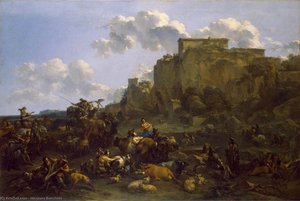
Nicolaes Berchem was a Dutch landscape painter and etcher who achieved wide popularity. He was born in Haarlem in 1620, the son of Pieter Claesz., a renowned still-life artist whose influence undoubtedly shaped Nicolaes’ early artistic sensibilities. Houbraken recounted tales of his father chasing him around Haarlem with the intent to beat him—a playful anecdote hinting at Berchem's spirited character and perhaps linked to his father’s hometown of Berchem near Antwerp. This familial connection fostered a deep appreciation for detail and observation, foundational elements in Berchem’s distinctive style. ### Early Training and Influences Berchem received instruction from several prominent Dutch masters, including Jan van Goyen, known for his subtle tonal landscapes; Pieter de Grebber, admired for his dynamic compositions; Jan Baptist Weenix, with whom he traveled to Italy; Jan Wils, and Claes Cornelisz. Moeyaert. These diverse influences provided the bedrock for Berchem’s versatile style, equipping him with technical skills and fostering an understanding of artistic conventions prevalent in Northern Europe during his formative years. The encounter with Jan Baptist Weenix proved particularly significant, marking the beginning of a collaborative journey that would ultimately expose Berchem to the transformative atmosphere of Italy. ### The Italianate Awakening Between 1642 and 1645, Berchem embarked on an unforgettable expedition to Italy alongside Weenix. This voyage ignited within him a passion for classical architecture and pastoral landscapes—the very subjects he would dedicate his artistic energies to exploring throughout his career. He meticulously sketched Roman ruins and observed the vibrant life of Italian countryside, absorbing the romantic spirit of the era and preparing to translate its essence onto canvas upon his return to Haarlem. This experience fundamentally reshaped Berchem’s aesthetic vision, propelling him toward what became known as the “Dutch Italianate” style—a genre characterized by idealized depictions of Italy infused with Northern European realism. ### Mastering Light and Atmosphere: A Distinctive Style Berchem’s paintings are instantly recognizable for their warm, golden light, often bathing scenes in the soft glow of dawn or dusk. This luminosity isn't merely a technical achievement; it imbues his artworks with a profound sense of tranquility, nostalgia, and timeless beauty. He skillfully blended Northern European realism with Southern romanticism, creating a unique style that celebrated both the grandeur of nature and the human connection to it. Berchem’s compositions are carefully balanced, frequently featuring classical ruins as evocative reminders of the past alongside figures engaged in pastoral activities—shepherds tending their flocks, travelers resting by a stream, or mythological scenes unfolding amidst idyllic settings. His meticulous attention to detail ensured that every brushstroke conveyed an emotional resonance that drew the viewer into the scene. ### Legacy and Enduring Influence Nicolaes Pietersz Berchem’s influence extended far beyond his prolific output—estimated at around 850 paintings, etchings, and drawings—demonstrating both his enduring popularity and lasting legacy. He was a dedicated teacher, nurturing the talents of numerous artists including Abraham Begeyn, Johannes van der Bent, his son Nicolaes, Isaack Croonenbergh, Simon Dubois, Karel du Jardin, and Jan Frans Soolmaker. His artistic vision resonated with subsequent generations, notably impacting French Rococo painter Jean-Baptiste Pillement and the Dutch “Cleves Romanticism” landscape painters like Barend Cornelis Koekkoek. Berchem’s contribution lies in his masterful bridging of Northern realism and Southern romanticism—a feat that cemented his place as a cornerstone of Dutch Baroque art and ensured that his paintings continue to captivate audiences centuries later. His work remains a poignant reminder of a time when art sought not just to represent the world but to elevate it.Gerelateerde artikelen

Top 10 Meesterwerken van de Gouden Eeuw: Kunst voor uw interieur | ArtsDot.nl
Ontdek de 10 meesterwerken van de Gouden Eeuw! Leer over Rembrandt, Vermeer & andere Hollandse schilders. Prachtige kunst reproducties voor uw interieur. Museumkwaliteit prints op ArtsDot.com.

Jan Steen: A Master of Dutch Genre Painting & the Golden Age
Explore the life & art of Jan Steen, a leading Dutch Golden Age painter renowned for his humorous genre scenes & insightful social commentary. Discover his techniques, legacy, and collecting tips.

Golden Age Reflections: Dutch Baroque Painting & Cultural Innovation
Explore the Dutch Golden Age of painting! Discover key artists like Vermeer & ter Borch, their innovative techniques, and the rich cultural context behind these Baroque masterpieces. Learn about collecting & appreciating this iconic art period.