


 Bekijk op ware grootte
 Verstuur
 Delen
Delen
 Details bekijken
 Gids voor studentenkunstwerken

 Download
 Vergelijkbare items
 Röntgenonderzoek
 Diavoorstelling
 Statistieken
Rustic Mill
 Olieverf op canvas
- Wanddecoratie
- Hudson River School
 1855
1855- 19e eeuw
 279.0 x 376.0 cm
 Lees meer
Handgemaakte olieverfreproductie
Met de hand geschilderd in olieverf op canvas in uw gewenste maat en lijst, op bestelling gemaakt door onze kunstenaars. ( Schakel over naar print Schakel over naar digitale afbeeldingen)




P118B €10

P118H €10

P118W €10

P438Z €10

P508JH €12

P508YH €12

P805H €10

P805Z €10

P919BZ €10

P919G €10

P919XJ €10

P959ZH €10

P968JZ €12

W106C €8

W218G €10

W218JH €8

W218Y €10

W307PJ €10

W316G €10

W316PJ €8

W316Y €10

W398PJ €8

W4111J €10

W500HY €15

W500JH €15

W692G €12

W849H €8

W940BG €15

W953PJ €8




Kies uit onze vooraf ingestelde maten die overeenkomen met de originele verhoudingen van het kunstwerk.

Voer de breedte en de hoogte in die u nodig heeft, passend bij uw lijst of uw muur. Dit is handgeschilderd, dus bij een afmeting met een andere vormverhouding kan de kunstenaar iets meer rondom het schilderij schilderen of juist iets meer weglaten — u kiest zelf. Wij sturen u een digitaal mockup ter goedkeuring voordat het schilderwerk begint. De afbeelding die op deze pagina wordt getoond, is niet het uiteindelijke resultaat — alleen de mockup geeft dit weer.
Na de bestelling zal het team van ArtsDot.com per e-mail contact opnemen met de klant voor instructies en een mockup-voorbeeld sturen.
Wereldwijde levering () binnen 3 tot 4 weken in plaats van de standaard 5 weken. (18 oktober). Zonder concessies aan de kwaliteit.

Gratis wereldwijde expressverzending

Hoogwaardig linnen canvas

Volledige verzendverzekering

Garantie op terugbetaling van invoerrechten

Garantie op exacte kleurweergave

Retourbeleid van 100 dagen (alleen bij defecten)

100% Geld-terug-garantie

Korting bij meerdere afnames
 De optie voor glas is alleen beschikbaar bij een formaat kleiner dan 110 cm.

Rustic Mill
Reproductiemethode
Formaat reproductie
-


Totaalprijs
€ 251
Een Pastorale Meesterwerk
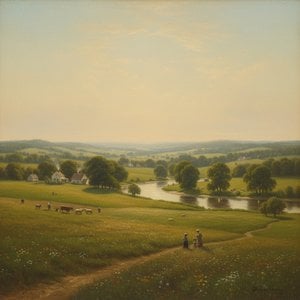
Dompel uzelf onder in de serene schoonheid van dit meeslepende landschapsschilderij door Albert Bierstadt. Dit kunstwerk, vervaardigd in 1855, nodigt de kijker uit tot een rustgevend landelijk tafereel waarin de pracht van de natuur het middelpunt vormt. De compositie toont een rustieke woning, genesteld tussen weelderig groen en imposante bomen, wat een gevoel van vrede en harmonie met de natuurlijke wereld oproept.Stijl en Techniek
De meesterlijke techniek van Bierstadt komt duidelijk naar voren in deze gedetailleerde weergave van een pastoraal landschap. Het kunstwerk is een schoolvoorbeeld van de Hudson River School-stijl, die wordt gekenmerkt door een minutieuze aandacht voor detail en een romantische portrettering van de natuur. Bierstadt maakt gebruik van een rijk aards kleurenpalet, waarbij diepe groentinten, warme bruintinten en zachte blauwen samensmelten tot een harmonieus geheel dat zowel rustgevend als visueel indrukwekkend is. Het gebruik van natuurlijk licht voegt diepte en dimensie toe aan de scène, waarbij schaduwen en highlights met grote expertise zijn weergegeven om het driedimensionale effect te versterken. De zichtbare penseelstreken zorgen voor textuur en vitaliteit, waardoor het landschap tot leven komt en de kijker uitnodigt om zich te verliezen in de schoonheid ervan.Historische Context
Als een sleutelfiguur van de Hudson River School maakte Albert Bierstadt deel uit van een artistieke beweging die de ongerepte landschappen van Amerika vierde. Dit schilderij weerspiegelt de fascinatie van die tijd voor de natuurlijke wereld en het verlangen om de grootsheid ervan op canvas vast te leggen. Hoewel het werk van Bierstadt vaak scènes uit het Amerikaanse Westen afbeeldde, toont dit specifieke stuk zijn vermogen om schoonheid te vinden in meer bescheiden, landelijke omgevingen.Symboliek en Emotionele Impact
Het rustieke huis en de kronkelende beek symboliseren respectievelijk stabiliteit en de voortdurende stroom van het leven. De algehele stemming van het kunstwerk is er een van rust en sereniteit, die een toevluchtsoord biedt aan de hectiek van het moderne leven. Het behendige gebruik van perspectief door Bierstadt trekt de kijker de scène in, waardoor een meeslepende ervaring ontstaat die hen transporteert naar een vredig platteland.Waarom dit Kunstwerk Opvalt
Dit schilderij is een getuigenis van de gave van Bierstadt om de essentie van de natuur met ongeëvenaarde precisie en kunstzinnigheid te vangen. Het samenspel van licht en schaduw, de gedetailleerde weergave van natuurlijke elementen en het harmonieuze kleurenpalet maken dit kunstwerk tot een opvallend stuk in elke collectie.Ideaal voor Kunstliefhebbers en Verzamelaars
Voor kunstliefhebbers en verzamelaars die op zoek zijn naar een hoogwaardige reproductie, biedt dit schilderij de mogelijkheid om een stukje Amerikaans artistiek erfgoed in huis te halen. De tijdloze aantrekkingskracht en serene schoonheid maken het een perfecte toevoeging aan elke interieurruimte, waarbij het een vleugje elegantie en rust toevoegt.Perfect voor Interieurontwerp
Interieurontwerpers zullen de veelzijdigheid van dit kunstwerk waarderen. Of het nu wordt geplaatst in een gezellige woonkamer, een rustige slaapkamer of een elegante eetkamer, dit schilderij versterkt de ambiance met zijn kalmerende aanwezigheid. De rijke aardse tinten complementeren diverse kleurenschema's, waardoor het een veelzijdige keuze is voor elk ontwerpproject. Ervaar de tijdloze schoonheid van dit meesterwerk en breng een stukje Amerikaanse kunstgeschiedenis in uw ruimte met een hoogwaardige reproductie van "Rustic Mill" door Albert Bierstadt.Vragen & Antwoorden
Hoe sterk is het contrast in "Rustic Mill" door Albert Bierstadt?
"Rustic Mill" door Albert Bierstadt vertoont een Verklaring contrast tussen de lichte en donkere partijen.
Welke kleur domineert de compositie van "Rustic Mill" door Albert Bierstadt?
De kleur die het meest opvalt in "Rustic Mill" is Ftalogroen (#20191d). De dominante kleur is handig bij het afstemmen van een kunstwerk op een interieur.
Is Albert Bierstadt, maker van "Rustic Mill", bekend onder andere namen?
Andere namen die bekend zijn voor Albert Bierstadt, maker van "Rustic Mill", zijn onder andere Henry Bierstadt, Edward Bierstadt, Charles Bierstadt.
Gerelateerde kunstwerken


Biografie van de kunstenaar
A Pioneer of the American West: The Life and Art of Albert Bierstadt
Albert Bierstadt’s story is deeply intertwined with the very formation of America itself. His family's early emigration to New Bedford, Massachusetts, when he was just a year old, planted the seeds for a lifelong fascination with the landscapes that would ultimately define his artistic legacy. Though initially self-taught, sketching with crayons as a youth, Bierstadt quickly recognized the need for formal training and embarked on studies in Düsseldorf, Germany, in 1853. This European grounding proved crucial, providing him with technical mastery—a meticulous attention to detail and a sophisticated understanding of light and atmosphere—that he would later apply to his depictions of the American wilderness. It wasn’t merely replication that Bierstadt sought; he aimed to convey the sublime power and beauty of nature, evoking an emotional response in the viewer.Capturing the Majesty: The Hudson River School and Beyond
Upon his return to the United States in 1857, Bierstadt swiftly became associated with the Hudson River School, a group of artists dedicated to portraying the American landscape with both accuracy and romantic idealism. While sharing their reverence for nature, Bierstadt soon distinguished himself through his ambitious scale and dramatic compositions. He wasn’t content to simply paint pretty pictures; he aimed to create immersive experiences that transported viewers directly into the heart of the wilderness. His breakthrough came in 1858 with a Swiss landscape exhibited at the National Academy of Design, earning him immediate acclaim and honorary membership. However, it was his subsequent expeditions westward—first with land surveyor Frederick W. Lander in 1859, then with author Fitz Hugh Ludlow in 1863 to Yosemite Valley—that truly ignited his artistic vision. These journeys weren’t merely acts of observation; they were profound immersions, allowing Bierstadt to absorb the grandeur of the Rocky Mountains, the vastness of the plains, and the awe-inspiring scale of canyons and waterfalls. He meticulously documented these experiences through countless sketches and studies, which served as the foundation for his monumental paintings.The Painter of Empires: Shaping Perceptions of the West
Bierstadt’s paintings weren't simply landscapes; they were statements about national identity and Manifest Destiny. His canvases—often enormous in size—depicted the American West not as a harsh, untamed frontier, but as a land of promise, abundance, and divine beauty. The Rocky Mountains, Lander’s Peak, completed in 1863 and purchased for an astonishing $25,000 (equivalent to nearly $400,000 today), exemplifies this approach. The painting isn't a precise topographical rendering; it’s a carefully constructed vision of idealized grandeur, bathed in golden light and imbued with a sense of spiritual significance. This ability to evoke emotion, to inspire awe, made Bierstadt immensely popular during his lifetime. He wasn’t just an artist; he was a cultural ambassador, shaping how Americans—and the world—perceived the West. His work fueled westward expansion by presenting it as a noble and divinely ordained undertaking. The dramatic lighting, often referred to as *luminism*, created a sense of ethereal beauty, transforming the rugged wilderness into a scene of almost religious reverence.Influences and Techniques
Bierstadt’s artistic development was shaped by several key influences. His early training in Düsseldorf instilled in him a mastery of technique—a meticulous attention to detail and a sophisticated understanding of light and atmosphere. He studied the works of German Romantic painters, particularly Caspar David Friedrich, whose emphasis on sublime landscapes profoundly influenced his own approach. However, Bierstadt’s style also evolved over time, incorporating elements of American Realism and Luminism. His expeditions westward provided him with firsthand experience of the American wilderness, which he translated into his paintings through detailed sketches and studies. He was a master of color, using rich, vibrant hues to capture the beauty of the natural world. Furthermore, Bierstadt’s use of scale—often creating monumental canvases that filled entire rooms—contributed significantly to the immersive quality of his work.Legacy and Influence
While Bierstadt's popularity waned somewhat in the late 19th century as artistic tastes shifted towards Impressionism and photography, his influence on American landscape painting remains undeniable. He demonstrated the power of large-scale canvases to create immersive experiences, a technique later adopted by many artists. His meticulous attention to detail and masterful use of light continue to inspire painters today. Beyond his technical achievements, Bierstadt’s work serves as a valuable historical document, offering insights into the evolving perceptions of the American West during a period of rapid change and expansion. He captured a moment in time—a vision of pristine wilderness before it was irrevocably altered by human intervention. His paintings are not just beautiful images; they are windows into a pivotal era in American history, reminding us of both the promise and the cost of westward expansion. His legacy endures, ensuring that his breathtaking landscapes will continue to captivate and inspire generations to come.
Albert Bierstadt
1830 - 1902 , Duitsland
Snelle feiten
- Artistic Movement Or Style: Hudson River School
- Artists Or Movements Influenced By This Artist: ['Rocky Mountain School']
- Artists Who Influenced This Artist: ['Europees landschap']
- Date Of Birth: 7 jan 1830
- Date Of Death: 18 feb 1902
- Full Name: Albert Bierstadt
- Nationality: Duits-Amerikaans
- Notable Artworks:
- Rocky Mountains
- Yosemite
- Place Of Birth: Solingen, Duitsland
Gerelateerde artikelen

The Sublime Landscape: Exploring the Hudson River School Movement
Explore the captivating world of the Hudson River School! Discover the history, artists, and defining characteristics of this iconic American art movement. Learn about Romanticism's influence & find inspiration for your collection.

Robert Spencer: Luminism, Narrative & the American Landscape Tradition
Explore the captivating world of Luminism & the Hudson River School with our expert analysis. Discover the history, artists, and enduring beauty of 19th-century American landscape painting. Find museum-quality reproductions at ArtsDot.

Top 10 Meesterwerken van de Hudson River School: Kunst voor uw interieur
Ontdek de 10 meesterwerken van de Hudson River School! Leer over Thomas Cole, Frederic Church & meer. Prachtige landschappen uit de 19e eeuw voor uw interieur. Kunst reproducties van museumkwaliteit op ArtsDot.com.
Thomas Worthington Whittredge: Capturing the American Pastoral Ideal with Luminist Light
Explore the luminous landscapes of Thomas Worthington Whittredge, a key figure in the Hudson River School and master of Luminism. Discover his captivating paintings & legacy with ArtsDot.

Albert Bierstadt: Luminosity, Landscape & the American Ideal
Explore the breathtaking landscapes of Albert Bierstadt, master of the American West & a leading figure in the Hudson River School. Discover his luminous style and iconic paintings – a timeless investment for art lovers.


