The Genesis of a Vision: Romanticism and the American Landscape
Romanticism (also known as the Romantic movement or Romantic era) was an artistic and intellectual movement that originated in Europe towards the end of the 18th century. The purpose of the movement was to advocate for the importance of subjectivity...
Before the sweeping vistas of the Hudson River School graced canvases, a profound intellectual shift was underway – Romanticism. Emerging in Europe towards the close of the 18th century, this movement represented a rebellion against the Enlightenment’s emphasis on reason and order. Where logic had reigned supreme, Romanticism championed subjectivity, imagination, and an almost reverent appreciation for the untamed power of nature. It wasn't merely about depicting landscapes; it was about evoking emotion, exploring the sublime—that awe-inspiring blend of beauty and terror—and recognizing a spiritual connection to the natural world. This philosophical foundation proved fertile ground for artists seeking to define a uniquely American aesthetic, one that moved away from European traditions and embraced the vastness and wildness of the New World. The rejection of social conventions in favor of individualism resonated deeply with a young nation forging its own identity, and this spirit would become inextricably linked with the landscapes they chose to portray.
Thomas Cole and the Founding of the Hudson River School
The Hudson River School was a mid-19th-century American art movement embodied by a group of landscape painters whose aesthetic vision was influenced by Romanticism. Early on, the paintings typically depicted the Hudson River Valley and the surroundi...
The name “Hudson River School” itself is somewhat ironic; it wasn’t initially intended as praise. In fact, the term emerged disparagingly in the 1870s, after the movement had begun to wane in popularity with the rise of plein-air painting styles like Barbizon. Yet, the label stuck, aptly characterizing a group of New York City-based landscape painters whose aesthetic vision was profoundly shaped by their surroundings and shared ideals. At the heart of this collective stood Thomas Cole, widely acknowledged as its founder. A British immigrant arriving in America in 1825, Cole experienced a transformative encounter with the Hudson River Valley. Unlike the meticulously cultivated landscapes of his homeland, the American wilderness possessed a raw, untamed beauty that ignited his imagination. His initial voyage up the river, sketching and absorbing the dramatic scenery of the Catskill Mountains, marked the genesis of a distinctly American landscape tradition. Cole’s early works weren't simply representations; they were imbued with allegorical meaning, often reflecting themes of discovery, exploration, and the nascent nation’s destiny. His close friend and protégé, Asher Brown Durand, would become another pivotal figure, solidifying the school’s principles and ensuring its continued evolution.
Defining Characteristics: Luminism, Detail, and the Pursuit of the Sublime
Luminism is a style of American landscape painting from the 1850s to 1870s, characterized by effects of light in a landscape, through the use of aerial perspective and the concealing of visible brushstrokes. Luminist landscapes emphasize tranquility,...
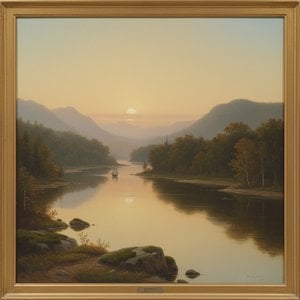
The paintings of the Hudson River School are immediately recognizable for their meticulous detail, dramatic lighting, and a pervasive sense of tranquility. While early works often featured grand, sweeping panoramas, a defining characteristic emerged in the mid-19th century known as Luminism. This style emphasized effects of light—soft, hazy skies, calm reflective waters—creating an atmosphere of serene contemplation. Artists like Fitz Henry Lane, Martin Johnson Heade, and John Frederick Kensett became masters of this technique, concealing visible brushstrokes to achieve a remarkable sense of realism and atmospheric depth. However, Luminism wasn’t merely about technical skill; it was about capturing a specific *feeling*—a quiet reverence for nature's beauty and the sublime power it held. The landscapes weren’t simply observed; they were experienced, filtered through the artist’s emotional lens. This pursuit of the sublime often involved juxtaposing peaceful agricultural scenes with the remaining vestiges of wilderness, acknowledging both the benefits of civilization and the inherent value of untouched natural spaces.
Second Generation Masters: Church, Bierstadt, and the Expansion Westward
Following Cole's untimely death in 1848, a second generation of Hudson River School artists emerged, building upon his legacy while forging their own distinct styles. Frederic Edwin Church, perhaps the most celebrated of these painters, brought an almost scientific precision to his depictions of nature, meticulously rendering every detail with breathtaking accuracy. Albert Bierstadt, influenced by his studies in Düsseldorf, created monumental canvases that captured the grandeur of the American West—the towering peaks of the Rocky Mountains, the vast expanse of the plains. These weren’t simply landscapes; they were epic narratives celebrating America's expansion and its seemingly limitless potential. Both Church and Bierstadt achieved immense popularity during their lifetimes, becoming celebrities whose paintings drew thousands of viewers eager to witness the beauty of a nation unfolding before them. Their works often depicted scenes that were largely inaccessible to most Americans at the time, offering a vicarious experience of the wilderness and fueling a growing sense of national pride.
Beyond Representation: Themes of Nationalism, Exploration, and Preservation
The Hudson River School paintings weren’t simply beautiful images; they were deeply intertwined with the social and political currents of 19th-century America. A strong undercurrent of nationalism ran through their work, celebrating the unique beauty of the American landscape as a symbol of national identity. The artists often depicted scenes that highlighted the country's vastness, its natural resources, and its potential for growth. Furthermore, these paintings played a crucial role in shaping public perception of the wilderness, fostering a growing awareness of its value and contributing to the early conservation movement. By depicting pristine landscapes, they implicitly argued for their preservation—a message that resonated with an increasingly concerned citizenry. The school’s emphasis on exploration also reflected the spirit of Manifest Destiny, documenting the westward expansion and celebrating the pioneers who ventured into uncharted territories. However, it's important to note that this celebration often overlooked the impact of settlement on Native American populations, a complex aspect of the era that is now receiving greater scholarly attention.
The Enduring Legacy: Influence and Rediscovery of the Hudson River School
While the popularity of the Hudson River School waned in the early 20th century, eclipsed by more modern art movements, its influence has proven remarkably enduring. After a period of relative obscurity, interest in the school resurged after World War I, fueled by a renewed sense of national pride and a growing appreciation for American history. The rediscovery of these paintings coincided with the regrowth of the Hudson Valley itself, prompting a deeper understanding of their historical context and artistic significance. Today, works by Thomas Cole, Frederic Church, Albert Bierstadt, and other masters grace the walls of major museums across the country, captivating audiences with their beauty and emotional depth. The school’s legacy extends beyond its paintings; it continues to inspire artists and nature enthusiasts alike, reminding us of the power of art to connect us to the natural world and to celebrate the enduring spirit of America. At ArtsDot.com, we are proud to offer high-quality reproductions of these iconic works, allowing you to bring the sublime landscapes of the Hudson River School into your own home.