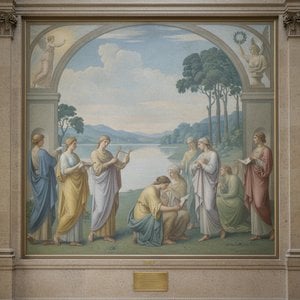
A Romantic Visionary of the Portuguese Soul
Miguel Ângelo Lupi de Azevedo stands as a pivotal figure in the tapestry of Portuguese Romantic art, embodying the movement’s profound preoccupation with emotion, imagination, and historical grandeur. Born in Lisbon in 1826 to an Italian immigrant family, his early life was infused with a cosmopolitan spirit that would forever shape his artistic trajectory. From a young age, Lupi demonstrated an exceptional, almost instinctive talent for drawing and painting. Driven by a passion that transcended familial expectations, he pursued his studies at the Lisbon Academy of Fine Arts—a rare feat for an unmatriculated student at the time. This unconventional beginning fostered a deep-seated connection to artistic exploration, setting the stage for a career defined by both academic rigor and soulful rebellion.
The trajectory of Lupi’s development was significantly altered by his exposure to the broader European landscape. Between 1860 and 1863, thanks to a generous state grant, he undertook formative studies in Italy. This immersion in Italian artistic culture exposed him to the delicate nuances of luminism and the structured elegance of neoclassicism. However, Lupi’s heart remained tethered to the Romantic ideals that were sweeping through the continent. He became a staunch advocate for a style characterized by dramatic contrasts of light and shadow, expressive brushwork, and an emphasis on capturing the sublime beauty of nature alongside the poignant, often turbulent, depths of human emotion. The works of masters like Eugène Delacroix served as vital inspirations, teaching him how to translate complex psychological states into a vivid visual language.
Mastery of Portraiture and Historical Narrative
Lupi’s artistic output was a sophisticated blend of portraiture and historical painting, genres that allowed him to navigate the intellectual and social currents of 19th-century Portugal. He achieved considerable renown as a master of the portrait, possessing a unique ability to capture the likenesses of prominent figures with meticulous detail while simultaneously unveiling their inner character through subtle gestures and evocative expressions. As a pioneer of realist portraiture in Portugal, his work during the 1870s and 1880s became a mirror for bourgeois society, documenting the faces and the very essence of an era.
Beyond the intimate scale of portraiture, Lupi sought to command the grand stage of historical painting. His ability to weave narrative tension into his canvases was perhaps most evident in his academic pursuits. After returning from Italy, he presented himself as a candidate for the Chair of Historical Painting at the Lisbon Academy with a powerful depiction of The Kiss of Judas. This work, along with his later responsibilities in inspecting monumental works in Paris, solidified his reputation as an artist capable of handling profound religious and historical themes. His paintings often utilized a dark, evocative palette to create atmospheres that felt both timeless and hauntingly immediate.
Legacy and Academic Influence
The significance of Miguel Ângelo Lupi de Azevedo extends far beyond the borders of his canvases; he was also a dedicated educator who shaped the next generation of Portuguese artists. His appointment to the Chair of Historical Painting at the Lisbon Academy allowed him to pass on his mastery of technique and his Romantic sensibilities to his students. He was not merely a painter of scenes, but a reformer of thought, even proposing plans for the improvement of the Royal Academy of Fine Arts to ensure its continued relevance in a changing world.
His life was marked by a remarkable resilience and a commitment to his craft that survived periods of financial uncertainty. Even when forced to work as an assistant bookkeeper at the Imprensa Nacional to support himself, his creative spirit remained undiminished. Today, Lupi is remembered not only for the technical brilliance of works such as The Water Girl or Hope and Sorrow but as a bridge between the classical traditions of the past and the burgeoning realism of the future. His legacy remains etched in the history of Portuguese art, representing a period where light, shadow, and human emotion converged to create something truly eternal.
질의응답
Miguel Ângelo Lupi De Azevedo의 다른 이름이나 별칭에는 무엇이 있나요?
Miguel Ângelo Lupi De Azevedo은(는) Miguel Ângelo Lupi(으)로도 알려져 있습니다.
Miguel Ângelo Lupi De Azevedo 작가는 어떤 색상을 가장 자주 사용했나요?
본 웹사이트에 등록된 작품 전반에 나타나는 Miguel Ângelo Lupi De Azevedo의 색채 활용은 작가의 팔레트 지놈 페이지에서 확인하실 수 있습니다.
Miguel Ângelo Lupi De Azevedo 작가의 출신 국가는 어디인가요?
Miguel Ângelo Lupi De Azevedo은(는) Portugal에서 태어났습니다.