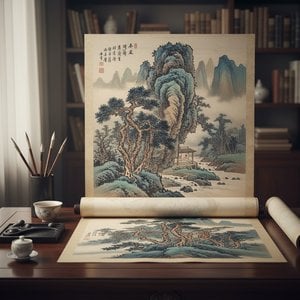
The Daoist Brush
Born in Jiangxi, Fang Congyi lived a life shaped by the quietude of spiritual practice and the movement of the natural world. In his youth, he sought a different kind of order, joining the Zhengyi Dao sect at a local temple to study as a Daoist priest. This period of religious devotion provided more than just spiritual grounding; it offered a lens through which he would eventually view the landscape. Following the death of his principal instructor in the early 1340s, he left the temple behind to travel along the Yangtze River, a path that led him toward the capital of Khanbaliq, now Beijing.
It was in the capital that his transition from priest to painter began to take shape. Finding patronage, he began to translate his travels and his spiritual observations into ink and color. His work became a record of the terrain he had traversed, rendered with a specific, kinetic energy that sought to capture the essence of the mountains rather than a mere imitation of their surface.
The Movement of Mountains
His technique was defined by a sense of constant motion, particularly in how he approached the physical structure of the earth. He did not treat mountains as static objects, but as living entities. In his hands, the brushwork became a whirlwind, charging the landscape with a vitality that seemed to defy the weight of the stone. This approach was deeply connected to the geomantic beliefs of his time, specifically the concept of longmo, or dragon veins, which suggests a pulsating life energy flowing through mountain ranges and watercourses.
The artist’s identity was often obscured by the various names he carried, reflecting a multifaceted existence that moved between the secular and the sacred. His various sobriquets include:
- Wuyu
- Fanghu
- Bumang Daoren
- Jinmen Yuke
- Guigu Shanren
A Legacy in Ink
The works attributed to him remain significant examples of Yuan dynasty landscape painting. His ability to dissolve solid forms into atmospheric mists allowed him to explore themes of emptiness and the transient nature of the physical world. This method moved beyond simple shan shui traditions, using the natural world as a vehicle for a more meditative exploration of existence.
His surviving compositions, such as those held in the Metropolitan Museum of Art, the Cleveland Museum of Art, and The Palace Museum, demonstrate a mastery of the handscroll format. Through these works, the energy of the mountains is preserved, captured in a way that suggests the landscape is perpetually ascending into the clouds.
Q&A
Fang Congyi 작가의 작품을 감상할 수 있는 3D 갤러리는 어디인가요?
Fang Congyi의 3D 갤러리는 작가의 작품들을 가상 3D 갤러리로 감상할 수 있는 페이지입니다.
Fang Congyi의 작품을 색상별로 찾아볼 수 있나요?
Fang Congyi의 작품은 작가의 컬러 인덱스 페이지에서 색상별로 감상하실 수 있습니다.
Fang Congyi 작가의 국적은 어디인가요?
Fang Congyi은(는) People's Republic of China 출신입니다.
Fang Congyi의 출생 도시와 국가는 어디인가요?
Fang Congyi은(는) People's Republic of China Jiangxi에서 태어났습니다.