
- ホーム

- 油絵の複製画
- ワシリー・ワシーリエヴィチ・カンディンスキー
- Yellow - Red - Blue

 プリントを購入
 シェアする
シェアする シェアする
シェアする
 Details

 ダウンロード
 似ている作品
 X-Ray
X-Ray スライドショー
Yellow - Red - Blue






P118B $10

P118H $10

P118W $10

P438Z $10

P508JH $12

P508YH $12

P805H $10

P805Z $10

P919BZ $10

P919G $10

P919XJ $10

P959ZH $10

P968JZ $12

W106C $8

W218G $10

W218JH $8

W218Y $10

W307PJ $10

W316G $10

W316PJ $8

W316Y $10

W398PJ $8

W4111J $10

W500HY $15

W500JH $15

W692G $12

W849H $8

W940BG $15

W953PJ $8




 続きを読む
続きを読む作品のオリジナル比率に合わせた、当店の規定サイズからお選びください。

特定のフレームやスペースに合わせて、ご希望のサイズをご入力いただけます。選択されたサイズが元の画像の比率と異なる場合、アートワークをトリミングするか、手描きで要素を追加して絵画を拡張いたします。デジタルモックアップ を制作し、制作開始前にご確認(承認)をいただきます。
画面上のプレビューは、実際のトリミングや拡張を正確に反映しているものではありません。最終的な構図は、モックアップによってのみ正確にご確認いただけます。
カスタムサイズもご利用いただけますが、元の比率を維持するためには、あらかじめ用意されたリストからサイズを選択することをお勧めいたします。
ご注文後、ArtsDot.com チームより詳細な指示をお送りするとともに、仕上がりイメージ(モックアップ)をご提供いたします。


 ガラスオプションは、110cm未満のサイズでのみご利用いただけます。

Yellow - Red - Blue
複製技法
複製画のサイズ
-


合計金額
-
作品解説
A Symphony of Form and Color: Exploring Kandinsky’s “Yellow-Red-Blue”
Wassily Kandinsky's "Yellow-Red-Blue," created in 1925, stands as a pivotal achievement in the evolution of abstract art. This iconic oil on canvas is more than just a painting; it’s a visual articulation of spiritual and emotional experience through the language of pure form and color. It currently resides at the Musée National d'Art Moderne in Paris, France, captivating viewers with its dynamic energy and enduring legacy.Deconstructing the Composition
The artwork is characterized by a precise arrangement of geometric shapes – triangles, squares, circles, and lines – floating within a defined space. These elements aren’t representations *of* anything; they *are* the subject matter. The dominant hues—yellow, red, and blue—are employed not descriptively but expressively. Yellow radiates warmth and excitement, red embodies passion and power, while blue evokes calmness and serenity. These colors interact with one another, creating a visual tension and harmony that draws the eye across the canvas. The composition feels both meticulously planned and spontaneously energetic.The Birth of Non-Representational Art
“Yellow-Red-Blue” is deeply rooted in the principles of Expressionism and Abstract art. Kandinsky, a pioneer in this realm, believed that color and form possessed inherent spiritual qualities capable of evoking emotions independent of recognizable imagery. He sought to liberate art from its traditional role as a mimetic representation of the physical world, instead focusing on the inner necessity of artistic expression. His time at the Bauhaus school in Germany further solidified his theories and influence on modern art movements.Symbolism Beyond Representation
While Kandinsky rejected direct symbolism tied to external objects, he believed colors and shapes held universal psychological effects. The precise relationships between these elements weren’t arbitrary; they were carefully orchestrated to create a specific emotional resonance. The circles might suggest completeness or spirituality, the triangles dynamism and direction, and the squares stability and order. However, Kandinsky intentionally left room for individual interpretation, encouraging viewers to engage with the artwork on a personal level and discover their own meaning within its abstract forms.Historical Context & Artistic Techniques
Kandinsky’s journey toward abstraction was gradual, evolving from earlier representational works influenced by Impressionism and Fauvism. The post-World War I era fostered a climate of experimentation and a rejection of traditional values, providing fertile ground for the development of abstract art. His use of oil on canvas allowed for rich texture and depth, while his bold brushstrokes contribute to the painting’s sense of dynamism. He masterfully employed color theory, understanding how different hues interact and influence one another to create specific emotional responses.Emotional Impact & Lasting Influence
“Yellow-Red-Blue” isn't simply a visually striking artwork; it’s an invitation to introspection. It encourages viewers to connect with their own emotions and experiences, bypassing the need for literal interpretation. The painting continues to inspire artists and captivate audiences today, serving as a testament to Kandinsky’s visionary approach and his profound impact on the course of modern art. Its clean lines and bold colors also make it a compelling choice for contemporary interior design, adding a touch of sophistication and intellectual depth to any space.関連作品


アーティストの略歴
Wassily Kandinsky (1866-1944): The Pioneer of Abstract Art
Wassily Wassilyevich Kandinsky, born in Moscow on December 4th, 1866, stands as a monumental figure in the history of art—a visionary who irrevocably transformed artistic expression and ushered in an era dominated by pure abstraction. His journey wasn’t one of immediate artistic epiphany; initially destined for a legal career at Moscow University, it was a transformative encounter with Claude Monet's “Haystacks” – capturing the shimmering light and atmospheric perspective of Impressionism – and witnessing Richard Wagner’s opera "Lohengrin" that ignited within him an irresistible yearning to pursue art. This pivotal moment, occurring around age thirty, marked not merely a career change but a profound reshaping of worldview, propelling him toward pioneering abstraction.
Early influences resonated deeply with Russian culture. His family's ethnographic expedition to the Vologda region in 1889 exposed him to vibrant color palettes and symbolic imagery derived from folk art—a formative experience that instilled a fascination for communicating emotion beyond literal representation. These foundational explorations weren’t simply aesthetic preferences; they were rooted in a profound connection to cultural heritage and an emerging understanding of art's capacity to transcend visual perception.
Moscow, 1866-1896: Seeds of Artistic Vision
Kandinsky’s formative years were marked by rigorous academic training—studying law at Moscow University alongside mastering the piano and cello. However, it was his encounter with Impressionism that fundamentally altered his artistic trajectory. As he recounted in autobiographical writings, “I remember that drawing and a little bit later painting lifted me out of the reality,” reflecting the transformative power of art to transcend mundane experience.
His marriage to Anna Chimyakina brought him into contact with a supportive family environment—a nurturing backdrop for cultivating his artistic sensibilities. He continued teaching law at Moscow University, demonstrating intellectual curiosity alongside developing his burgeoning talent for visual expression.
Munich and Gabriele Münter: The Birth of Expressionism
In 1896 Kandinsky relocated to Munich, enrolling in Anton Azbe’s prestigious private painting school—where he honed his skills in image composition and experimented with color harmonies. Simultaneously, he embarked on a romantic relationship with Gabriele Münter, forging an artistic partnership that would endure for decades.
During this period, Kandinsky's canvases pulsed with emotional intensity—characterized by bold colors and expressive brushstrokes—reflecting the influence of Expressionism’s preoccupation with subjective experience. Works like “Papeln (Poplars)” exemplify this early stylistic phase—capturing the dynamism of nature through vibrant hues and textured surfaces.
The Blue Rider Group and Geometric Harmony
The formation of Der Blaue Reiter (The Blue Rider) in Munich in 1911 marked a crucial juncture in Kandinsky’s artistic evolution. Alongside Gabriele Münter, he established an influential avant-garde collective—embracing geometric abstraction as a means of conveying spiritual truths.
His theoretical writings, notably “Concerning the Spiritual in Art,” articulated his conviction that art should aspire to transcend mere imitation of nature—seeking instead to reveal the artist’s inner world and resonate with viewers on a deeper level. Kandinsky championed the use of geometric forms—circles, triangles, squares—to evoke specific emotional responses—believing they possessed inherent symbolic significance.
“Several Circles” (140 x 140 cm), created in 1923 exemplifies this phase—a dynamic composition where color and form intertwine harmoniously—reflecting Kandinsky’s unwavering commitment to exploring the expressive potential of abstraction. This stylistic shift signaled a decisive break from representational art—embracing instead a visual language rooted in spiritual contemplation.
Bauhaus Influence and Legacy
Kandinsky's involvement with the Bauhaus school in Germany from 1922 until its closure in 1933 profoundly impacted generations of artists—solidifying his role as a champion of geometric abstraction and fostering innovation within architectural design. He taught at Bauhaus, imparting his theories on color and form—inspiring students to pursue artistic experimentation.
Following the Nazi regime’s seizure of power, Kandinsky emigrated to France in 1933—where he continued producing monumental canvases imbued with spiritual resonance—such as “Composition VII”—a testament to his enduring artistic vision. His legacy extends far beyond the realm of painting—influencing subsequent movements and shaping perceptions of abstract art worldwide.
Kandinsky’s unwavering belief in art's capacity to communicate transcendent truths—coupled with his pioneering exploration of geometric abstraction—continues to inspire artists today—affirming his place as one of the most transformative figures in 20th-century artistic history.

ワシリー・ワシーリエヴィチ・カンディンスキー
1866 - 1944 , ロシア
基本情報
- Artistic Movement Or Style: 抽象芸術、表現主義
- Artists Who Influenced This Artist:
- クロード・モネ
- リヒャルト・ヴァグナー
- Date Of Birth: 1866年12月4日
- Date Of Death: 1944年12月13日
- Full Name: ワシリー・ワシーリエヴィチ・カンディンスキー
- Nationality: ロシア
- Notable Artworks:
- いくつかの円
- 構成作品IX
- Place Of Birth: モスクワ、ロシア
関連記事

Beyond Form & Color: Geometric Abstraction's Enduring Legacy in Art History
Explore the captivating world of geometric abstraction! Discover its origins, key artists like Malevich & Mondrian, and why this movement remains highly valued by art collectors today. Expert insights at ArtsDot.

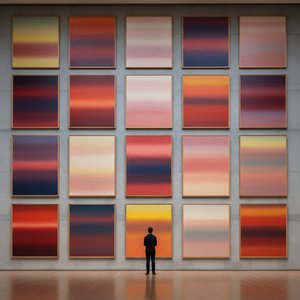
マーク・ロスコ傑作25選:色彩が織りなす深遠な世界|ArtsDot
マーク・ロスコの傑作25選。抽象表現主義を代表する巨匠、色彩が織りなす深遠な世界を探求します。絵画の背景や技法、感動的なストーリーを紐解き、ArtsDotで高品質なアートプリントをお楽しみください。リビングやオフィスにモダンアートを飾るなら!

Kandinsky's Masterpieces: 25 Paintings That Define Abstract Art | ArtsDot
Journey through Wassily Kandinsky's 25 most iconic abstract paintings. Explore his revolutionary use of color, form & spiritual expressionism. Find museum-quality Kandinsky reproductions and elevate your home decor with ArtsDot.com. Discover all masterpieces on ArtsDot.com!

幾何学的抽象絵画を定義した傑作10選|アート、アーティスト、インテリア装飾
モンドリアン、マレーヴィチ…幾何学的抽象絵画を代表する傑作10選。各作品の背景や色彩構成、アーティストの情熱に迫ります。美術館品質の複製画はArtsDot.comで。オンラインでアートコレクションをご覧ください。

Beyond Form & Color: Geometric Abstraction's Evolution in 20th/21st Century Art
Explore the evolution of geometric abstraction from Cubism to contemporary art. Discover key artists like Malevich & Mondrian, investment insights, and expert collecting advice at ArtsDot.



