
- ホーム

- キャンバスプリント用
- ナンダラール・ボース
- Abhimanue Badh
 手描き複製画を注文する
 シェアする
シェアする シェアする
シェアする
 Details

 ダウンロード
 似ている作品
 X-Ray
X-Ray スライドショー
Abhimanue Badh
 Indo-Islamic Style
 1947
1947- Modern
 1790.0 x 1300.0 cm
 National Gallery of Modern Art
 続きを読む
続きを読む



P118B $10

P118H $10

P118W $10

P438Z $10

P508JH $12

P508YH $12

P805H $10

P805Z $10

P919BZ $10

P919G $10

P919XJ $10

P959ZH $10

P968JZ $12

W106C $8

W218G $10

W218JH $8

W218Y $10

W307PJ $10

W316G $10

W316PJ $8

W316Y $10

W398PJ $8

W4111J $10

W500HY $15

W500JH $15

W692G $12

W849H $8

W940BG $15

W953PJ $8




作品のオリジナル比率に合わせた、当店の規定サイズからお選びください。

特定のフレームやスペースに合わせて、ご自身でサイズを指定することも可能です。選択されたサイズが元の画像の比率と一致しない場合、作品をトリミングするか、鏡面反射または単色での塗りつぶしによって画像を拡張いたします。制作を開始する前に、ご確認用のデジタルモックアップをお送りいたします。
画面上のプレビューには、実際のトリミングや拡張は反映されませんのでご注意ください。最終的な構図を正確に確認できるのは、モックアップのみとなります。
カスタムサイズも承っておりますが、元の比率を維持するためには、あらかじめ用意されたリストからサイズを選択することをお勧めいたします。


 ガラスオプションは、110cm未満のサイズでのみご利用いただけます。

Abhimanue Badh
ジークレー/アートプリント
複製画のサイズ
-


合計金額
-
作品詳細説明
A Heroic Tragedy in Gold and Ochre
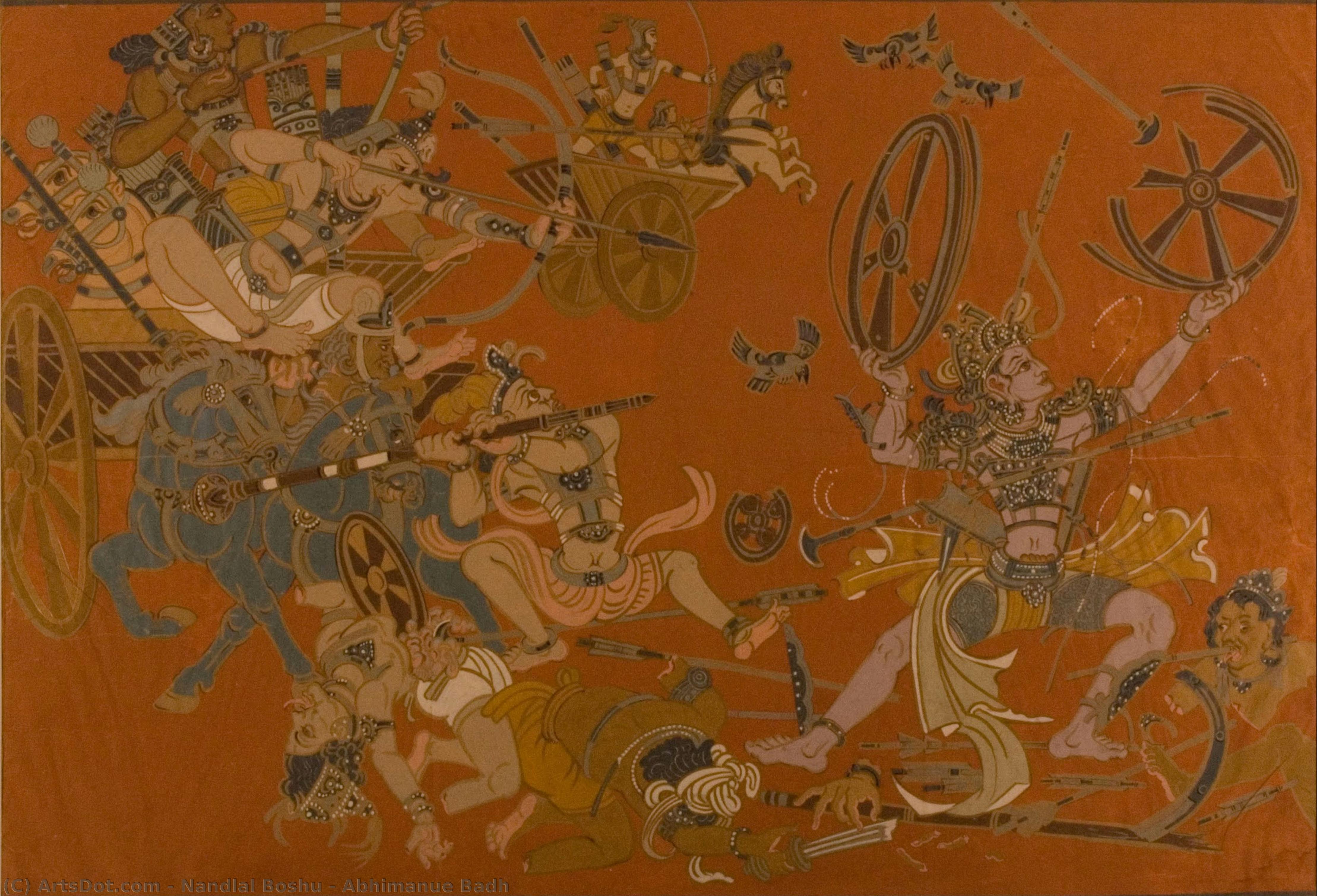
In the heart of Nandalal Bose’s profound contribution to Indian modernism lies Abhimanue Badh, a work that breathes life into the ancient echoes of the Mahabharata. This masterpiece captures the tragic moment of the young hero Abhimanyu’s demise, an episode defined by both unparalleled bravery and heartbreaking injustice. As one of the most significant figures of the Bengal School, Bose does not merely illustrate a myth; he orchestrates a visual symphony of chaos and courage. The painting presents a dense, kinetic landscape where the boundaries between man and myth blur, inviting the viewer into a swirling vortex of combat that feels both timeless and urgently present.
The composition is a masterclass in controlled chaos. Within a crowded and energetic frame, the artist utilizes a flattened perspective reminiscent of classical Indian mural traditions to emphasize the sheer scale of the struggle. The eye is immediately drawn to the interplay of geometric precision—the sharp lines of spears, the circular strength of shields, and the rotating wheels of chariots—against the fluid, organic forms of the warriors' bodies. This tension between structure and movement creates a rhythmic pulse throughout the piece, ensuring that even in its most crowded moments, the painting maintains a sense of epic grandeur.
The Alchemy of Color and Line
Technically, Abhimanue Badh is an exploration of warmth and intensity. The palette is dominated by a luminous spectrum of oranges, golds, and deep ochres, creating an atmosphere that feels as though it is radiating heat from the very center of the battlefield. This monochromatic warmth serves to unify the disparate elements of the battle, casting a divine yet violent glow over the scene. Bose’s meticulous brushwork achieves a rich, layered texture that suggests the weight of history itself, giving the surface a tactile quality that invites close inspection.
The artist's lineage, deeply rooted in the study of the Ajanta cave murals and Mughal miniature traditions, is evident in his masterful use of line. Every contour of a muscle, every arc of a weapon, is defined with a precision that speaks to his disciplined training at Kala Bhavana. These lines do more than define shape; they direct the emotional flow of the piece, guiding the viewer from the frantic energy of the periphery toward the tragic epicenter of the hero's stand. For the collector or designer, this work offers a profound sense of movement and light that can serve as a commanding focal point in any sophisticated interior.
A Legacy of Cultural Revival
Beyond its aesthetic brilliance, this artwork stands as a testament to the revival of Indian visual identity. Created during a period of immense national transformation, Bose’s work reflects his commitment to a "new visual language"—one that drew strength from India's classical past to forge a modern future. The symbolism of the chariot and the heroic struggle serves as a metaphor for the indomitable human spirit in the face of overwhelming odds. To possess a reproduction of this work is to hold a piece of the soul of Indian modernism, bringing into one's space a narrative of resilience, artistry, and the eternal drama of the human condition.
関連作品


アーティストの略歴
生い立ちとキャリア
ナンダラル・ボース、インドが誇る偉大な芸術家は、1882年12月3日、ビハール州ムンゲール地区ハヴェリ・カラグプルにある中産階級のベンガル人家庭に生を受けました。幼い頃から芸術への情熱を燃やしていた彼は、当初、家族の反対に直面しながらも、自らの道を信じて芸術家としての歩みを進めました。カルカッタ美術学校に入学したボースは、そこでアジャンター石窟の壁画から深いインスピレーションを受けました。彼は、古典的なインド文化の復興を目指す国際的な芸術家や作家たちの輪に加わり、その活動は非暴力運動とも深く結びついていきます。1930年に制作された、杖をついて歩くマハトマ・ガンジーを描いた白黒のリノカット版画は、その精神を象徴する記念碑的な作品です。芸術的スタイルと貢献
ナンダラル・ボースの画風は、伝統的なインドの感性とペルシャの影響を融合させた、独自の「インディアン・スタイル」として知られています。その作品群には、インド神話の情景や女性の美しさ、そして素朴な村の生活が息づいており、彼は近代インド美術の先駆者として確固たる地位を築きました。ナンダラル・ボースによる代表的な作品には、以下のようなものがあります:- ライオン (59 x 63 cm, ニューデリー国立近代美術館蔵, テンペラ) - [https://ArtsDot.com/@@/d3zhue-nandlal-boshu-a-lion](https://ArtsDot.com/@@/d3zhue-nandlal-boshu-a-lion)
- ドール・ワラ(太鼓叩き) (59 x 63 cm, ニューデリー国立近代美術館蔵, テンペラ) - [https://ArtsDot.com/@@/d3zgtg-nandlal-boshu-dhol-wala](https://ArtsDot.com/@@/d3zgtg-nandlal-boshu-dhol-wala)
- プラナム(礼拝) (50 x 55 cm, ニューデリー国立近代美術館蔵, テンペラ) - [https://ArtsDot.com/@@/d3zgta-nandlal-boshu-pranam](https://ArtsDot.com/@@/d3zgta-nandlal-boshu-pranam)
遺産と評価
ナンダラル・ボースがインド美術界に残した功績は計り知れません。彼はインド憲法の挿絵を制作するという重要な任務を任されただけでなく、1976年にはインド考古調査局によって、その作品が「芸術の宝」と見なされる「九人の芸術家」の一人として公式に認められました。今日、デリーの国立近代美術館には、彼の魂が宿る7,000点を超える膨大な作品が大切に保管されています。 関連リンク:* ナンダラル・ボースのWikipedia(英語) - [https://en.wikipedia.org/wiki/nandalal_bose](https://en.wikipedia.org/wiki/nandalal_bose)
* ArtsDot.comにおけるナンダラル・ボシュの作品集 - [https://ArtsDot.com/@/nandlal-boshu](https://ArtsDot.com/@/nandlal-boshu)

ナンダラール・ボース
1882 - 1966 , インド
基本情報
- Artistic Movement Or Style: インド様式
- Artists Or Movements Influenced By This Artist: ['アジャンター石窟寺院の壁画']
- Artists Who Influenced This Artist: ['アバニンドナート・タゴール']
- Date Of Birth: 1882年12月3日
- Date Of Death: 1966年4月16日
- Full Name: ナンダラール・ボース
- Nationality: インド
- Notable Artworks:
- ライオン
- ドール・ワラ
- プラナム
- Place Of Birth: インド、カルグプル
関連記事

Echoes of Olympus: Mythological Narratives in Western Art Through the Ages
Explore the captivating history of mythological narratives in Western art! From ancient Greece to modern masterpieces, discover iconic artworks & symbolism. Expert analysis and high-quality reproductions at ArtsDot.


神話と個人的な象徴が織りなす世界:油絵による自己の神話の表現
油絵で自己の神話を表現しませんか?象徴主義、色彩心理学、構図など専門的な知識を基に、内面世界を深掘りするアート作品をご提案。高級美術品からカスタムオーダーまで、ArtsDotがあなたの創造性をサポートします。

Raja Ravi Varma: Bridging Tradition & Modernity in 19th-Century Indian Art
Explore the life & art of Raja Ravi Varma, a pioneer who fused European techniques with Indian iconography. Discover his iconic paintings, lasting legacy, and influence on modern Indian art at ArtsDot.
Heritage Through Paintings: A Cultural Memory of Civilizations – From Ancient Murals to Modern Expressions
Explore the rich history of paintings & their role in preserving cultural heritage. Expert analysis, fascinating insights, and a journey through art from ancient murals to modern masterpieces. Discover the stories behind iconic artworks!

From Snapshot to Legacy: The Art of Commissioning a Hand-Painted Reproduction from Photography – Preserving Memories Through Oil Painting Techniques
Transform cherished photos into timeless oil paintings with skilled artists. Trusted for bespoke portraits & heirloom art. Discover the process, styles & lasting value – a legacy preserved.

