
- Home

- Stampa su tela
- Yi Eungro
- Composition
 Ordina la riproduzione Acquista download
 Invia
Invia
 Condividi
 Dettagli
 Aggiungi ai preferiti

 Scarica
 Simili
 Radiografia
 Slideshow
Composition
 Collage
- WallArt
- Abstract Expressionism
 1970
1970- Modern
 120.0 x 65.0 cm
 Museo Lee Ungno
 Scopri di più
Giclée / Stampa d'arte
Stampa giclée o su tela di qualità museale, con produzione rapida e diverse opzioni di finitura.




































Scegli tra le nostre dimensioni predefinite, che rispettano le proporzioni originali dell'opera d'arte.

È possibile inserire dimensioni personalizzate per adattare l'opera a una cornice o a uno spazio specifico. Se la dimensione selezionata non corrisponde alle proporzioni dell'immagine originale, procederemo al ritaglio dell'opera o all'estensione dell'immagine con un bordo specchiato o a tinta unita. Un mockup digitale ti verrà inviato per approvazione prima dell'inizio della produzione.
Si prega di notare che l'anteprima a schermo non riflette il ritaglio o l'estensione effettivi. Solo il mockup mostrerà accuratamente la composizione finale.
Sebbene siano disponibili dimensioni personalizzate, si raccomanda di selezionare una dimensione dall'elenco predefinito per preservare le proporzioni originali.
Consegna in tutto il mondo () in 2 settimane invece delle normali 4/5 settimane. (2 Luglio)

Spedizione espressa gratuita in tutto il mondo

Tela in lino di alta qualità

Assicurazione completa sulla spedizione

Garanzia di rimborso dei dazi doganali

Garanzia di fedeltà cromatica

Politica di reso entro 60 giorni (solo per difetti)

Garanzia di rimborso al 100%

Sconto per acquisti multipli
 L'opzione vetro è disponibile solo per dimensioni inferiori a 110 cm

Composition
Giclée / Stampa d'arte
Dimensioni riproduzione
-


Prezzo totale finale
-
Descrizione dell'opera
A Symphony of Texture and Tradition
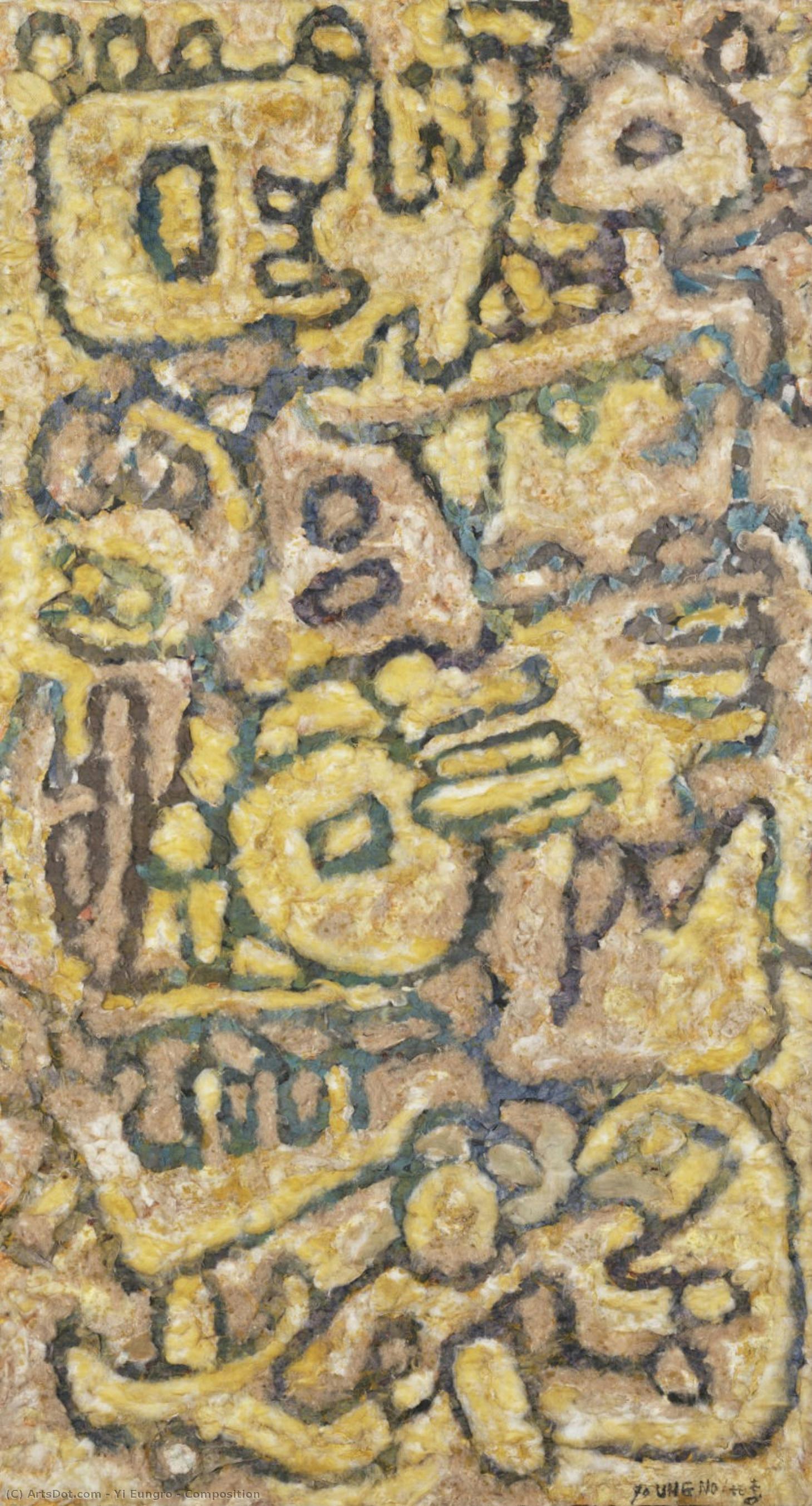
In the evocative masterpiece Composition, created in 1970, the legendary Korean artist Lee Ungno (Yi Eungro) achieves a breathtaking synthesis of Eastern materiality and Western abstraction. This vertical work serves as a profound testament to the artist's lifelong quest to modernize traditional Korean aesthetics through a global lens. At first glance, the viewer is swept into a dense, rhythmic dance of ochre, gold, and amber tones that seem to pulse with an internal, primal energy. The painting does not merely sit upon the canvas; it breathes through a complex layering of textures that challenge the very boundaries between painting and collage.
Lee Ungno’s technical brilliance in this period lies in his revolutionary use of hanji—traditional Korean mulberry paper—as a foundational element. By integrating cotton wool and other tactile materials, he moved beyond the mere application of pigment to create a sculptural surface. The technique involves tearing, reassembling, and painting over fragments of medium, a process that mirrors the fragmented yet unified nature of memory and history. This method allows the artist to achieve an aesthetically harmonious unity, where the "alien" elements of the collage are absorbed into a singular, cohesive whole, contrasting sharply with the more analytical approach found in Western collage traditions.
The Emotional Resonance of Abstract Form
The visual language of Composition is one of controlled chaos. There is no singular focal point to anchor the eye; instead, the viewer’s gaze wanders through a labyrinth of overlapping organic shapes and thick, irregular lines. Subtle traces of darker blue delineate certain forms, providing a necessary tension against the overwhelming warmth of the palette. This lack of a traditional subject matter invites a deeply personal, subjective interpretation. To the collector or interior designer, the piece offers a sense of dynamic movement and dreamlike introspection, making it an ideal centerpiece for spaces that require a sophisticated yet emotionally charged atmosphere.
Beyond its formal qualities, the work carries a profound historical weight. Having navigated the complexities of life in both Seoul and Paris, Lee Ungno utilized this composition to bridge two worlds. The piece evokes a sense of ancient landscapes reimagined through the lens of mid-century expressionism. It is an art of layers—both physical and metaphorical—where the soft texture of cotton wool meets the ruggedness of heavy brushstrokes. For those seeking to adorn a collection with a piece that embodies resilience, innovation, and the beautiful tension between tradition and modernity, this reproduction of Composition offers an unparalleled opportunity to possess a fragment of art history's most transformative era.
Opere simili


Biografia dell'artista
Early Life and Training
Yi Eungro (이응노), born Lee Ungno in Seoul, South Korea on January 12, 1904, possessed an innate fascination for art from a young age. He received his initial artistic education at Hongseong Botong Hakyo (홍성보통학교, 홍城초등학교, 洪城普通學校), where he honed his skills in classical Chinese calligraphy alongside painting landscapes of Yongbongsan Mountain and Deoksungsan Mountain—a formative experience that instilled in him a lifelong appreciation for Eastern aesthetics. Recognizing his ambition, Lee dedicated himself to mastering painting under Yeomjae Song Tae-hoe (예마재 송태호), a celebrated calligrapher-painter-photographer who profoundly shaped his artistic vision.Artistic Career in Korea and Japan
Lee Ungno’s professional journey commenced in Seoul in 1922, where he became an apprentice to Kim Gyujin (김규진), a pivotal figure in Korean art history. Under Kim Gyujin's tutelage, Lee excelled in the “Haegang Style,” characterized by meticulous brushwork and a focus on capturing the spirit of traditional Korean scholarship—a stylistic choice that would define his artistic output for decades to come. His participation in the 3rd Annual Joseon Art Exhibition yielded considerable recognition, notably securing a prize for his depiction of a bamboo (Mukjuk), symbolizing resilience and harmony—a motif that recurred throughout his oeuvre. Throughout the colonial period, Lee consistently achieved acclaim at Joseon Art Exhibitions, demonstrating unwavering dedication to preserving Korean artistic traditions amidst challenging circumstances. However, Lee Ungno harbored a conviction that Eastern ink painters needed to embrace innovation while retaining their core values. Beginning in the early 1930s, he experimented with blending Western stylistic elements—particularly naturalistic landscapes—with Eastern techniques and brushstrokes.International Recognition and Later Life
Following his formative training in Korean inkwash painting, Lee Ungno embarked on a transformative journey into Western art practices during his time in Japan. His artistic explorations from the 1950s reflected an ambitious attempt to synthesize Eastern mediums and expressive gestures with Western perspective and compositional principles. Moving to France in 1958 marked a pivotal moment in Lee Ungno’s career, establishing him as a prominent figure within the burgeoning field of abstract art. He achieved renown for his series of ink and paper collages—particularly “Abstract Letters”—which captured the dynamism of urban life and explored the interplay between form and texture. Furthermore, Lee's monumental "Crowd Paintings" tackled complex themes of human experience and societal observation with remarkable boldness and originality.Legacy
Lee Ungno’s contribution to Korean art history is undeniable. He stands as one of the pioneers of Korean abstract art, championing a stylistic approach that prioritized experimentation while honoring the heritage of Eastern artistic traditions. The Lee Ungno Museum (이응노 미술관), inaugurated in Daejeon in 2007, serves as a testament to his enduring legacy—preserving and showcasing his remarkable artworks—and ensuring that his vision continues to inspire future generations of artists. His influence extends beyond Korea, shaping the broader discourse on Eastern-Western artistic dialogue and solidifying his place among the most significant figures in contemporary Korean art.
Yi Eungro
1904 - 1989 , Corea del Sud
Dati rapidi
- Artistic Movement Or Style: Eastern & Western Expressionism
- Artists Or Movements Influenced By This Artist: ['Haegang Style']
- Artists Who Influenced This Artist: ['Yeomjae Song Tae-hoe']
- Date Of Birth: January 12, 1904
- Date Of Death: January 10, 1989
- Full Name: Yi Eungro (Lee Ungno)
- Nationality: Korean-French
- Notable Artworks: ['Composition']
- Place Of Birth: Seoul, South Korea
Articoli correlati

Kazimir Malevich: Le 25 Opere Iconiche che Hanno Rivoluzionato l'Arte Moderna | ArtsDot
Esplora le 25 opere iconiche di Kazimir Malevich, pioniere del suprematismo e dell'arte astratta. Scopri la storia dietro 'Black Square', 'Bianco su bianco' e altre creazioni rivoluzionarie. Trova riproduzioni d'arte di alta qualità per decorare la tua casa su ArtsDot.com.

John George Brown: Uno sguardo intimo sull'America del XIX secolo attraverso la pittura di genere
Scopri la vita e le opere di John George Brown, maestro del realismo americano. Analisi approfondita della sua pittura di genere, i suoi soggetti iconici e l'influenza sulla storia dell'arte americana.

I 10 Dipinti Più Famosi Dominati dal Marrone Sabbia: Arte e Decorazioni Raffinate
Esplora i 10 dipinti più iconici dominati dal fascino del marrone sabbia! Scopri la storia, gli artisti e le tecniche dietro capolavori senza tempo. Trova riproduzioni di alta qualità per decorare casa con arte e stile su ArtsDot.com.
Rosso Brunastro nell'Arte: I 10 Capolavori Più Affascinanti da Esporre
Esplora i 10 dipinti più iconici dominati dal rosso brunastro! Scopri la storia di Caravaggio, Rembrandt e altri maestri. Trova riproduzioni d'arte di alta qualità per decorare casa con stile su .

The Golden Hue: Exploring Symbolism & Emotion in Yellow Art
Explore the rich symbolism & emotional power of yellow in art history! From Van Gogh to Kandinsky, discover how artists used this vibrant hue. Expert analysis & high-quality reproductions at ArtsDot.


