


 Előnézet
 Megosztás
 Megosztás
 Részletek

 Letöltés
 Hasonló alkotások
 X-ray felvétel
 Diavetítés
Untitled 29

 Tovább olvasom
Giclée / Műnyomat
Múzeumi minőségű giclée vagy vászonnyomat, gyors gyártással és rugalmas finomítási lehetőségekkel. ( Áttérés a kézzel festett másolatra Képváltás)




P118B $10

P118H $10

P118W $10

P438Z $10

P508JH $12

P508YH $12

P805H $10

P805Z $10

P919BZ $10

P919G $10

P919XJ $10

P959ZH $10

P968JZ $12

W106C $8

W218G $10

W218JH $8

W218Y $10

W307PJ $10

W316G $10

W316PJ $8

W316Y $10

W398PJ $8

W4111J $10

W500HY $15

W500JH $15

W692G $12

W849H $8

W940BG $15

W953PJ $8




Válasszon előre meghatározott méreteink közül, amelyek megfelelnek a műalkotás eredeti arányainak.

Megadhat saját méreteket is egy konkrét kerethez vagy helyszínhez igazítva. Amennyiben a kiválasztott méret nem egyezik az eredeti kép arányokkal, a műalkotást le fogjuk vágni, vagy kiegészítjük a képet tükrözött vagy egyszínű szélekkel. A gyártás megkezdése előtt egy digitális tervezetet küldünk jóváhagyásra.
Kérjük, vegye figyelembe, hogy a képernyőn látható előnézet nem tükrözi a tényleges levágást vagy kiegészítést. Csak a tervezet mutatja pontosan a végső kompozíciót.
Bár az egyedi méretek is elérhetőek, az eredeti arányok megőrzése érdekében azt javasoljuk, hogy válasszon a előre meghatározott listából származó méretet.
Világszerte történő kiszállítás területére 2 hét alatt, a szokásos 4-5 hét helyett. 11 augusztus

Ingyenes globális expressz szállítás

Prémium minőségű len vászon

Teljes szállítási biztosítás

Vámvisszatérítési Garancia

Tökéletes színpontosság garancia

60 napos visszaküldési lehetőség (csak gyártási hibák esetén)

100%-os pénzvisszatérítési garancia

Kedvezmény több termény esetén
 Az üvegkeretes opció csak 110 cm alatti méretben érhető el

Untitled 29
Giclée / Műnyomat
A reprodukció mérete
-


Összesített ár
$ 62
Termékinformációk
A Glimpse into Pollock’s Untamed Imagination
Jackson Pollock, a name synonymous with Abstract Expressionism and revolutionary artistic technique, often surprises viewers when confronted with works like “Untitled 29.” While instantly recognizable as a product of his hand, this pencil drawing offers a fascinating departure from the explosive canvases for which he is celebrated. It’s a window into the artist's creative process, revealing a foundational skill in draftsmanship and a penchant for dynamic form that predates – and perhaps informs – his famed “drip” paintings. The work depicts a powerfully rendered creature, reminiscent of a bull or ram, not as a realistic depiction but as an embodiment of raw energy and primal force. The absence of a title encourages viewers to engage directly with the image, interpreting its meaning without preconceived notions.
Deconstructing the Form: Style and Technique
“Untitled 29” is executed entirely in graphite pencil, showcasing Pollock’s mastery of tonal variation and line work. The composition isn't about delicate shading or precise rendering; instead, it embraces bold, expressive lines that define the creature’s muscular structure. The artist employs a geometric approach to form, angular shapes contributing to a sense of stylized power. This is not an animal observed from life, but one conjured from imagination – a mythical beast brought forth through deliberate mark-making. The layering of pencil strokes creates a rich texture, a tactile quality that invites close inspection. The technique feels almost sculptural, building form through density and contrast. It’s a testament to Pollock's early training in traditional art techniques, skills he would later dismantle and reconstruct within his groundbreaking abstract style.
Echoes of Influence: Historical Context
To understand “Untitled 29,” it’s crucial to consider the artistic landscape that shaped Pollock. His formative years were marked by exposure to Regionalist painters like Thomas Hart Benton, whose emphasis on American themes and dynamic compositions resonated with the young artist. However, Pollock didn't simply mimic these influences; he absorbed them, filtered them through his own sensibility, and ultimately forged a new path. The influence of Surrealism is also palpable – not in overt imagery, but in the exploration of the subconscious and the embrace of automatism, a technique where artistic creation proceeds without conscious control. Furthermore, Pollock’s fascination with Native American art, stemming from childhood experiences accompanying his father on surveying trips, likely contributed to his appreciation for bold forms and symbolic representation. This drawing can be seen as an early experiment in distilling these influences into a uniquely personal visual language.
The Power of the Mythical: Symbolism and Emotional Impact
While devoid of explicit narrative, “Untitled 29” evokes a powerful emotional response. The creature’s angled pose and intense gaze convey a sense of contained energy, perhaps even menace. Bulls and rams have long been symbols of strength, virility, and untamed power across various cultures – associations that undoubtedly contribute to the drawing's impact. The lack of background or contextual elements focuses all attention on the creature itself, amplifying its presence and symbolic weight. The work isn’t about telling a story; it’s about evoking a feeling—a primal connection to forces beyond our control. It is an exploration of form and energy that resonates with the core tenets of Abstract Expressionism, foreshadowing the larger-scale explorations Pollock would soon undertake with paint.
Hasonló műalkotások


A művész életrajza
Early Life and the Seeds of Innovation
Paul Jackson Pollock, born in Cody, Wyoming, in 1912, was a restless spirit from the outset. His early life was marked by frequent relocation as his father pursued work as a land surveyor across the vast landscapes of the American West. This itinerant existence instilled in young Pollock a deep connection to the natural world and an exposure to diverse cultures, particularly through encounters with Native American art during those surveying trips – impressions that would subtly permeate his artistic vision later in life. Though he never explicitly imitated Indigenous styles, the raw energy and spiritual resonance of these early experiences undoubtedly left their mark. Pollock’s formal artistic training began at the Manual Arts High School in Los Angeles, followed by studies at the Art Students League of New York under the tutelage of Thomas Hart Benton. Benton, a prominent figure in the Regionalist movement, emphasized rhythmic composition and narrative themes rooted in American life. While Pollock initially absorbed these lessons, his inherent inclination leaned toward more abstract explorations. He was also profoundly impacted by Mexican muralists like José Clemente Orozco, whose powerful depictions of social struggle resonated deeply with him. These early influences laid a foundation, but it was the burgeoning world of Surrealism that truly unlocked Pollock’s artistic potential.The Birth of Action Painting and a Revolutionary Technique
The 1930s saw Pollock experimenting with various techniques, seeking alternatives to traditional brushwork. He began pouring paint, exploring its fluidity and unpredictable nature. However, it was around 1947 that his artistic trajectory underwent a radical transformation. Abandoning the easel altogether, Pollock laid canvases directly on the floor, initiating what would become known as his “drip technique.” He then proceeded to drip, splash, and fling paint onto the canvas from above, orchestrating a dynamic dance between artist, medium, and surface. This wasn’t merely about applying paint; it was about embodying the act of creation itself. Pollock's canvases became arenas for physical expression, capturing the immediacy of his gestures and emotions. The resulting paintings are characterized by their “all-over” composition – a lack of central focus that invites the viewer to explore the entire surface as a unified field of energy. Intricate networks of lines and colors intertwine, creating a visual complexity that is both captivating and challenging. He employed unconventional tools—sticks, knives, even syringes—to manipulate the paint in unpredictable ways, further emphasizing the spontaneous nature of his process.- He mixed unconventional materials into the paint, such as sand and tar.
- His technique was a direct rejection of traditional brushwork and compositional rules.
Influence and Development
Pollock’s artistic journey wasn't solely defined by his groundbreaking drip technique. He drew inspiration from diverse sources, including the works of European modernists like Piet Mondrian and Wassily Kandinsky, as well as the vibrant murals of Mexican artists such as Diego Rivera. The influence of Surrealism is also evident in his early work, particularly his exploration of subconscious imagery and dreamlike landscapes. His time at the Art Students League under Thomas Hart Benton provided a crucial grounding in traditional painting techniques, which he later subverted to create his own unique style. His marriage to Lee Krasner was pivotal; she not only provided emotional support but also encouraged his artistic experimentation and helped him navigate the complexities of the New York art scene.Iconic Works and Lasting Legacy
Pollock’s most celebrated works—such as Number 1, 1950 (Lavender Mist), One: Number 31, 1950, Blue Poles: Number 11, 1952, and *Convergence*—are testaments to his revolutionary technique. These paintings are not simply images; they are records of a performance, imbued with the artist’s physical presence and emotional intensity. The dynamic energy that emanates from these canvases is palpable, drawing viewers into a world of pure abstraction. Key Works:- Lavender Mist (1950)
- One: Number 31 (1950)
- Blue Poles (1952)
- Convergence (1956)

Jackson Pollock
1912 - 1956 , Egyesült Államok
Rövid tények
- Artistic Movement Or Style: Absztrakt expresszionizmus
- Artists Or Movements Influenced By This Artist: ['Surrealizmus']
- Artists Who Influenced This Artist: ['Thomas Hart Benton']
- Date Of Birth: 1912. jan 28.
- Date Of Death: 1956. aug 11.
- Full Name: Paul Jackson Pollock
- Nationality: Amerikai
- Notable Artworks:
- Number 1, 1950
- Blue Poles
- Convergence
- Place Of Birth: Cody, Wyoming
Kapcsolódó cikkek
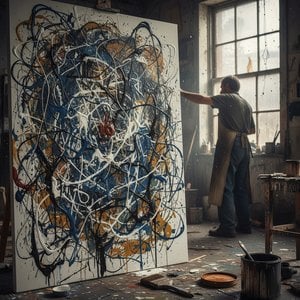
Paul Jackson Pollock: A Radical Departure – Exploring Abstract Expressionism's Pioneering Figure and His Enduring Legacy
Explore the revolutionary art of Jackson Pollock & Abstract Expressionism. Discover his iconic drip paintings, lasting impact, and considerations for collecting this pivotal American artist. Expert insights at ArtsDot.

A modern gyűjtő útmutatója: Érdekes absztrakt reprodukciókba való befektetés – A hitelesség, a piaci érték és a személyes kifejezés kihívásai
Befektessen stílusosan! Útmutató absztrakt reprodukciók vásárlásához: hitelesség, piaci érték, személyes ízlés. Prémium minőségű képek a ArtsDot-tól – szakértői tanácsadással!

A modern absztrakció útvesztői: Érzelmi rezonancia és esztétikai választás a kortárs művészetben
Fedezze fel az absztrakt művészet világát! Mélyreható elemzések, a legnagyobb mesterek alkotásai és szakértői tanácsok gyűjtőknek. Prémium minőségű reprodukciók és inspiráció otthonába – ArtsDot.

The Nuances of Graphite: Exploring Emotional Depth & Technical Mastery in Pencil Drawing
Explore the captivating world of graphite drawing! Discover its rich history, master essential techniques like chiaroscuro, and learn how artists evoke emotion through this timeless medium. Expert insights for art enthusiasts.

The Roaring Twenties Revisited: Art Deco & Modernist Expressions for the Discerning Collector
Explore the glamour of Art Deco & the innovation of Modernism! Discover key artists, investment potential, and expert guidance for collecting 1920s art. Enhance your space with timeless masterpieces.



