Aperçu en situation
 Envoyer
 Partager
 Détails de l'œuvre
 Guide
Guide

 Télécharger l'image
 Articles similaires
 Radiographie
 Diaporama
 Q&A
Q&A Statistiques
Pink Lady

- 61.0 x 48.0 cm


 Lire la suite
L’œuvre d'art présentée sur cette page est protégée par le droit d'auteur, ce qui signifie que nous ne pouvons légalement créer ou vendre de reproduction identique. Cette protection est appliquée en vertu d'accords internationaux tels que la Convention de Berne et par les lois nationales, notamment celles énoncées par le Loi américaine sur le droit d'auteur - Titre 17.
Cette méthode est pleinement conforme aux réglementations sur le droit d'auteur car elle ne repose pas sur la copie ou la duplication de l'œuvre protégée. Il s'agit plutôt d'une réinterprétation créative — une nouvelle peinture qui s'inspire de l'original sans pour autant lui être identique.
Giclées et impressions d'art
Impressions giclées ou sur toile de qualité musée, avec une production rapide et des finitions au choix. ( Commander la reproduction peinte à la main Passer au format numérique)




P118B €10

P118H €10

P118W €10

P438Z €10

P508JH €12

P508YH €12

P805H €10

P805Z €10

P919BZ €10

P919G €10

P919XJ €10

P959ZH €10

P968JZ €12

W106C €8

W218G €10

W218JH €8

W218Y €10

W307PJ €10

W316G €10

W316PJ €8

W316Y €10

W398PJ €8

W4111J €10

W500HY €15

W500JH €15

W692G €12

W849H €8

W940BG €15

W953PJ €8




Choisissez parmi nos formats prédéfinis qui respectent les proportions originales de l’œuvre.

Saisissez la largeur et la hauteur souhaitées pour qu'elles s'adaptent à votre cadre ou à votre mur. Une impression peut être recadrée, mais jamais agrandie au-delà de l'image originale ; ainsi, un format de forme différente entraînera la perte d'une partie de l'image. Nous vous envoyons une maquette numérique pour approbation avant toute impression. L'image présentée sur cette page ne montre pas le recadrage réel — seule la maquette le permet.
Livraison dans le monde entier () en 2 semaines au lieu des 4/5 semaines habituelles. (2 novembre)

Livraison express gratuite dans le monde entier

Toile de lin de qualité supérieure

Assurance transport complète

Garantie de remboursement des droits de douane

Garantie de fidélité des couleurs

Politique de retour de 100 jours (uniquement en cas de défaut)

Garantie de remboursement à 100%

Offre de tarifs dégressifs
 L'option verre n'est disponible que pour les dimensions inférieures à 110 cm.

Pink Lady
Giclées et impressions d'art
Format de la reproduction
-


Prix total
€ 55
A Portrait of Turbulent Emotion: Willem de Kooning’s “Pink Lady”
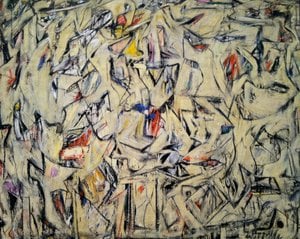
The painting "Pink Lady," created by Willem de Kooning in 1965, stands as a cornerstone of Abstract Expressionism and embodies the movement's preoccupation with raw emotion and spontaneous gesture. More than just a depiction of a woman—though undeniably present—it’s an exploration of psychological complexity rendered through a masterful blend of color and form that continues to captivate viewers decades after its creation. This striking artwork offers a glimpse into De Kooning’s artistic vision during his most prolific period, reflecting the anxieties and uncertainties of the Cold War era while simultaneously pushing boundaries of representational art.The Style and Technique: Embracing Gestural Abstraction
De Kooning's approach to painting was fundamentally antithetical to traditional academic conventions. He rejected meticulous detail in favor of a gestural style characterized by bold brushstrokes, drips, and smears—techniques that prioritized feeling over precise observation. “Pink Lady” exemplifies this ethos perfectly. The woman’s figure isn’t rendered with anatomical accuracy; instead, it's fragmented into amorphous shapes – swirls, patches, and angular protrusions – which convey a sense of dynamism and instability. These forms are layered with vibrant shades of pink—ranging from delicate blush tones to intense crimson hues—creating an illusion of skin texture and emphasizing the artist’s deliberate disregard for conventional realism. The yellow background serves as a counterpoint to the pink, amplifying the painting's emotional intensity and contributing to its overall visual impact.Historical Context: Navigating Anxiety in the Mid-Century
Painted during the height of the Cold War, “Pink Lady” reflects the pervasive anxieties surrounding geopolitical tensions and societal upheaval. De Kooning’s work aligns with a broader artistic impulse to confront uncomfortable truths about human experience—fear, aggression, and vulnerability—rather than offering comforting illusions. The painting's unsettling depiction of femininity speaks to anxieties about gender roles and identity during this period, mirroring broader cultural debates concerning female empowerment and psychological complexity. Furthermore, De Kooning’s stylistic choices can be interpreted as a reaction against the perceived sterility of postwar European art, asserting instead an uncompromising commitment to expressive freedom.Symbolism: Exploring Inner Landscape
While ostensibly portraying a woman, “Pink Lady” transcends literal representation, delving into realms of psychological symbolism. The pink skin tone itself is significant—often associated with femininity and vulnerability but also imbued with connotations of erotic desire and primal instinct. The fragmented form of the figure symbolizes the disintegration of identity and the struggle to maintain composure amidst turbulent emotions. Critics have noted parallels between De Kooning’s painting and Freud's theories on psychoanalysis, suggesting that “Pink Lady” represents an unconscious confrontation with repressed desires and anxieties.Emotional Impact: A Resonance of Raw Feeling
Ultimately, "Pink Lady" succeeds in conveying a profound emotional resonance. Its unsettling beauty stems from its refusal to sanitize or sentimentalize human experience. The painting compels viewers to confront uncomfortable truths about the complexities of emotion—passion, rage, despair—and invites contemplation on the nature of selfhood and psychological vulnerability. It’s a piece that lingers in the mind long after viewing, prompting reflection on themes of trauma, resilience, and the enduring power of art to express the deepest recesses of human consciousness. Its vibrant colors and energetic brushstrokes capture not just an image but also a palpable sense of unease—a testament to De Kooning's unparalleled ability to translate inner turmoil into visual form.Questions et réponses
Quel âge avait Willem de Kooning lors de la création de « Pink Lady » ?
Willem de Kooning a réalisé « Pink Lady » à l'âge de 61. L'artiste est né en 1904 et l'œuvre date de 1965.
Quelle est la forme et les dimensions de «Pink Lady» de Willem de Kooning ?
«Pink Lady» de Willem de Kooning est une œuvre au format Portrait de 61 x 48 cm.
«Pink Lady» de Willem de Kooning utilise-t-il des contrastes marqués ou des harmonies douces ?
La composition chromatique de «Pink Lady» de Willem de Kooning allie un contraste Serene à une harmonie Unified Palette.
Œuvres similaires


Biographie de l'artiste
jeunesse et carrière
Willem de Kooning, un artiste expressionniste abstrait néerlandais-américain renommé, est né le 24 avril 1904 à Rotterdam, aux Pays-Bas. Ses parents, Leendert de Kooning et Cornelia Nobel, ont divorcé en 1907, et de Kooning a vécu avec son père avant de passer sous la tutelle de sa mère. Il quitte l'école en 1916 et devient apprenti dans un cabinet d'arts commerciaux.développement artistique
De Kooning a suivi des cours du soir à l’Académie des Beaux-Arts et des Sciences Techniques à Rotterdam de 1916 à 1924. En 1927, il s'installe à New York City, où il travaille comme peintre décorateur et commence à développer son style artistique unique.expressionnisme abstrait
Le travail de De Kooning a évolué vers l’expressionnisme abstrait dans les années 1950, caractérisé par des coups de pinceau audacieux et des couleurs vibrantes. Sa peinture Woman I (1950-1952) est une œuvre fondamentale de ce mouvement, combinant la figuration à l'improvisation et à l'intensité émotionnelle.œuvres notables et collections
* The Glazier (137 x 112 cm, huile sur toile) : une peinture sombre aux tons terreux inspirée des fresques de Boscoreale. * Door to the River (expressionnisme abstrait) : une peinture à large coup de pinceau rappelant son passé de peintre décorateur. * Standing Man (expressionnisme abstrait) : un exemple caractéristique du style expressionniste abstrait de De Kooning.musées et collections
* Musée Boijmans Van Beuningen, Rotterdam, aux Pays-Bas : présente une impressionnante collection de plus de 151 000 œuvres d'art. * Bibliothèque universitaire de Leiden, aux Pays-Bas : abrite un centre culturel important avec plus de 5 200 000 volumes et 1 000 000 de livres électroniques. L'héritage de Willem de Kooning continue d'inspirer les artistes et les amateurs d'art, consolidant ainsi sa place en tant que pionnier de l'expressionnisme abstrait.
Willem de Kooning
1904 - 1997 , Pays-Bas
L'essentiel de l'artiste
- Artistes Influents: ['Arshile Gorky']
- Date De Décès: 19 mars 1997
- Date De Naissance: 24 avril 1904
- Lieu De Naissance: Rotterdam, Pays-Bas
- Mouvement Artistique: Expressionnisme abstrait
- Nationalité: Néerlandais-Américain
- Nom Complet: Willem de Kooning
- Oeuvres Notables:
- Woman I
- The Glazier
- Excavation
Articles connexes

Expressionnisme Abstrait : Les 10 Chefs-d'Œuvre Incontournables pour Décorer avec Art et Histoire
Plongez au cœur de l'Expressionnisme Abstrait avec ! Découvrez les 10 œuvres majeures de Pollock, Rothko et De Kooning. Histoire, techniques & inspiration déco. Explorez la collection complète en ligne.

Les 25 chefs-d'œuvre de Kandinsky : l'éveil de l'art abstrait
Explorez les 25 chefs-d'œuvre de Kandinsky et l'éveil de l'abstraction. Découvrez toute la collection sur ArtsDot.com.

Maîtriser l'ombre : les 25 chefs-d'œuvre puissants de Francisco Goya
Explorez les 25 chefs-d'œuvre de Goya, entre ombre et lumière. Trouvez l'art ultime sur ArtsDot.com.

Willem de Kooning : Abstraction, Geste et Évolution de la Peinture Américaine d'Après-Guerre
Explorez l'évolution artistique de Willem de Kooning et son rôle clé dans l'expressionnisme abstrait américain. Analyse approfondie, influences européennes et héritage durable pour les collectionneurs avertis.

Au-Delà de la Représentation : Exploration du Paysage Émotionnel de l'Expressionnisme Abstrait
Explorez l'univers fascinant de l'Expressionnisme Abstrait avec ArtsDot. Analyse approfondie des maîtres (Pollock, Rothko, De Kooning) et conseils d'experts pour collectionner ces œuvres emblématiques. Découvrez une sélection unique.