
- Accueil

- Impression sur toile
- Thomas Eakins
- Home Ranch
 Commander la reproduction Acheter l'image haute résolution
 Partager
 Partager
 Details
 Ajouter aux favoris

 Télécharger
 Articles similaires
 X-Ray
X-Ray
 Diaporama
Home Ranch


 Afficher la suite
Giclée / Impression d'art
Impression giclée ou sur toile de qualité musée, avec une production rapide et des finitions au choix.




P118B $10

P118H $10

P118W $10

P438Z $10

P508JH $12

P508YH $12

P805H $10

P805Z $10

P919BZ $10

P919G $10

P919XJ $10

P959ZH $10

P968JZ $12

W106C $8

W218G $10

W218JH $8

W218Y $10

W307PJ $10

W316G $10

W316PJ $8

W316Y $10

W398PJ $8

W4111J $10

W500HY $15

W500JH $15

W692G $12

W849H $8

W940BG $15

W953PJ $8




Choisissez parmi nos formats prédéfinis qui respectent les proportions originales de l’œuvre.

Vous pouvez saisir vos propres dimensions pour vous adapter à un cadre ou à un espace spécifique. Si la taille sélectionnée ne correspond pas aux proportions de l'image originale, nous recadrerons l'œuvre ou étendrons l'image avec une bordure en miroir ou une couleur unie. Une maquette numérique vous sera envoyée pour approbation avant le début de la production.
Veuillez noter que l'aperçu à l'écran ne reflète pas le recadrage ou l'extension réelle. Seule la maquette montrera avec précision la composition finale.
Bien que des tailles personnalisées soient disponibles, nous vous recommandons de choisir une dimension dans la liste prédéfinie afin de préserver les proportions originales.
Livraison dans le monde entier () en 2 semaines au lieu des 4/5 semaines habituelles. (2 juillet)

Livraison express gratuite dans le monde entier

Toile de lin de haute qualité

Assurance transport complète

Garantie de remboursement des frais de douane

Garantie de fidélité des couleurs

Politique de retour de 60 jours (uniquement en cas de défaut)

Garantie de remboursement à 100%

Réduction sur les achats groupés
 L'option verre n'est disponible que pour les dimensions inférieures à 110 cm.

Home Ranch
Giclée / Impression d'art
Format de reproduction
-


Prix total final
-
Description de l'œuvre
The Quiet Drama of Everyday Life
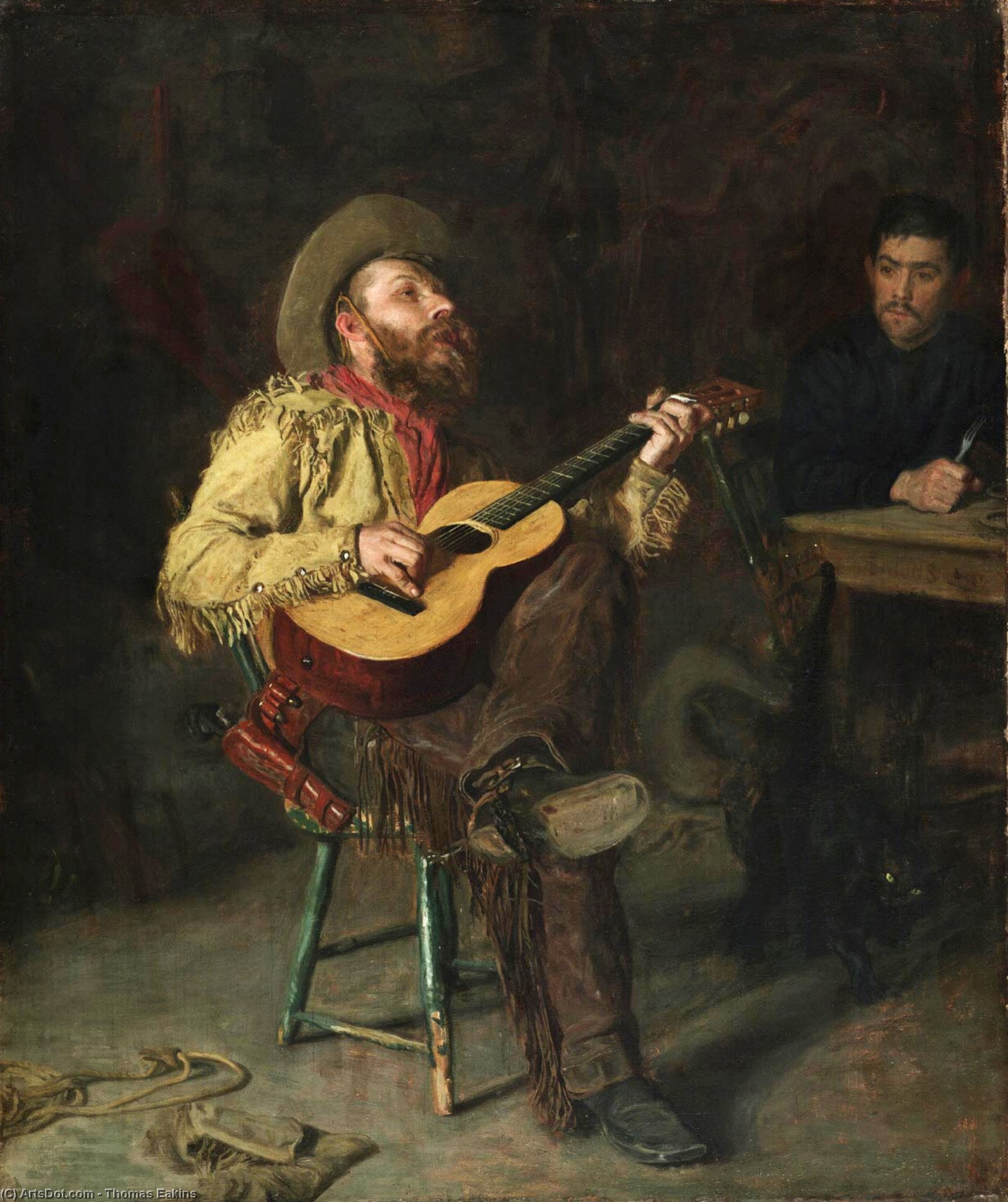
Thomas Eakins’s “Home Ranch,” painted in 1892 and now residing within the Philadelphia Museum of Art, isn't a grand historical tableau or a dramatic portrait; instead, it offers a remarkably intimate glimpse into the domestic sphere of late 19th-century America. It’s a scene seemingly devoid of overt narrative – a man playing the guitar, two figures observing him, a table laden with books – yet within this simplicity lies a profound exploration of human connection, observation, and the subtle nuances of social interaction. Eakins, a master of realism, eschewed romanticism or idealized representations in favor of an unflinching honesty that captured the essence of his subjects’ lives as he witnessed them.
The painting immediately draws the eye to the central figure, a man absorbed in his music. His posture is relaxed yet focused, his expression hinting at both contentment and perhaps a touch of melancholy. He's not performing for an audience; rather, he seems lost within his own world, creating a private moment of enjoyment. The other figures – a woman and a younger man – are rendered with equal care, their gazes directed towards the musician with varying degrees of interest and contemplation. Eakins’s skill lies in conveying these unspoken exchanges—the shared experience of music, the quiet observation, the subtle dynamics of relationships—without resorting to explicit gestures or dialogue.
A Masterclass in Composition and Light
Eakins's compositional choices are meticulously considered. The room itself is rendered with a remarkable sense of depth and spatial awareness. The placement of the furniture – the dining table, chairs, and books – establishes a comfortable, lived-in atmosphere. Notice how the light, soft and warm, filters through the windows, casting gentle shadows that define the forms and create a sense of intimacy. This use of light isn’t merely decorative; it's integral to the painting’s mood, contributing significantly to the relaxed and casual ambiance.
The artist’s attention to detail is astonishing. The texture of the clothing, the sheen of the guitar strings, the worn surfaces of the furniture – all are rendered with painstaking accuracy. Eakins was a student of anatomy and observation, and this dedication to realism extends beyond mere representation; it reflects a deep understanding of how light interacts with form and how materials possess unique qualities. The subtle variations in tone and color create a sense of visual richness that invites close examination.
The Context of American Realism
"Home Ranch" is firmly rooted within the context of American realism, a movement that emerged in the late 19th century as a reaction against romanticism and idealization. Artists like Eakins sought to depict everyday life with honesty and objectivity, often focusing on working-class subjects and urban environments. Philadelphia, where Eakins spent much of his career, provided a rich source of inspiration—a city of factories, row houses, and diverse communities.
Eakins’s work challenged conventional notions of portraiture by eschewing traditional formal poses and idealized representations. Instead, he captured his subjects in candid moments, revealing their personalities and experiences. “Home Ranch” exemplifies this approach, offering a glimpse into the private lives of ordinary people—a testament to Eakins's belief that beauty and significance could be found in the most unassuming scenes.
Owning a Piece of History
Hand-painted reproductions of "Home Ranch" by Thomas Eakins offer art enthusiasts a unique opportunity to bring this iconic work into their homes. These meticulously crafted reproductions capture the painting’s rich detail, vibrant colors, and evocative atmosphere with remarkable fidelity. Whether displayed in a formal living room or a more casual space, “Home Ranch” will undoubtedly serve as a captivating conversation piece—a window into the world of American realism and a celebration of Eakins's artistic genius.
Œuvres apparentées


Biographie de l'artiste
Une vie dédiée à la capture de la réalité
Thomas Cowperthwait Eakins, peintre américain réaliste, photographe, sculpteur et pédagogue en beaux-arts, a laissé une marque indélébile sur la toile de l'histoire de l'art américain. Né le 25 juillet 1844 à Philadelphie, en Pennsylvanie, sa vie fut un témoignage de son dévouement inébranlable à capturer l'essence de la réalité.Jeunesse et formation
La jeunesse d’Eakins fut marquée par un vif intérêt pour le dessin et les sciences. Il fréquenta Central High School puis étudia à la Pennsylvania Academy of the Fine Arts, où il perfectionna ses compétences en dessin et en anatomie. Son séjour en Europe, notamment sous la tutelle de Jean-Léon Gérôme à Paris, influença grandement son approche artistique.Une carrière définie par le réalisme
Le travail d’Eakins se caractérise par un réalisme implacable, une caractéristique qui le distinguait de ses contemporains. Ses portraits, au nombre de plusieurs centaines, offrent un aperçu poignant du tissu intellectuel et social de la fin du XIXe et du début du XXe siècle à Philadelphie. Parmi les œuvres notables, citons Max Schmitt en monocellulaire, qui ne se contente pas de démontrer la maîtrise d’Eakins dans la capture du mouvement, mais révèle également son vif intérêt pour la forme humaine.Enseignement et controverse
Le passage d'Eakins à l'Pennsylvania Academy of the Fine Arts fut marqué à la fois par l'influence et la controverse. Son approche pédagogique, qui mettait l’accent sur l’importance d’étudier le corps humain en direct, conduisait souvent à des frictions avec ses pairs. Cela, combiné à des scandales personnels, a entravé son succès et nui à sa réputation de son vivant.Héritage
Malgré les défis auxquels il a été confronté, Eakins est aujourd'hui célébré comme "le plus fort, le plus profond réaliste du XIXe et du début du XXe siècle dans l’art américain". Son œuvre se trouve dans divers musées, dont le Metropolitan Museum of Art, qui abrite plusieurs de ses œuvres notables.- Le champion en monocellulaire (Max Schmitt en monocellulaire) - une œuvre majeure qui témoigne de la maîtrise précoce d’Eakins dans la capture du mouvement.
- Thomas Eakins - explorez l'ensemble des œuvres d'Eakins sur ArtsDot, offrant un aperçu approfondi de son évolution artistique et de son style.
- Wikipédia : Thomas Eakins - plongez au cœur de l’entrée Wikipédia complète consacrée à Eakins, détaillant sa vie, ses influences et l'impact de son œuvre sur l'histoire de l'art américain.

Thomas Eakins
1844 - 1916 , États-Unis d'Amérique
En bref
- Artistes Influents: ['Jean-Léon Gérôme']
- Date De Décès: 25 juin 1916
- Date De Naissance: 25 juillet 1844
- Lieu De Naissance: Philadelphie, États-Unis
- Mouvement Artistique: Réalisme américain
- Nationalité: Américaine
- Nom Complet: Thomas Cowperthwait Eakins
- Œuvres Notables:
- Max Schmitt en monocellulaire
- La Clinique Gross
Articles connexes

L'École d'Ashcan : Réalisme urbain et démocratisation de l'art américain
Explorez l'École d'Ashcan : un mouvement artistique révolutionnaire capturant la vie urbaine américaine au début du XXe siècle. Découvrez ses figures clés, thèmes et son héritage durable avec ArtsDot.

Réalisme Contemporain : Les 10 Chefs-d'œuvre Qui Ont Marqué l'Histoire de l'Art
Plongez au cœur du Réalisme Contemporain avec les 10 œuvres incontournables qui ont marqué l'histoire de l'art. Découvrez Lucian Freud, Gerhard Richter et bien d'autres ! Reproductions de qualité muséale sur .

Abbott Handerson Thayer: Ethereal Realism & Spiritual Symbolism in American Art
Explore the captivating world of Abbott Handerson Thayer, a pioneer of American realism & Symbolism. Discover his ethereal angel paintings, innovative techniques, and lasting influence on art history. Learn about his scientific pursuits & Transcendentalist spirit.

Les 10 Chefs-d'œuvre du Réalisme Académique : Artistes et Décor Intemporels
Plongez dans l'univers du Réalisme Académique avec ArtsDot.com ! Découvrez 10 chefs-d'œuvre intemporels de Bouguereau, Gérôme et Cabanel. Reproductions de qualité muséale pour une décoration intérieure élégante. Explorez la collection en ligne !

Réalisme Américain : 10 Chefs-d'œuvre Incontournables pour une Déco Inspirée
Plongez au cœur du Réalisme Américain avec 10 chefs-d'œuvre d'Edward Hopper, Andrew Wyeth et plus. Découvrez l'histoire et les techniques de ces artistes emblématiques. Reproductions de tableaux de qualité musée sur ArtsDot.com !



