- Accueil

- Reproduction de peinture à l'huile
- Roy Lichtenstein
- Dans la voiture
 Commander l'impression Acheter l'image haute résolution
 Partager
 Partager
 Details
 Ajouter aux favoris

 Télécharger
 Articles similaires
 X-Ray
X-Ray
 Diaporama
Dans la voiture
 Acrylique sur toile
- Art mural
- Pop Art
 1963
1963- Moderne
 172.0 x 203.0 cm
Reproduction à l'huile faite à la main
Huile sur toile peinte à la main, avec cadre et dimensions personnalisés, réalisée sur commande par nos artistes.




P118B $10

P118H $10

P118W $10

P438Z $10

P508JH $12

P508YH $12

P805H $10

P805Z $10

P919BZ $10

P919G $10

P919XJ $10

P959ZH $10

P968JZ $12

W106C $8

W218G $10

W218JH $8

W218Y $10

W307PJ $10

W316G $10

W316PJ $8

W316Y $10

W398PJ $8

W4111J $10

W500HY $15

W500JH $15

W692G $12

W849H $8

W940BG $15

W953PJ $8




 En savoir plus
Choisissez parmi nos formats prédéfinis qui respectent les proportions originales de l’œuvre.

Vous pouvez saisir vos propres dimensions pour l'adapter à un cadre ou à un espace spécifique. Si la taille sélectionnée ne correspond pas aux proportions de l'image d'origine, nous recadrerons l'œuvre ou prolongerons la peinture avec des éléments peints à la main supplémentaires. Une maquette numérique vous sera envoyée pour approbation avant le début de la production.
Veuillez noter que l'aperçu à l'écran ne reflète pas le recadrage ou l'extension réels. Seule la maquette montrera fidèlement la composition finale.
Bien que des tailles personnalisées soient disponibles, nous vous recommandons de sélectionner une dimension dans la liste prédéfinie afin de préserver les proportions d'origine.
Après la commande, l’équipe ArtsDot.com contactera le client par e-mail pour obtenir ses instructions et lui fournira une maquette d’aperçu.
Livraison dans le monde entier () en 3 à 4 semaines au lieu des 5 semaines habituelles. (1 juillet). Aucune concession sur la qualité.

Livraison express gratuite dans le monde entier

Toile de lin de haute qualité

Assurance transport complète

Garantie de remboursement des frais de douane

Garantie de fidélité des couleurs

Politique de retour de 60 jours (uniquement en cas de défaut)

Garantie de remboursement à 100%

Réduction sur les achats groupés
 L'option verre n'est disponible que pour les dimensions inférieures à 110 cm.

Dans la voiture
Technique de reproduction
Format de reproduction
-


Prix total final
-
Description de l'œuvre
In the Car : Decoding Roy Lichtenstein’s Pop Art Masterpiece
Roy Lichtenstein's *In the Car*, painted in 1963, stands as an emblem of Pop Art’s audacious challenge to artistic conventions and its embrace of popular culture. More than just a depiction of a couple seated within a automobile, this artwork is a meticulously crafted commentary on romance, tension, and the pervasive influence of comic books—a medium previously considered solely for commercial purposes. Lichtenstein's signature style elevates the commonplace to high art with striking visual language, cementing his place as one of the most influential artists of the mid-century era.The Narrative Within the Frame
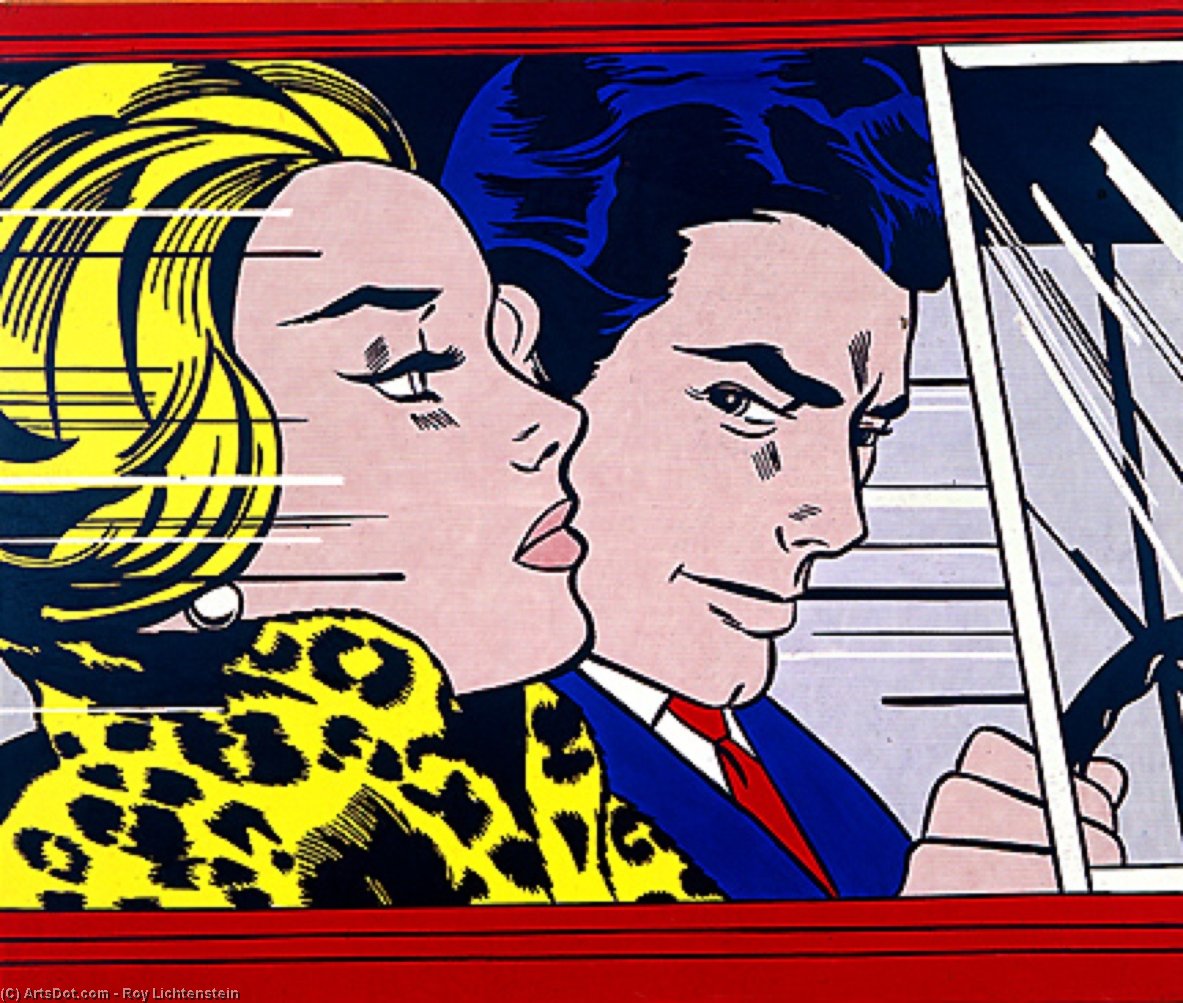
The painting presents a cropped view of a man and woman inside a car, caught in what appears to be an intense exchange. The woman’s face is partially obscured, conveying a palpable sense of resignation or distress—a subtle yet powerful gesture that invites viewers to contemplate unspoken emotions. Her vibrant yellow leopard-print coat sharply contrasts with the blue-haired male figure beside her, creating a visual dichotomy that underscores the complexities of interpersonal relationships. This isn't merely a snapshot; it’s a carefully selected frame from Tony Abruzzo’s comic book *Girl’s Romances* #78—a deliberate appropriation of imagery designed to provoke reflection and stimulate imaginative interpretation. The scene is charged with unspoken emotion, prompting viewers to construct their own narrative around this ambiguous moment.Pop Art & Comic Book Aesthetics: A Bold Hybrid
Lichtenstein brilliantly disrupted the boundaries between “high” and “low” culture by drawing inspiration directly from comic books—a medium then largely dismissed as frivolous entertainment. *In the Car* exemplifies his technique of isolating panels, magnifying them dramatically, and rendering them in bold colors with thick black outlines—a stylistic choice that echoes the mechanical printing process inherent in comics. Crucially, Lichtenstein incorporates Benday dots—the halftone pattern used to simulate shading—mimicking the aesthetic conventions of comic book illustrations. These dots aren’t merely decorative; they generate a sense of movement and texture, simultaneously referencing mass production and artistic intention—a paradoxical fusion that encapsulates the core ethos of Pop Art.Technique & Artistic Choices: Precision Meets Illusion
The painting's execution demonstrates remarkable precision. Lichtenstein didn’t simply copy the comic panel verbatim; he painstakingly recreated it using oil paint on canvas—a labor-intensive process reflecting his deliberate engagement with industrial techniques and his desire to elevate them to the realm of fine art. The artist meticulously applied each BenDay dot by hand (or with assistants), ensuring consistency and achieving a remarkable level of detail. Furthermore, Lichtenstein strategically utilized primary colors – reds, yellows, blues – amplifying their emotional impact and creating a visually arresting composition that adheres to principles of graphic design. The cropping of the image—extending the hair beyond the canvas edges—adds dynamism and invites viewers into the scene, fostering a sense of immediacy and engagement. Finally, Lichtenstein minimized perspective, flattening the image to prioritize visual impact over realistic representation—a stylistic decision characteristic of Pop Art’s rejection of traditional artistic conventions.Historical Context & Symbolism: Reflections of American Culture
Created during a period of burgeoning consumer culture in America—marked by an unprecedented fascination with advertising and mass media—*In the Car* serves as a poignant reflection of these societal trends. Lichtenstein frequently explored narratives centered on women grappling with emotional turmoil within romantic contexts, addressing themes of vulnerability and anxiety prevalent in mid-century society. The painting can be interpreted as a critique of idealized portrayals of love found in comic books—questioning their authenticity and highlighting the anxieties surrounding interpersonal relationships during this era. The car itself symbolizes freedom and mobility—a visual motif that contrasts with the claustrophobia implied by the confined space within which the figures inhabit, furthering the artwork’s symbolic depth.Emotional Resonance & Lasting Impact: An Icon of Modern Art
*In the Car* transcends mere visual spectacle; it evokes a complex range of emotions – tension, apprehension, and perhaps even melancholy—resonating powerfully with audiences today. Lichtenstein's stylistic choice—the seemingly impersonal depiction of figures—paradoxically allows viewers to project their own experiences onto the scene, fostering universal empathy and contemplation. The painting’s enduring influence extends beyond the art world, impacting contemporary artists and designers alike. Its bold aesthetic and thought-provoking themes solidify *In the Car*'s position as a cornerstone of Pop Art—a testament to Lichtenstein's genius and his ability to transform everyday imagery into timeless works of art. It remains an unforgettable reminder of Lichtenstein’s contribution to modern artistic expressionŒuvres apparentées


Biographie de l'artiste
jeune vie et éducation
roy fox lichtenstein, un artiste pop américain de premier plan, est né le 27 octobre 1923 à New York. Il a grandi dans une famille juive de milieu-classe supérieur, son père étant courtier en immobilier et sa mère femme au foyer. L'intérêt de Lichtenstein pour l'art et le design a commencé comme un passe-temps pendant ses années scolaires.carrière artistique
Après avoir terminé sa scolarité secondaire au Dwight School en 1940, Lichtenstein a étudié à l’Art Students League of New York sous la tutelle de Reginald Marsh. Il a ensuite obtenu une licence en arts plastiques de l'Ohio State University, interrompue par un service militaire de trois ans pendant la Seconde Guerre mondiale.- look mickey (1961, National Gallery of Art, Washington, D.C.), l'une des premières œuvres pop de Lichtenstein, a marqué le début de sa carrière influente.
- Son travail était fortement influencé par la publicité et les styles de bandes dessinées populaires, avec des œuvres notables telles que Wham!, drowning girl et oh, jeff...i love you, too...but...
- La pièce la plus chère de Lichtenstein, Masterpiece, a été vendue pour 165 millions de dollars en janvier 2017.
enseignement et influences
Lichtenstein a enseigné dans diverses institutions, notamment l'université d'État de New York à Oswego et l'université Rutgers. Son travail a été influencé par Allan Kaprow, un collègue professeur à Rutgers, ce qui a ravivé son intérêt pour les images proto-pop. Expositions notables :- the museum chambre de commerce (Toulouse, France), présentant diverses œuvres d'art, y compris celles du mouvement pop art.
- Le travail de Lichtenstein a été exposé à la Leo Castelli Gallery à New York, avec sa première exposition personnelle en 1962 ayant été entièrement achetée par des collectionneurs influents avant l'ouverture.
héritage et impact
Roy Lichtenstein est décédé le 29 septembre 1997, laissant derrière lui un héritage en tant que figure de proue du mouvement pop art. Son œuvre continue d’être célébrée pour son mélange innovant d’art haut et d’art populaire, ce qui la rend accessible à un public plus large.- Explorez davantage l'œuvre de Lichtenstein sur ArtsDot.com
- Découvrez le monde de l'art pop et de ses artistes influents sur pop art and beyond: navigating contemporary styles with ArtsDot.com

Roy Lichtenstein
1923 - 1997 , États-Unis d'Amérique
En bref
- Artistes Influents:
- Reginald Marsh
- Allan Kaprow
- Date De Décès: 29 septembre 1997
- Date De Naissance: 27 octobre 1923
- Lieu De Naissance: Manhattan, États-Unis
- Mouvement Artistique: Pop Art
- Nationalité: Américaine
- Nom Complet: Roy Lichtenstein
- Oeuvres Notables:
- Look Mickey
- Whaam!
- Drowning Girl
- Masterpiece
Articles connexes

Roy Lichtenstein : Les 25 Œuvres Maîtresses du Roi de la Pop Art | ArtsDot
Plongez dans l'univers vibrant de Roy Lichtenstein ! Découvrez les 25 œuvres emblématiques du Pop Art américain, de 'Look Mickey' à 'Whaam!'. Retrouvez l'histoire et la technique derrière chaque chef-d'œuvre. Reproductions d'art de qualité musée sur ArtsDot.com.


Élever la Passion : La Transformation de la Culture Populaire en Peinture à l'Huile Fine – Une Exploration Artistique et Collectionnelle
Transformez vos souvenirs en œuvres d'art exceptionnelles ! Découvrez l'expertise de nos artistes pour des peintures à l'huile personnalisées et reproductions de qualité muséale. Investissez dans l'art durable.

Défis aux Conventions : Pop Art, Origines, Évolution et Héritage Durable
Explorez l'histoire fascinante du Pop Art : de ses origines à son influence durable. Découvrez les œuvres emblématiques d'Andy Warhol et des artistes clés. Guide expert pour collectionneurs.

L'Élégance du Fandom : Intégrer l'Art Pop Culture dans un Décor Sophistiqué
Transformez votre intérieur avec l'art pop culture ! Découvrez nos conseils d'experts pour intégrer subtilement vos passions dans un décor élégant et raffiné. Guide complet & inspiration déco.

De la Passion à la Toile : Guide Complet pour Commander une Peinture Pop Culture Personnalisée
Créez votre peinture pop art personnalisée avec ArtsDot ! Artistes experts, qualité musée, livraison mondiale. Transformez vos passions en œuvres uniques. Demandez un devis gratuit !