
- Accueil

- Reproduction de peinture à l'huile
- Raphaël
- Madonna Studies

 Commander l'impression Acheter l'image haute résolution
 Partager
 Partager
 Details
 Ajouter aux favoris

 Télécharger
 Articles similaires
 X-Ray
X-Ray
 Diaporama
Madonna Studies
 Oil On Canvas
- WallArt
- High Renaissance
 1513
1513 42.0 x 27.0 cm
 Afficher la suite
Reproduction à l'huile faite à la main
Huile sur toile peinte à la main, avec cadre et dimensions personnalisés, réalisée sur commande par nos artistes.




P118B $10

P118H $10

P118W $10

P438Z $10

P508JH $12

P508YH $12

P805H $10

P805Z $10

P919BZ $10

P919G $10

P919XJ $10

P959ZH $10

P968JZ $12

W106C $8

W218G $10

W218JH $8

W218Y $10

W307PJ $10

W316G $10

W316PJ $8

W316Y $10

W398PJ $8

W4111J $10

W500HY $15

W500JH $15

W692G $12

W849H $8

W940BG $15

W953PJ $8




Choisissez parmi nos formats prédéfinis qui respectent les proportions originales de l’œuvre.

Vous pouvez saisir vos propres dimensions pour l'adapter à un cadre ou à un espace spécifique. Si la taille sélectionnée ne correspond pas aux proportions de l'image d'origine, nous recadrerons l'œuvre ou prolongerons la peinture avec des éléments peints à la main supplémentaires. Une maquette numérique vous sera envoyée pour approbation avant le début de la production.
Veuillez noter que l'aperçu à l'écran ne reflète pas le recadrage ou l'extension réels. Seule la maquette montrera fidèlement la composition finale.
Bien que des tailles personnalisées soient disponibles, nous vous recommandons de sélectionner une dimension dans la liste prédéfinie afin de préserver les proportions d'origine.
Après la commande, l’équipe ArtsDot.com contactera le client par e-mail pour obtenir ses instructions et lui fournira une maquette d’aperçu.
Livraison dans le monde entier () en 3 à 4 semaines au lieu des 5 semaines habituelles. (2 juillet). Aucune concession sur la qualité.

Livraison express gratuite dans le monde entier

Toile de lin de haute qualité

Assurance transport complète

Garantie de remboursement des frais de douane

Garantie de fidélité des couleurs

Politique de retour de 60 jours (uniquement en cas de défaut)

Garantie de remboursement à 100%

Réduction sur les achats groupés
 L'option verre n'est disponible que pour les dimensions inférieures à 110 cm.

Madonna Studies
Technique de reproduction
Format de reproduction
-


Prix total final
-
Description de l'œuvre
A Moment of Grace: Raphael’s Madonna Studies
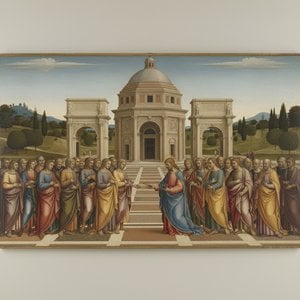
This exquisite hand-painted reproduction captures a quintessential moment from one of the High Renaissance's most beloved figures – Raphael Sanzio da Urbino. Dating back to 1513, this “Madonna Studies” offers a profound glimpse into the artist’s meticulous approach and his deep understanding of human emotion and divine grace. Measuring 42 x 27 cm, the artwork immediately draws the eye to the central figure: a woman radiating serenity and tenderness as she cradles the infant Jesus. The composition, characteristic of Raphael's mature style, is imbued with a sense of balanced harmony, reflecting the ideals of classical beauty and spiritual contemplation that defined the era.
- The Artist’s Hand: Executed in the High Renaissance style, this piece showcases Raphael’s mastery of *sfumato*, a technique perfected during his time in Florence. This subtle blurring of lines and colors creates an ethereal quality, softening the forms and lending a dreamlike atmosphere to the scene.
- Technical Brilliance: The painting employs oil on panel, a medium favored by Raphael for its rich color saturation and ability to achieve smooth transitions – essential elements in replicating his signature style.
A Window into Renaissance Symbolism
More than just a depiction of the Virgin Mary and Child, this “Madonna Studies” is laden with symbolic meaning deeply rooted in Christian iconography. The pose itself—the Madonna Piena, or Full Virgin—is a common representation emphasizing Mary’s role as the vessel of divine grace. The infant Jesus, often depicted with a star above his head, symbolizes hope, salvation, and the promise of eternal life. The presence of secondary figures within the background, subtly integrated into the composition, likely represent angels or other celestial beings, further reinforcing the sacred narrative.
- Color Palette: Raphael’s use of rich blues, reds, and golds reflects the wealth and prestige associated with the Papacy during this period.
- Compositional Harmony: The pyramidal composition, a hallmark of Renaissance art, directs the viewer's eye towards the central figures while creating a sense of stability and order.
Historical Context & Raphael’s Legacy
Created in 1513, this “Madonna Studies” was produced during a pivotal moment in Raphael’s career. Having spent formative years in Florence under the tutelage of Leonardo da Vinci and Perugino, he had absorbed their innovative techniques and artistic philosophies. His father, Giovanni Santi, a poet and painter himself, played a crucial role in shaping young Raphael's artistic sensibilities, exposing him to humanist ideals and fostering his appreciation for beauty and intellectual discourse. This artwork stands as a testament to the Urbino Renaissance – a period of unparalleled artistic flourishing that saw Raphael emerge as one of the most influential artists of all time.
Emotional Resonance & Artistic Value
This hand-painted reproduction transcends mere replication; it captures the essence of Raphael’s genius. The serene expression on Mary's face, the tenderness with which she holds her child, and the overall atmosphere of peace and reverence evoke a powerful emotional response in the viewer. Whether adorning a private residence or gracing a corporate space, this artwork offers a timeless connection to one of history’s greatest artistic masters – a piece that speaks volumes about faith, beauty, and the enduring power of human creativity.
Œuvres apparentées


Biographie de l'artiste
**Jeunesse et formation**
Raphaël (Raffaello Sanzio da Urbino), un peintre et architecte italien renommé, est né entre le 28 mars et le 6 avril 1483, dans la petite mais culturellement significative ville d'Urbino. Son père, Giovanni Santi, était peintre de cour du duc, lui offrant une exposition précoce au monde artistique. Après le décès de son père à l’âge de onze ans, Raphaël a vraisemblablement géré l’atelier familial, consolidant ainsi sa base artistique.**Carrière artistique et influences**
Le parcours artistique de Raphaël peut être divisé en trois phases distinctes, chacune marquée par un style unique :- Premières années à Umbrie : caractérisée par l'influence de son père et l'ambiance culturelle d’Urbino.
- Période florentine (1504-1508) : absorbant les traditions artistiques de Florence, qui a considérablement façonné son style.
- Période romaine (1508-1520) : travaillant pour deux papes et leurs associés, produisant certaines de ses œuvres les plus célèbres, notamment l’école des Athènes dans la stanza della segnatura du Vatican.
**Œuvres notables et héritage**
Certaines des œuvres notables de Raphaël comprennent :- Le jugement de Salomon (voir sur ArtsDot)
- La madone d’Esterházy (voir sur ArtsDot)
- Les Stanze Vaticanes - Vue de la stanza della segnatura (voir sur ArtsDot)
- Saint Sébastien (voir sur ArtsDot)
- La femme voilée (voir sur ArtsDot)
**Influence et héritage**
L'influence de Raphaël sur l'art est profonde, avec son œuvre constituant un pilier du grand Siècle. Son style serein et harmonieux a servi de modèle à la peinture néoclassique, comme le note l’historien d’art Johann Joachim Winckelmann. Malgré l'influence ultérieure du style de Michel-Ange, Raphaël reste l'un des artistes les plus vénérés de l'histoire. Voir le profil de Raphaël sur ArtsDot
Raphaël
1483 - 1520 , Italie
En bref
- Artistes Influents:
- Giovanni Santi
- Pietro Perugino
- Date De Décès: 6 avril 1520
- Date De Naissance: 28 mars 1483
- Influences Artistiques: Peinture néoclassique
- Lieu De Naissance: Urbino, Italie
- Mouvement Artistique: Haute Renaissance
- Nationalité: Italienne
- Nom Complet: Raphaël (Raffaello Sanzio)
- Œuvres Notables:
- L'École d'Athènes
- Madone Esterházy
- La Transfiguration
- Les Stanze Vaticanes
Articles connexes
Pietro Perugino: Umbrian Master of Serenity & Precursor to Raphael's High Renaissance
Explore the life & art of Pietro Perugino, a pivotal Renaissance master and Raphael’s influential teacher. Discover his serene compositions, Sistine Chapel frescoes, and lasting legacy with ArtsDot.
Les 10 Chefs-d'œuvre de la Haute Renaissance : Artistes et Décor d'Exception
Plongez au cœur de la Haute Renaissance avec les 10 chefs-d'œuvre incontournables de Léonard de Vinci, Michel-Ange et Raphaël. Découvrez l'histoire fascinante de ces tableaux emblématiques et trouvez l'inspiration pour une décoration intérieure d'exception sur .

Renaissance Humaniste : 10 Chefs-d'œuvre Révolutionnaires pour Votre Intérieur
Plongez au cœur de la Renaissance humaniste avec 10 chefs-d'œuvre exceptionnels : Léonard de Vinci, Michel-Ange et plus encore. Découvrez l'histoire, les techniques et le symbolisme de ces peintures iconiques. Trouvez votre reproduction d'art idéale sur ArtsDot.com !

Raphaël : Les 25 Chefs-d'œuvre Incontournables pour une Décoration d'Exception
Plongez dans l'univers de Raphaël avec les 25 œuvres incontournables du maître italien. Découvrez l'histoire, la technique et la beauté intemporelle de ses chefs-d'œuvre Renaissance. Reproductions de qualité muséale sur ArtsDot.com.

Proto-Renaissance : 10 Chefs-d'œuvre Révolutionnaires pour une Décoration d'Exception
Plongez au cœur de la Proto-Renaissance avec ArtsDot.com ! Découvrez 10 chefs-d'œuvre intemporels de Giotto, Cimabue et autres maîtres italiens. Retables gothiques, fresques émouvantes… Trouvez l’inspiration déco & achetez des reproductions d'art exceptionnelles. Explorez la collection sur ArtsDot



