- Accueil

- Reproduction de peinture à l'huile
- Paul Signac
- Antibes, thunderstorms
 Commander l'impression Acheter l'image haute résolution
 Partager
 Partager
 Details
 Ajouter aux favoris

 Télécharger
 Articles similaires
 X-Ray
X-Ray
 Diaporama
Antibes, thunderstorms
 Oil On Canvas
- WallArt
- Neo-Impressionism
 1919
1919- 19th Century
 46.0 x 55.0 cm
 Afficher la suite
Reproduction à l'huile faite à la main
Huile sur toile peinte à la main, avec cadre et dimensions personnalisés, réalisée sur commande par nos artistes.




P118B $10

P118H $10

P118W $10

P438Z $10

P508JH $12

P508YH $12

P805H $10

P805Z $10

P919BZ $10

P919G $10

P919XJ $10

P959ZH $10

P968JZ $12

W106C $8

W218G $10

W218JH $8

W218Y $10

W307PJ $10

W316G $10

W316PJ $8

W316Y $10

W398PJ $8

W4111J $10

W500HY $15

W500JH $15

W692G $12

W849H $8

W940BG $15

W953PJ $8




 En savoir plus
Choisissez parmi nos formats prédéfinis qui respectent les proportions originales de l’œuvre.

Vous pouvez saisir vos propres dimensions pour l'adapter à un cadre ou à un espace spécifique. Si la taille sélectionnée ne correspond pas aux proportions de l'image d'origine, nous recadrerons l'œuvre ou prolongerons la peinture avec des éléments peints à la main supplémentaires. Une maquette numérique vous sera envoyée pour approbation avant le début de la production.
Veuillez noter que l'aperçu à l'écran ne reflète pas le recadrage ou l'extension réels. Seule la maquette montrera fidèlement la composition finale.
Bien que des tailles personnalisées soient disponibles, nous vous recommandons de sélectionner une dimension dans la liste prédéfinie afin de préserver les proportions d'origine.
Après la commande, l’équipe ArtsDot.com contactera le client par e-mail pour obtenir ses instructions et lui fournira une maquette d’aperçu.
Livraison dans le monde entier () en 3 à 4 semaines au lieu des 5 semaines habituelles. (1 juillet). Aucune concession sur la qualité.

Livraison express gratuite dans le monde entier

Toile de lin de haute qualité

Assurance transport complète

Garantie de remboursement des frais de douane

Garantie de fidélité des couleurs

Politique de retour de 60 jours (uniquement en cas de défaut)

Garantie de remboursement à 100%

Réduction sur les achats groupés
 L'option verre n'est disponible que pour les dimensions inférieures à 110 cm.

Antibes, thunderstorms
Technique de reproduction
Format de reproduction
-


Prix total final
-
Description de l'œuvre
Antibes, Thunderstorms – A Pointillist Masterpiece by Paul Signac
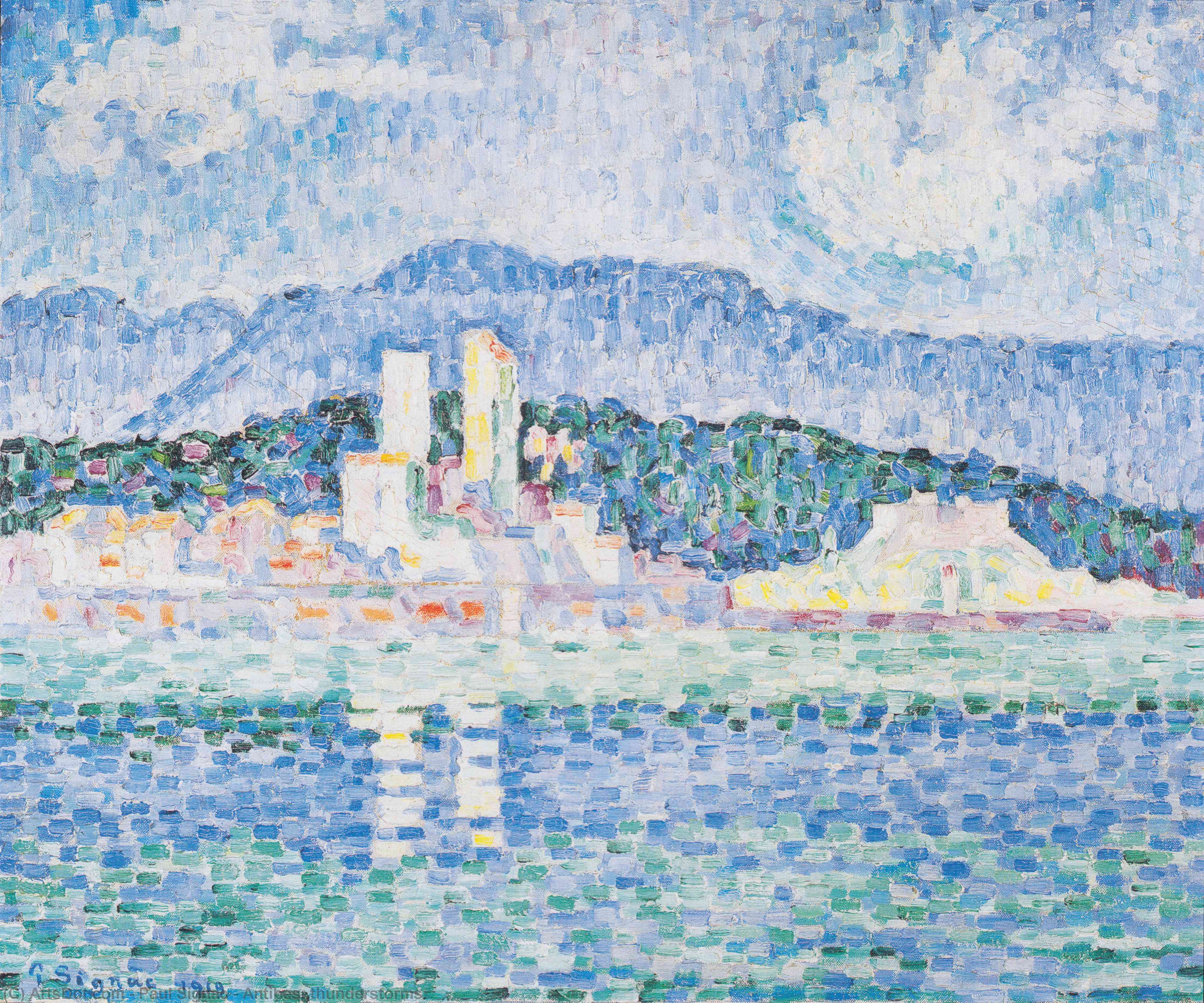
Paul Signac’s “Antibes, Thunderstorms,” painted in 1919, is more than just a depiction of a coastal scene; it's a meticulously constructed meditation on light, color, and the very nature of perception. This evocative work, measuring 46 x 55 cm, captures the dramatic beauty of Antibes, France, at dusk or dawn – a moment suspended in time where the sea, sky, and architecture converge under a brooding, storm-laden canopy. The painting’s immediate impact lies in its shimmering surface, created through Signac's revolutionary Pointillist technique, a method he pioneered alongside Georges Seurat.
- The Science of Color: Signac’s approach was deeply rooted in scientific principles. He believed that the eye could more effectively blend colors when presented with small dots of pure hue than when painted with broad strokes. This optical mixing is brilliantly demonstrated here, where countless tiny points of color – blues, greens, ochres, and whites – coalesce to create a luminous effect, mimicking the way light itself interacts with the landscape.
- A Harmonious Vision: The composition emphasizes atmospheric perspective, utilizing darker blues and greens in the distance to suggest depth while brighter colors draw the viewer’s eye towards the foreground elements. This careful manipulation of value and saturation creates a sense of spatial recession, characteristic of Pointillism's focus on visual sensation rather than strict realism.
The Birth of Pointillism
“Antibes, Thunderstorms” represents a crucial moment in the development of modern art. Signac’s work emerged from a desire to move beyond the limitations of Impressionism, which often struggled to capture the fleeting effects of light and atmosphere. He sought a more systematic approach, one that could harness the power of color theory to create paintings that were both visually stunning and intellectually rigorous. This pursuit led him and Seurat to develop Pointillism – a technique that would profoundly influence generations of artists.
The painting’s meticulous detail—the individual dots painstakingly applied layer upon layer—reflects Signac's belief in the importance of observation and scientific analysis. It wasn't simply about representing what he saw; it was about understanding *how* he saw it, translating his visual experience into a structured system of color and form.
Symbolism and Emotional Impact
Beyond its technical brilliance, “Antibes, Thunderstorms” possesses a subtle symbolic resonance. The depiction of a coastal scene, coupled with the dramatic presence of impending storms, evokes a sense of both tranquility and unease. The hazy atmosphere, created by Signac’s technique, lends the painting a dreamlike quality, inviting contemplation about the transient nature of beauty and the power of the natural world.
The shimmering light and textured surface create an immersive experience for the viewer, transporting them to the shores of Antibes. The work's emotional impact is one of quiet wonder – a reminder of the profound beauty that can be found in even the most fleeting moments.
Provenance and Significance
Painted in 1919, this artwork stands as a testament to Paul Signac’s enduring legacy. His innovative approach to color and composition continues to inspire artists today, and his work is held in prestigious collections worldwide. This hand-painted reproduction offers an exceptional opportunity to own a piece of art history – a window into the mind of one of modernism's most influential figures.
Œuvres apparentées


Biographie de l'artiste
The Harmonious Vision of Paul Signac
Paul Victor Jules Signac, born in Paris on November 11th, 1863, emerged as a pivotal figure in the evolution of modern art, inextricably linked to the birth and development of Neo-Impressionism. Initially drawn to architecture, a youthful encounter with Claude Monet’s exhibition ignited within him an enduring passion for painting, setting him on a path that would redefine color theory and artistic expression. Signac wasn't merely a painter; he was a dedicated explorer of light, color, and the very science underpinning visual perception. His early works, though demonstrating Impressionistic leanings, quickly evolved under the profound influence of Georges Seurat, forging a partnership that birthed Pointillism – a technique characterized by the meticulous application of tiny, distinct dots of pure color intended to blend optically in the viewer’s eye. This wasn't simply about aesthetics; it was an attempt to systematize painting, grounding it in scientific principles and challenging conventional artistic norms.The Impressionist Spark & The Seurat Collaboration
The meeting between Signac and Seurat in 1884 proved transformative for both artists. They shared a fascination with Eugène Delacroix’s writings on color theory, particularly his exploration of complementary contrasts and the emotional impact of hue. Together, they embarked on a rigorous investigation into these principles, translating them into a revolutionary painting technique. Signac wholeheartedly embraced Seurat’s vision, abandoning the fleeting brushstrokes of Impressionism for the precise, calculated application of points of color. Boulevard de Clichy (1886) stands as an early testament to this new approach, showcasing Signac’s meticulous style and his commitment to capturing the vibrancy of urban life through a scientific lens. He meticulously studied Monet's methods, absorbing his understanding of how light transforms surfaces—a pursuit that would inform his entire artistic career. The duo established the Société des Artistes Indépendants together, marking the beginning of their collaborative journey and solidifying their commitment to artistic innovation.The Birth of Pointillism & Scientific Color Theory
Signac’s breakthrough came with the development of Pointillism alongside Seurat. Recognizing that Impressionist painters struggled to convey depth and luminosity effectively, Signac championed a radical departure from traditional methods. He proposed a revolutionary technique based on dividing tones into minuscule dots of pure color—a method he termed “division scientifique du ton.” This approach wasn’t merely about visual appearance; it was rooted in scientific observation and underpinned by the belief that the human eye could synthesize these dots to create an illusion of depth and vibrancy surpassing what conventional brushstrokes could achieve. Signac meticulously documented his experiments, analyzing how color interacts with light and exploring the psychological effects of hue—a pursuit that would become central to his artistic philosophy.Coastal Inspirations & Saint-Tropez Revisited
Inspired by the Mediterranean coast, Signac found solace and creative impetus in Saint-Tropez from 1892 onwards. He purchased a villa there, *La Hune*, transforming it into a hub for artists—a space where he nurtured young talents and fostered experimentation. The shimmering waters of the Riviera served as a constant source of inspiration, prompting Signac to revisit his technique and explore new expressive possibilities. His paintings from this period are characterized by luminous colors and delicate brushstrokes that capture the ethereal beauty of coastal landscapes. He meticulously studied the effects of sunlight on water surfaces, striving to reproduce accurately the subtle nuances of color and light—a dedication that reflected his unwavering commitment to scientific observation and artistic excellence.A Legacy of Independence & Artistic Influence
Signac’s role extended beyond his own artistic endeavors; he was a fervent advocate for artistic freedom and championed the avant-garde movement through his leadership within the Société des Artistes Indépendants. As president from 1908 until his death in 1935, Signac fostered an environment where artists could challenge conventions and pursue innovative ideas without fear of censure. He welcomed young painters who embraced Fauvism and Cubism—artists like Henri Matisse and André Derain—who shared his belief in the transformative power of color and experimentation. Signac’s unwavering support for these groundbreaking movements cemented his place as a pivotal figure in shaping the trajectory of 20th-century art, leaving behind an enduring legacy that continues to inspire artists today. His meticulous approach to painting, combined with his profound understanding of scientific principles, established him as one of the most influential painters of his time—a true pioneer of Neo-Impressionism and a champion of artistic liberty.
Paul Signac
1863 - 1935 , France
En bref
- Artistic Movement Or Style: Neo-Impressionism, Pointillism
- Artists Or Movements Influenced By This Artist:
- Henri Matisse
- Fauvism
- Artists Who Influenced This Artist:
- Claude Monet
- Georges Seurat
- Date Of Birth: 1863
- Date Of Death: 1935
- Full Name: Paul Victor Jules Signac
- Nationality: French
- Notable Artworks:
- Boulevard de Clichy
- The Red Buoy
- La Valleuse
- Place Of Birth: Paris
Articles connexes

Henri Moret: Capturing the Essence of Brittany's Light – A Study in Post-Impressionist Landscape Painting
Explore the captivating landscapes of Henri Moret, a master of Post-Impressionism. Discover his unique style, key works, and legacy in our expert guide. Learn about collecting Moret's art & its investment potential.

Georges Seurat : Les 25 Œuvres Maîtresses du Pointillisme | ArtsDot
Plongez dans l'univers lumineux de Georges Seurat ! Découvrez les 25 œuvres majeures du pointillisme, de 'Un dimanche après-midi à l'Île de la Grande Jatte' aux 'Poseuses'. Reproductions d'art exceptionnelles et inspiration déco sur ArtsDot.com.
Evoking the Horizon: A Historical & Artistic Exploration of Coastal Scenes in Painting
Explore the rich history of coastal scenes in painting! Discover Impressionist masterpieces, American realism & contemporary visions. Learn about renowned artists and find your perfect seascape at ArtsDot.

Paul Signac: Pointillism, Politics & the Pursuit of Harmony in Modern Art
Explore the life & art of Paul Signac, a key figure in Neo-Impressionism. Discover his Pointillist technique, anarchist beliefs, and stunning coastal scenes. Learn about his influence on modern art history.

Georges Seurat : Pointillisme, Perception et les Fondements Scientifiques de l'Art Moderne
Explorez l'univers révolutionnaire de Georges Seurat et du pointillisme. Découvrez la science derrière cette technique picturale unique, son influence sur l'art moderne et l'analyse approfondie de ses œuvres majeures.