
- Accueil

- Reproduction de peinture à l'huile
- Nicolas Poussin
- The Baby Moses Saved from the River

 Commander l'impression Acheter l'image haute résolution
 Partager
 Partager
 Details
 Ajouter aux favoris

 Télécharger
 Articles similaires
 X-Ray
X-Ray
 Diaporama
The Baby Moses Saved from the River

Reproduction à l'huile faite à la main
Huile sur toile peinte à la main, avec cadre et dimensions personnalisés, réalisée sur commande par nos artistes.




P118B $10

P118H $10

P118W $10

P438Z $10

P508JH $12

P508YH $12

P805H $10

P805Z $10

P919BZ $10

P919G $10

P919XJ $10

P959ZH $10

P968JZ $12

W106C $8

W218G $10

W218JH $8

W218Y $10

W307PJ $10

W316G $10

W316PJ $8

W316Y $10

W398PJ $8

W4111J $10

W500HY $15

W500JH $15

W692G $12

W849H $8

W940BG $15

W953PJ $8




 En savoir plus
Choisissez parmi nos formats prédéfinis qui respectent les proportions originales de l’œuvre.

Vous pouvez saisir vos propres dimensions pour l'adapter à un cadre ou à un espace spécifique. Si la taille sélectionnée ne correspond pas aux proportions de l'image d'origine, nous recadrerons l'œuvre ou prolongerons la peinture avec des éléments peints à la main supplémentaires. Une maquette numérique vous sera envoyée pour approbation avant le début de la production.
Veuillez noter que l'aperçu à l'écran ne reflète pas le recadrage ou l'extension réels. Seule la maquette montrera fidèlement la composition finale.
Bien que des tailles personnalisées soient disponibles, nous vous recommandons de sélectionner une dimension dans la liste prédéfinie afin de préserver les proportions d'origine.
Après la commande, l’équipe ArtsDot.com contactera le client par e-mail pour obtenir ses instructions et lui fournira une maquette d’aperçu.
Livraison dans le monde entier () en 3 à 4 semaines au lieu des 5 semaines habituelles. (1 juillet). Aucune concession sur la qualité.

Livraison express gratuite dans le monde entier

Toile de lin de haute qualité

Assurance transport complète

Garantie de remboursement des frais de douane

Garantie de fidélité des couleurs

Politique de retour de 60 jours (uniquement en cas de défaut)

Garantie de remboursement à 100%

Réduction sur les achats groupés
 L'option verre n'est disponible que pour les dimensions inférieures à 110 cm.

The Baby Moses Saved from the River
Technique de reproduction
Format de reproduction
-


Prix total final
-
Description de l'œuvre
A Testament to Classical Grace: Decoding Nicolas Poussin’s “The Baby Moses Saved from the River”
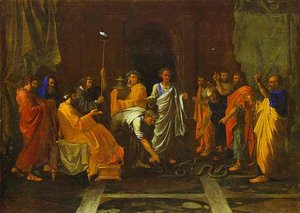
Nicolas Poussin's "The Baby Moses Saved from the River," painted around 1638, transcends mere depiction; it embodies a profound engagement with classical ideals and represents a cornerstone of French Baroque art. This monumental canvas, housed in the Louvre Museum, captures a dramatic biblical narrative—the rescue of Moses by Pharaoh’s daughter—with an unparalleled level of artistic sophistication that continues to captivate audiences centuries later. Examining its intricacies reveals not only masterful technique but also layers of symbolic meaning and emotional resonance.Style and Technique: Baroque Drama Illuminated
Poussin's style firmly establishes itself within the Baroque tradition, yet distinguishes itself from its Venetian counterparts through a deliberate restraint in color palettes and an unwavering commitment to disegno—the Italian term for “drawing,” which emphasizes line and form as foundational elements of artistic expression. Unlike the opulent hues favored by Titian and Veronese, Poussin employs muted tones – predominantly earthy browns, ochres, and creams – creating a sense of solemn grandeur that underscores the gravity of the biblical subject matter. The artist’s meticulous attention to detail is evident in every brushstroke; he painstakingly renders textures with remarkable accuracy, from the rough stone of the mountains to the smooth surface of the river water. This painstaking approach contributes significantly to the painting's illusionistic depth and enhances its dramatic impact.Historical Context: Rome as Cradle of Inspiration
Poussin’s artistic journey began in Rome, where he immersed himself in the legacy of antiquity—the sculptures of Michelangelo and Raphael—inspiring him to emulate their sculptural qualities within his paintings. The Renaissance fervor for reviving classical forms had begun to dissipate by Poussin's time, but Roman artists continued to champion humanist ideals and strive for idealized representations of human figures and landscapes. “The Baby Moses Saved from the River” reflects this intellectual climate, drawing heavily upon mythological precedents—particularly the story of Isis and Osiris—to elevate the biblical narrative beyond a simple recounting of events. The composition deliberately borrows elements from classical temple architecture, mirroring the grandeur and serenity associated with Roman artistic tradition.Symbolism: Light, Order, and Divine Providence
The painting’s symbolism is rich and multifaceted. Notably, the pervasive use of light—particularly diffused sunlight—serves as a central motif, symbolizing divine providence and illuminating the scene with an ethereal glow. This luminous quality isn't merely decorative; it underscores the moral significance of the narrative – highlighting God’s intervention in protecting Moses and ensuring his survival. Furthermore, the carefully arranged figures embody classical ideals of harmony and proportion. The pyramidal composition—a technique borrowed from Roman sculpture—creates a sense of stability and balance, reinforcing the painting’s overarching message of hope and redemption. Each element contributes to a larger tapestry of meaning, inviting contemplation on themes of faith, compassion, and divine grace.Emotional Impact: Capturing Sacred Narrative
Ultimately, “The Baby Moses Saved from the River” succeeds in conveying profound emotional depth. The artist skillfully portrays the vulnerability of the infant Moses juxtaposed against the resolute determination of those striving to save him—a dynamic that resonates with universal human experiences of fear and courage. The faces of the figures are rendered with expressive subtlety, capturing a spectrum of emotions ranging from concern to reverence. Through his masterful manipulation of light and color, Poussin evokes a palpable atmosphere of urgency and solemn contemplation, prompting viewers to consider the enduring power of faith and compassion. This artwork remains an unforgettable testament to the transformative potential of classical art—a timeless masterpiece that continues to inspire awe and admiration.Œuvres apparentées



Biographie de l'artiste
jeune vie et formation
nicolas poussin, né en juin 1594, était la quintessence de la peinture baroque française classique. Malgré avoir passé la majeure partie de sa carrière à Rome, il est resté profondément ancré dans les traditions artistiques françaises. Ses premiers jours en tant que peintre étaient enveloppés d'incertitude, mais dès 1612, il avait initié des études formelles à Paris, absorbant les influences d'artistes moins connus avant d'être attiré par Rome en 1624.style artistique et influences
L’esthétique de Poussin, célébrée pour sa composition cohérente et sa priorité accordée à la linéarité, a jeté un précédent qui a influencé des maîtres comme jacques-louis david et paul cézanne bien au 20e siècle. Son style distinct s'est cristallisé à travers des œuvres célèbres comme la mort de Germanicus et sa série emblématique les sept sacrements.œuvres notables et musées
- nicolas poussin: autoportrait1 (baroque, huile), un témoignage de sa maîtrise du médium.
- Bacchanale devant un temple (74 x 101 cm, Legion of Honor, San Francisco, États-Unis, huile sur toile), mettant en valeur sa capacité à équilibrer la composition et le récit.
- le musée des beaux-arts de Carcassonne, une destination incontournable pour les amateurs d'art, abritant une impressionnante collection de peintures occidentales du 17e au 20e siècle.
héritage et impact
L’allégeance de Poussin est restée à Rome, où il s'est finalement concentré sur l'incorporation d'paysages vastes dans son art. Sa maturité en tant qu'artiste est encapsulée dans des œuvres comme Orion aveuglé à la recherche du soleil et les saisons, annonçant une ère de composition rigoureuse imprégnée de la beauté sereine du monde naturel.explorez davantage avec ArtsDot.com
découvrez les chefs-d'œuvre du musée France et plongez dans le monde de la peinture baroque française avec musée picasso, musée des beaux-arts de Carcassonne et d'autres musées notables. Visitez la page de Nicolas Poussin sur ArtsDot.com pour explorer davantage de ses œuvres et en apprendre davantage sur le contexte dans lequel elles ont été créées.références

Nicolas Poussin
1594 - 1665 , France
En bref
- Artistes Influents:
- Raphaël
- Titian
- Date De Décès: 1665
- Date De Naissance: Juin 1594
- Influence Sur Les Artistes:
- Jacques-Louis David
- Paul Cézanne
- Lieu De Naissance: Le Havre, France
- Mouvement Artistique: Baroque français classique
- Nationalité: Française
- Nom Complet: Nicolas Poussin
- Oeuvres Notables:
- La Mort de Germanicus
- Les Sept Sacrements
- Un Chemin romain
- Orion aveuglé
- Les Saisons
Articles connexes

Baroque Classicism: Reconciling Drama & Order in 17th-Century Art
Explore the captivating world of Baroque Classicism! Discover its history, key artists like Caravaggio & Rubens, and defining characteristics. Expert insights & high-quality reproductions at ArtsDot.


L'Alliance de la Technologie et de la Tradition : Le Processus Contemporain de Création Artistique Personnalisée
ArtsDot : Transformez vos souvenirs en œuvres d'art uniques ! Peintures à l'huile personnalisées par des artistes experts, qualité musée garantie. Restauration et reproductions fidèles. Conseil personnalisé.

Nicolas Poussin : Classicisme, Allégorie et Ordre dans la Peinture Française du XVIIe Siècle
Explorez l'univers de Nicolas Poussin et le classicisme français du XVIIe siècle. Analyse approfondie de son œuvre, des allégories complexes à la maîtrise de la composition. Découvrez l'influence durable de ce maître incontesté.
Alte Pinakothek : 25 Chefs-d'œuvre pour Embellir Votre Intérieur
Plongez au cœur de l'Alte Pinakothek, Munich ! Découvrez 25 chefs-d'œuvre de Dürer à Rembrandt. Explorez l'art Renaissance et baroque, leurs couleurs & histoires fascinantes. Reproductions de qualité sur ArtsDot.com.

Les 10 plus grandes gravures : Chefs-d'œuvre qui ont révolutionné l'art | ArtsDot
Plongez dans l'univers fascinant des 10 plus grandes gravures de l'histoire ! Découvrez les chefs-d'œuvre de Rembrandt, Goya et Dürer. Inspirez votre décoration intérieure avec ArtsDot : reproductions d'art de qualité muséale en ligne. Explorez la collection sur ArtsDot.com



