- Accueil

- Impression sur toile
- Lovis Corinth
- Homeric Laughter, First Version
 Commander la reproduction Acheter l'image haute résolution
 Partager
 Partager
 Details
 Ajouter aux favoris

 Télécharger
 Articles similaires
 X-Ray
X-Ray
 Diaporama
Homeric Laughter, First Version
 Oil On Canvas
- WallArt
- Expressionism
 1909
1909- 19th Century
 98.0 x 120.0 cm
 Bayerische Staatsgemaldesammlungen
 Afficher la suite
Giclée / Impression d'art
Impression giclée ou sur toile de qualité musée, avec une production rapide et des finitions au choix.




P118B $10

P118H $10

P118W $10

P438Z $10

P508JH $12

P508YH $12

P805H $10

P805Z $10

P919BZ $10

P919G $10

P919XJ $10

P959ZH $10

P968JZ $12

W106C $8

W218G $10

W218JH $8

W218Y $10

W307PJ $10

W316G $10

W316PJ $8

W316Y $10

W398PJ $8

W4111J $10

W500HY $15

W500JH $15

W692G $12

W849H $8

W940BG $15

W953PJ $8




Choisissez parmi nos formats prédéfinis qui respectent les proportions originales de l’œuvre.

Vous pouvez saisir vos propres dimensions pour vous adapter à un cadre ou à un espace spécifique. Si la taille sélectionnée ne correspond pas aux proportions de l'image originale, nous recadrerons l'œuvre ou étendrons l'image avec une bordure en miroir ou une couleur unie. Une maquette numérique vous sera envoyée pour approbation avant le début de la production.
Veuillez noter que l'aperçu à l'écran ne reflète pas le recadrage ou l'extension réelle. Seule la maquette montrera avec précision la composition finale.
Bien que des tailles personnalisées soient disponibles, nous vous recommandons de choisir une dimension dans la liste prédéfinie afin de préserver les proportions originales.
Livraison dans le monde entier () en 2 semaines au lieu des 4/5 semaines habituelles. (2 juillet)

Livraison express gratuite dans le monde entier

Toile de lin de haute qualité

Assurance transport complète

Garantie de remboursement des frais de douane

Garantie de fidélité des couleurs

Politique de retour de 60 jours (uniquement en cas de défaut)

Garantie de remboursement à 100%

Réduction sur les achats groupés
 L'option verre n'est disponible que pour les dimensions inférieures à 110 cm.

Homeric Laughter, First Version
Giclée / Impression d'art
Format de reproduction
-


Prix total final
-
Description de l'œuvre
A Moment of Shared Revelry: Unpacking “Homeric Laughter”
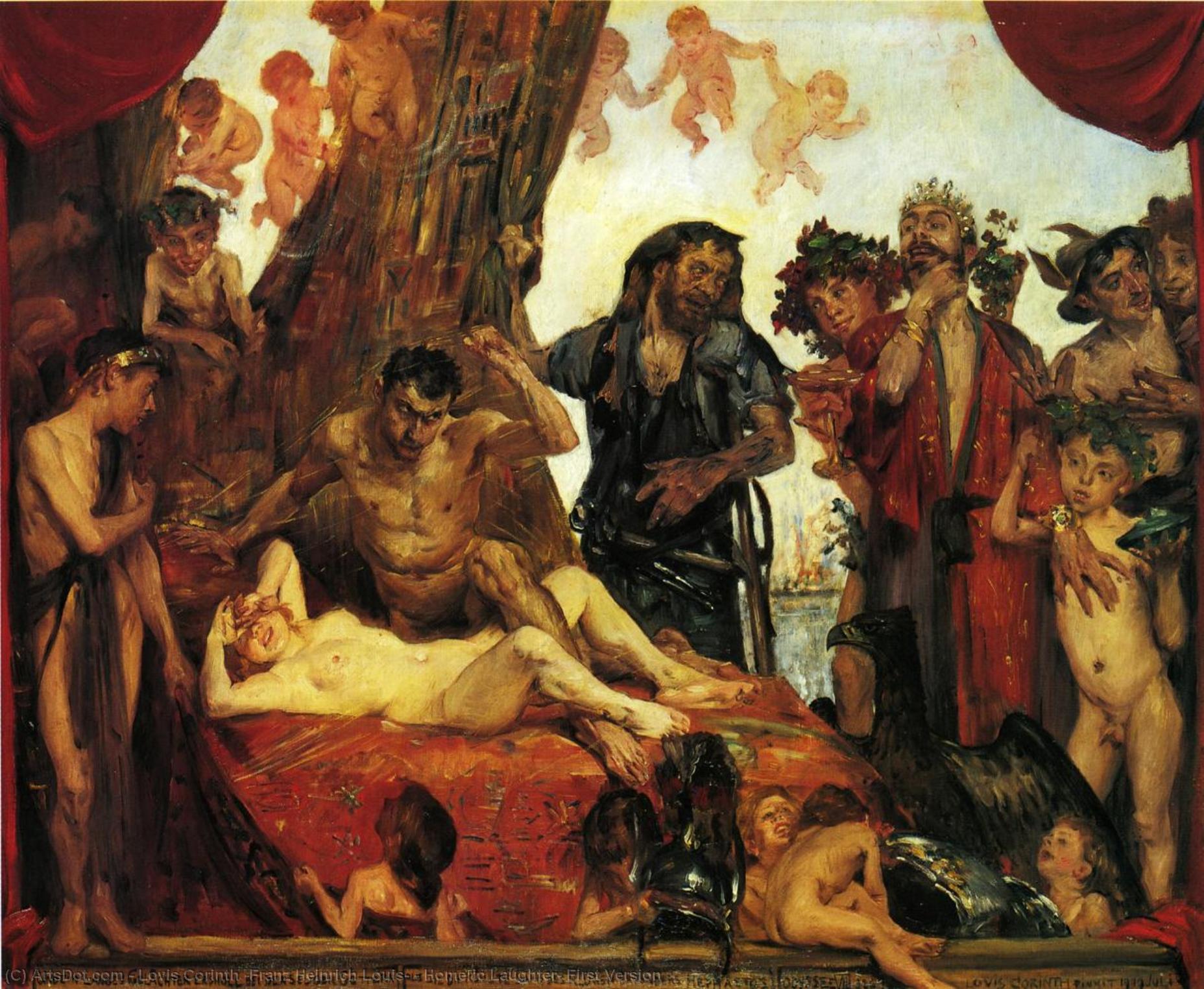
Lovis Corinth’s “Homeric Laughter,” painted in 1909, isn't merely a depiction of a gathering; it’s an invitation into a vibrant tableau of human connection and the intoxicating pleasure of shared experience. The painting immediately draws the eye with its scale – a generous 98 x 120 cm canvas – allowing for a complete immersion in the scene. Corinth masterfully captures a group of individuals, numbering at least thirteen, engaged in what appears to be an animated conversation or perhaps a lighthearted celebration. The central figure, a woman reclining on a bed, is undeniably the focal point, her exposed form not presented with overt sexuality but rather as a symbol of vulnerability and openness within this intimate setting. The surrounding figures – men and women alike, some standing, others seated or kneeling – contribute to a sense of communal warmth and relaxed conviviality.

The Expressionist Palette and Corinth’s Unique Style
Painted during a pivotal period in Corinth's artistic evolution, “Homeric Laughter” exemplifies his distinctive style – a potent blend of Impressionism and burgeoning Expressionism. He abandons the meticulous detail favored by earlier academic training, opting instead for bold brushstrokes, vibrant colors, and a deliberately loose application of paint. Notice how he uses color not to represent reality but to evoke feeling; the reds and oranges dominate, radiating warmth and suggesting an atmosphere of joyous abandon. Corinth’s technique is characterized by a dynamic layering of pigments, creating a sense of movement and immediacy. The figures aren't sharply defined; they are rendered with a slightly blurred quality, contributing to the painting’s overall dreamlike atmosphere. This approach was influenced by his travels through Paris and Antwerp, where he encountered artists like Rubens and Impressionists who challenged traditional artistic conventions.
Echoes of Homer and the Celebration of Human Connection
The title itself, “Homeric Laughter,” immediately connects the painting to the works of ancient Greek poet Homer. Homer’s epics are filled with scenes of feasting, drinking, and boisterous gatherings – celebrations of life, friendship, and human connection. Corinth's painting captures this spirit, suggesting a modern-day reimagining of these timeless themes. The objects scattered around the group—a bowl and a cup—further reinforce the idea of shared indulgence and communal enjoyment. The woman on the bed isn’t simply exposed; she embodies a state of relaxed vulnerability, inviting the viewer to contemplate the dynamics of intimacy and social interaction within this circle.
A Window into Corinth's Life and Artistic Journey
Lovis Corinth’s life was marked by both artistic triumph and personal hardship. Following a debilitating stroke in 1911, he adapted his technique, favoring his right hand and exploring themes of domesticity and family. “Homeric Laughter” can be viewed as a reflection of this evolving perspective – a celebration of the simple pleasures of life and the importance of human relationships. Corinth’s work is deeply personal, imbued with emotion and a profound understanding of the human condition. Reproductions of “Homeric Laughter” offer a captivating glimpse into his world, inviting viewers to share in his vision of joy, connection, and the enduring power of art.
Œuvres apparentées




Biographie de l'artiste
Première Vie et Formation
Lovis Corinth, né Franz Heinrich Louis le 21 juillet 1858 à Tapiau, en Prusse (aujourd'hui Gvardejsk, Russie), était un artiste et écrivain allemand dont l’œuvre mûre de peintre et graveur a réalisé une synthèse de l'impressionnisme et de l'expressionnisme. Sa jeunesse fut marquée par son talent pour le dessin, ce qui l'amena à étudier la peinture à l'Académie de Königsberg en 1876.Développement Artistique
Le développement artistique de Corinth a été influencé par plusieurs figures clés et mouvements :- Ses premiers travaux étaient naturalistes, encouragés par son instructeur Otto Günther.
- Il étudia sous la direction de Ludwig von Löfftz à l'Académie des beaux-arts de Munich, qui mettait l’accent sur une observation attentive des couleurs et des valeurs.
- Corinth a également été influencé par Courbet et l'École de Barbizon, ainsi que par les œuvres de Rubens pendant son séjour à Anvers.
Œuvres Notables et Style
Parmi les œuvres notables de Corinth figurent :- Dans la boucherie (78 x 89 cm, Staatsgalerie Stuttgart, Allemagne), qui met en valeur son utilisation de l'huile sur toile.
- Autoportrait (47 x 53 cm, Kunsthalle Bremen, Allemagne), démontrant sa compétence au dessin.
- Femme semi-nue avec un chapeau (283 x 383 cm, Kunstpalast, Düsseldorf, Allemagne), soulignant son utilisation du crayon.
Héritage et Vie Ultérieure
La vie ultérieure de Corinth a été marquée par sa présidence de la Sécession berlinoise de 1915 à 1925. Il a également publié de nombreux essais sur l'histoire de l'art, dont "Das Erlenen der Malerei" ("Sur l'apprentissage de la peinture") en 1908. Corinth est décédé le 17 juillet 1925 après un accident vasculaire cérébral qui l’avait partiellement paralysé en 1911. Liens Clés :
Lovis Corinth
1858 - 1925 , Pays-Bas
En bref
- Artistes Influents:
- Courbet
- Rubens
- Date De Décès: 17 juillet 1925
- Date De Naissance: 21 juillet 1858
- Lieu De Naissance: Tauwade, Pays-Bas
- Mouvement Artistique: Expressionnisme, Impressionnisme
- Nationalité: Allemande
- Nom Complet: Lovis Corinth (Franz Heinrich Louis)
- Œuvres Notables:
- Dans la boucherie
- Autoportrait
- Semi-nue au chapeau
Articles connexes

Lovis Corinth: Bridging Impressionism & Expressionism – A Study of Artistic Evolution
Explore the fascinating artistic journey of Lovis Corinth, a pivotal figure bridging Impressionism & Expressionism. Discover his evolution, key works, and lasting impact on modern art with ArtsDot.

La Psychologie de l'Imagerie Ludique : Explorer les Peintures Humoristiques et Fantaisistes comme Catalyseurs du Bien-Être Émotionnel et des Liens Sociaux
Explorez le pouvoir des peintures humoristiques et fantaisistes sur votre bien-être émotionnel. Découvrez l'histoire de l'art, les secrets du surréalisme et nos conseils d'experts pour une décoration intérieure inspirée et équilibrée.

Top 10 des Chefs-d'œuvre à l'Acrylique qui ont Révolutionné l'Art |
Plongez dans l'univers vibrant des 10 chefs-d'œuvre à l'acrylique qui ont marqué l'histoire de l'art. Découvrez Jackson Pollock, Rothko et autres artistes emblématiques. Reproductions de qualité muséale sur . Explorez la collection !
Les 10 Chefs-d'œuvre à l'Huile qui ont Révolutionné l'Art |
Plongez dans l'univers des 10 chefs-d'œuvre à l'huile qui ont marqué l'histoire de l'art ! Découvrez les secrets de Van Gogh, Monet, Rembrandt et autres artistes emblématiques. Trouvez l'inspiration déco & achetez des reproductions de qualité sur .

From Snapshot to Legacy: The Art of Commissioning a Hand-Painted Reproduction from Photography – Preserving Memories Through Oil Painting Techniques
Transform cherished photos into timeless oil paintings with skilled artists. Trusted for bespoke portraits & heirloom art. Discover the process, styles & lasting value – a legacy preserved.