

 Envoyer
 Partager
 Détails de l'œuvre
 Guide
Guide

 Télécharger l'image
 Articles similaires
 Diaporama
 Questions et réponses
 Statistiques
Untitled

- 118.0 x 84.0 cm


 Lire la suite
L’œuvre d'art présentée sur cette page est protégée par le droit d'auteur, ce qui signifie que nous ne pouvons légalement créer ou vendre de reproduction identique. Cette protection est appliquée en vertu d'accords internationaux tels que la Convention de Berne et par les lois nationales, notamment celles énoncées par le Loi américaine sur le droit d'auteur - Titre 17.
Cette méthode est pleinement conforme aux réglementations sur le droit d'auteur car elle ne repose pas sur la copie ou la duplication de l'œuvre protégée. Il s'agit plutôt d'une réinterprétation créative — une nouvelle peinture qui s'inspire de l'original sans pour autant lui être identique.
Giclées et impressions d'art
Impressions giclées ou sur toile de qualité musée, avec une production rapide et des finitions au choix. ( Commander la reproduction peinte à la main Passer au format numérique)




































Choisissez parmi nos formats prédéfinis qui respectent les proportions originales de l’œuvre.

Saisissez la largeur et la hauteur souhaitées pour qu'elles s'adaptent à votre cadre ou à votre mur. Une impression peut être recadrée, mais jamais agrandie au-delà de l'image originale ; ainsi, un format de forme différente entraînera la perte d'une partie de l'image. Nous vous envoyons une maquette numérique pour approbation avant toute impression. L'image présentée sur cette page ne montre pas le recadrage réel — seule la maquette le permet.
Livraison dans le monde entier () en 2 semaines au lieu des 4/5 semaines habituelles. (10 novembre)

Livraison express gratuite dans le monde entier

Toile de lin de qualité supérieure

Assurance transport complète

Garantie de remboursement des droits de douane

Garantie de fidélité des couleurs

Politique de retour de 100 jours (uniquement en cas de défaut)

Garantie de remboursement à 100%

Offre de tarifs dégressifs
 L'option verre n'est disponible que pour les dimensions inférieures à 110 cm.

Untitled
Giclées et impressions d'art
Format de la reproduction
-


Prix total
€ 56
The Tactile Poetry of Form and Wood
In the evocative work Untitled (1956) by the Swiss master Karl Schmid, we are invited into an intimate dialogue between the artist’s hand and the raw, organic essence of wood. This piece serves as a profound testament to Schmid’s unique ability to bridge the gap between the precision of craftsmanship and the fluidity of fine art. At first glance, the viewer is struck by the rhythmic complexity of the carved patterns that dance across the wooden panel. These intricate designs, which subtly coalesce into shapes reminiscent of the human form, suggest a deep-seated fascination with anatomy and the structural beauty of living beings. The composition does not merely present a surface; it presents a landscape of texture where every groove and indentation tells a story of deliberate, meditative creation.
The technique employed here is nothing short of masterful, reflecting Schmid’s foundational years as an apprentice cabinetmaker and carpenter. This background in woodworking allowed him to approach the medium with an unparalleled understanding of grain, resistance, and depth. The presence of the carving tool within the frame serves as a poignant meta-commentary on the act of creation itself, reminding us that art is often born from the physical struggle between tool and material. Each figure carved into the panel varies slightly in its execution, creating a sense of organic movement—as if the figures are caught in a moment of metamorphosis or emerging slowly from the very heart of the timber.
A Legacy of Resilience and Observation
To truly appreciate this work, one must consider the biographical tapestry of Karl Schmid. Born in Zurich, his life was shaped by profound personal challenges, including the loss of his father and the complexities of a family history marked by mental illness. These early experiences instilled in him a heightened sensitivity to the nuances of existence—a way of seeing that finds beauty in both fragility and strength. In Untitled, this sensitivity manifests as a reverence for the natural world. The way the light catches the ridges of the carved wood evokes a sense of warmth and permanence, offering a sanctuary of order and artistry amidst the chaos of the human condition.
For the discerning collector or interior designer, this piece offers more than mere decoration; it provides a focal point of intellectual and emotional depth. The neutral, earthy tones of the wooden panel allow it to integrate seamlessly into sophisticated, contemporary spaces, while its complex textures demand close inspection, rewarding the viewer with new discoveries upon every encounter. It is a work that embodies the concept of "living art"—a piece that breathes with the history of its maker and the enduring spirit of the medium. Owning a reproduction of such a significant work allows one to bring a fragment of Schmid’s profound sculptural legacy into the home, fostering an environment of contemplation, craftsmanship, and timeless elegance.
Questions et réponses
À quelle étape de la carrière de Karl Schmid s'inscrit « Untitled », compte tenu de sa date ?
«Untitled», créé en 1956, appartient à la période Mature Period de la carrière de Karl Schmid.
Existe-t-il une fiche informative sur «Untitled» de Karl Schmid destinée aux étudiants ?
Le guide de « Untitled » est la page Fiche pédagogique de l'œuvre — une fiche informative imprimable présentant l'œuvre accompagnée de sa légende, de sa mention de crédit et de son tableau d'identification (artiste, dates, technique, dimensions originales, collection).
Quelle ambiance et quelle émotion «Untitled» de Karl Schmid exprime-t-il ?
L'atmosphère qui se dégage de «Untitled» de Karl Schmid est Earthy, et sa tonalité émotionnelle est Reflective.
Œuvres similaires


Biographie de l'artiste
Une vie forgée dans la résilience et la précision
La vie de Karl Schmid est un témoignage profond de la capacité de l'esprit humain à trouver la beauté au milieu de l'adversité. Né à Zurich en 1914, ses premières années furent assombries par la tragédie personnelle et l'instabilité ; la perte de son père durant la Grande Guerre et les luttes complexes liées à la santé mentale de sa mère créèrent un environnement exigeant une immense résilience. Pourtant, c'est précisément dans ce creuset d'adversité que Schmid développa un regard singulièrement aiguisé sur les complexités de l'existence. Sa formation initiale ne se trouva pas uniquement dans un atelier traditionnel, mais à travers le monde tactile et discipliné de l'artisanat. Un apprentissage en tant qu'ébéniste et charpentier lui inculqua un respect fondamental pour la matière et la structure — une précision qui deviendrait plus tard la colonne vertébrale de ses œuvres sculpturales et anatomiques.
En mûrissant, le parcours de Schmid l'entraîna vers l'intersection de l'art et de la science. Le temps passé dans les sanatoriums de Davos, bien que dicté par la maladie, s'avéra être une période d'immense expansion intellectuelle et créative. C'est là qu'il gravit les orbites de géants tels qu'Oskar Kokoschka et Ernst Ludwig Kirchner. Ces rencontres furent bien plus que de simples liens sociaux ; elles constituèrent de profonds dialogues artistiques qui aidèrent à façonner sa compréhension de l'expressionnisme et de la condition humaine. Cette période de vulnérabilité partagée et d'exploration créative permit à Schmid de tisser l'émotion brute de son histoire personnelle dans un langage artistique sophistiqué.
La synthèse de la forme, de l'anatomie et de l'abstraction
L'œuvre de Schmid se caractérise par une fluidité remarquable, naviguant sans transition entre les exigences rigides de l'exactitude scientifique et les mouvements libérés de l'abstraction moderne. Il possédait une capacité rare à combler le fossé entre l'empirique et le spirituel. Dans ses illustrations anatomiques, on découvre un dévouement méticuleux à la vérité du corps humain, où chaque ligne sert l'objectif d'une clarté biologique. Cependant, il ne permit jamais à la science de dépouiller ses sujets de leur âme ; au contraire, il insuffla à ses études une grâce artistique qui les éleva de simples diagrammes au rang d'œuvres d'une beauté profonde.
Cette dualité est peut-être plus évidente dans sa transition à travers divers mouvements stylistiques :
- L'abstraction géométrique et l'Art Déco : Ses premières explorations embrassèrent l'élégance structurée de l'ère Art Déco, utilisant des lignes épurées et des motifs rythmiques.
- Les principes constructivistes : Dans des œuvres telles que sa pièce de 1959 « Sans titre », Schmid utilisa l'or sur noir pour créer une qualité musicale et dynamique, reflétant l'énergie de la lyre par la précision géométrique.
- L'intersection de l'art et de la science : Ses œuvres plus tardives, incluant l'évocateur « Œuvre spirituelle » (1986), démontrent une maîtrise de la synthèse d'influences disparates, mêlant la logique structurelle de ses racines de sculpteur sur bois à un expressionnisme profond et contemplatif.
L'héritage d'un visionnaire polyvalent
Karl Schmid demeure une figure singulière de l'histoire de l'art suisse, un polymathe dont les contributions s'étendent de la peinture à la sculpture, en passant par la gravure et l'enseignement. Il ne s'est pas contenté d'exister au sein d'un seul mouvement ; il a plutôt agi comme un conduit entre le monde tactile de l'artisan et le monde intellectuel de l'avant-garde. Sa capacité à collaborer avec des luminaires tels que Hans Arp et Kokoschka témoigne de sa stature au sein de la communauté artistique européenne, pourtant son travail demeure profondément personnel, ancré dans ses propres observations de la vie, de la mort et des merveilles biologiques du monde naturel.
Aujourd'hui, Schmid est commémoré non seulement pour la maîtrise technique de ses sculptures sur bois ou la précision de ses gravures, mais pour sa capacité à trouver une vérité unifiée dans les fragments de l'expérience humaine. Son héritage continue d'inspirer ceux qui cherchent l'harmonie entre l'esprit analytique et le cœur créatif, prouvant que l'art peut être à la fois une étude rigoureuse du réel et une évasion transcendante de celui-ci.

Karl Schmid
1914 - 1998 , Suisse
L'essentiel de l'artiste
- Artistic Movement Or Style: Constructivist
- Artists Or Movements Influenced By This Artist: ['Hans Arp']
- Artists Who Influenced This Artist:
- Oskar Kokoschka
- Ernst Ludwig Kirchner
- Date Of Birth: 1914-05-10
- Date Of Death: 1998-08-13
- Full Name: Karl Schmid
- Nationality: Swiss
- Notable Artworks:
- Untitled Side 1
- Untitled
- Spiritual Work
- Place Of Birth: Zurich, Switzerland
Articles connexes

Les 10 Chefs-d'œuvre en Bronze qui ont Révolutionné l'Art : Collection ArtsDot
Plongez dans l'univers fascinant des 10 chefs-d'œuvre en bronze qui ont marqué l'histoire de l'art. Découvrez Rodin, Degas et les secrets de ces sculptures iconiques. Reproductions d'art exceptionnelles sur ArtsDot.com – Explorez la collection !

L'Évolution du Volume : Analyse des Procédés et de l'Histoire de la Sculpture
Explorez l'évolution technique de la sculpture, du marbre classique à l'art cinétique. Maîtrisez l'histoire du volume dès maintenant.
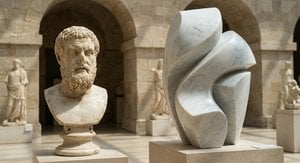
The Enduring Allure of Marble in Art History: From Classical Sculpture to Modern Abstraction
Explore the captivating history of marble sculpture from ancient Greece to modern art. Discover renowned artists like Canova & Michelangelo, carving techniques, and investment insights at ArtsDot.

Les 10 Chefs-d'œuvre Bronzes Qui Ont Révolutionné la Sculpture | ArtsDot
Plongez dans l'univers fascinant des 10 sculptures en bronze les plus emblématiques de l'histoire de l'art. Rodin, Degas et autres maîtres révélés ! Découvrez leur histoire, leurs techniques et trouvez l'œuvre parfaite pour sublimer votre intérieur sur ArtsDot.com.

The Enduring Form: Exploring Themes & Techniques in Sculpture Across Historical Periods
Explore the rich history of sculpture from ancient masterpieces to contemporary innovations. Discover key techniques, influential artists & investment potential for discerning art collectors.

