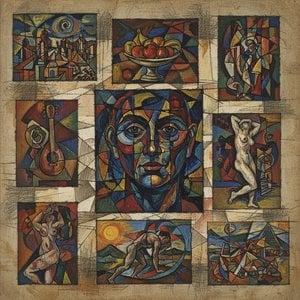
A Life Marked by Protest and Artistic Expression
León David Ferrari, Argentine conceptual artist, left an indelible mark on the art world with his provocative works that challenged the status quo. Born in Buenos Aires, Argentina, on September 3, 1920, Ferrari’s life was a testament to the power of artistic expression as a form of dissent. From early influences rooted in European Surrealism and Expressionism to his unwavering commitment to social justice, Ferrari's journey embodies the spirit of avant-garde art.Early Life and Artistic Beginnings
Ferrari’s formative years were shaped by the turbulent political landscape of Argentina during the 1950s. Witnessing firsthand the repressive policies of the military dictatorship fueled a deep conviction that art could serve as a vehicle for resistance. He began his artistic explorations with meticulous oil paintings on paper, reflecting a preoccupation with formal experimentation and exploring the boundaries between representation and abstraction. His initial works were marked by a rejection of traditional aesthetics, prioritizing conceptual ideas over visual realism—a characteristic that would define his entire oeuvre.Notable Works and Exhibitions
Ferrari gained international recognition for his groundbreaking piece “São Paulo Association Award,” which cemented his reputation as a pioneer of Conceptual Art. This monumental sculpture, crafted from reclaimed materials, powerfully conveyed a critique of consumer culture and the dehumanizing effects of industrialization. Furthermore, his series "Untitled (Paper)" showcased his mastery of printmaking techniques, utilizing paper as a medium to explore themes of materiality and process. His artistic vision extended beyond individual artworks; he actively engaged in collaborative projects with fellow artists, fostering dialogue and promoting collective action.Influences and Artistic Development
Ferrari’s artistic trajectory was profoundly impacted by the legacy of European masters such as Marcel Duchamp and Yves Klein. Duchamp's conceptual approach—challenging notions of originality and authorship—served as an inspiration for Ferrari's own explorations into the realm of ideas. Similarly, Klein’s use of monochrome color and geometric abstraction encouraged Ferrari to embrace simplicity and purity in his artistic language. Throughout his career, he consistently pushed boundaries, experimenting with diverse mediums and techniques while maintaining a steadfast dedication to conveying complex social and political messages.Legacy and Historical Significance
León David Ferrari's enduring influence on contemporary art is undeniable. His uncompromising stance against injustice and his unwavering belief in the transformative potential of artistic expression continue to resonate with artists and audiences alike. Recognized for his contribution to Argentine art history, Ferrari’s work stands as a symbol of intellectual courage and artistic integrity—a reminder that art can serve as a catalyst for social change and a beacon of creative innovation. His legacy resides not only in his celebrated artworks but also in the spirit of questioning and challenging established norms that he instilled within generations of artists.Questions et réponses
Où puis-je consulter l'ensemble des œuvres de León Ferrari ?
Retrouvez toutes les œuvres de León Ferrari sur ce site en consultant sa page Toutes les œuvres d'art.
Combien d'œuvres de León Ferrari sont disponibles à la consultation ?
Vous pouvez parcourir 56 œuvres œuvres de León Ferrari sur la page Toutes les œuvres d'art.
Existe-t-il un aperçu de tous les sujets peints par León Ferrari ?
L'Index thématique de León Ferrari est une page qui répertorie les œuvres de l'artiste par thématiques.